
Mere Exposure Effect: The Neuroscience Behind Why Familiar Brands Win
Coca-Cola has approximately 100% global brand awareness. They spend $4 billion a year on advertising. If marketing were purely about information transfer - telling people a brand exists - Coca-Cola would have stopped advertising decades ago. They haven’t. Because marketing isn’t about information. It’s about familiarity. And familiarity creates preference.
This is the mere exposure effect. And it’s why the “just post consistently” advice you’ve heard a thousand times is not a content tip. It’s neuroscience.
What is the Mere Exposure Effect?
The mere exposure effect (also called the familiarity principle) is a psychological phenomenon where people develop a preference for things simply because they are familiar with them - even when that familiarity offers no rational advantage.
The behavioral phenomenon, as Zajonc described it: we tend to prioritize what is familiar, even when familiarity offers no rational advantage over alternatives.
This was first rigorously demonstrated by psychologist Robert Zajonc in 1968. In his experiments, subjects were shown a series of abstract shapes (Chinese-like characters, random polygons) some shapes more frequently than others. When later asked which shapes they preferred, subjects consistently chose the ones they had been shown more often - despite having no conscious memory of seeing them before.
The exposure happened. The preference formed. The conscious mind didn’t know why.
Zajonc’s conclusion: exposure alone is sufficient to create preference, independent of any other information about the stimulus.
You don’t need to convince people your brand is better. You just need to show up enough times that their brain starts treating your brand as familiar - and familiar = safe, trustworthy, and preferred.
The Brain Science Behind It
The mere exposure effect operates through processing fluency - the ease with which our brain processes a stimulus.
When we encounter something familiar, our brain processes it faster and with less effort than something new. This ease of processing is interpreted by the brain as a positive signal: “This thing is easy to process, therefore it must be good, safe, or correct.”
The brain then generates a subtle positive affect (feeling) associated with that stimulus. This happens automatically, pre-consciously. It is a System 1 response - fast, emotional, and not subject to rational override.
The critical implication: you don’t need people to pay conscious attention to your content for it to build preference. Passive exposure - scrolling past your post, seeing your logo in peripheral vision, hearing your brand name in conversation - still counts. Still accumulates. Still builds familiarity.
This is why out-of-home advertising (billboards, bus shelters, subway ads) still works for brand building even when no one is actively reading it.
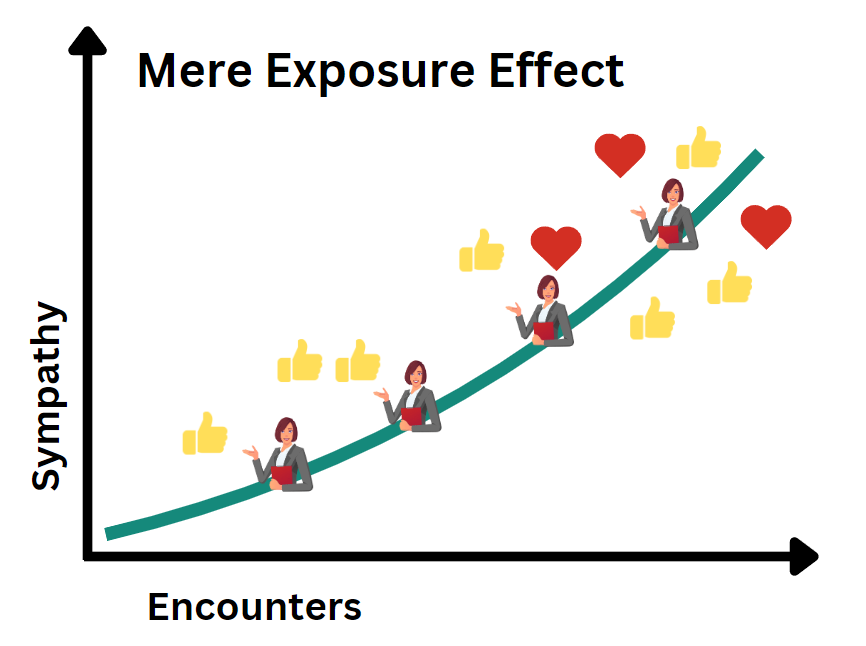 The mere exposure effect: preference increases with each exposure even when the person has no conscious memory of prior encounters. Processing fluency - the ease with which the brain handles familiar stimuli - generates a positive feeling automatically. This is why passive exposure (billboard seen 50 times, logo glimpsed in a feed) still builds preference. Source: Varify.io
Mere Exposure Effect in Branding - Real Examples
Coca-Cola’s Continuous Presence
Coca-Cola’s bottle design - the iconic contour bottle introduced in 1915 - has barely changed in over 100 years. The red color, the script logo, the distinctive shape. Every touchpoint reinforces familiarity.
When you see that red can, your brain processes it in milliseconds - not because you’re thinking about Coca-Cola, but because the pattern is so deeply familiar it has become automatic. That automatic recognition generates a mild positive affect. That affect influences purchase behavior.
They don’t advertise because people don’t know what Coca-Cola is. They advertise to keep the familiarity fresh.
Điện Máy Xanh - Familiarity Through Distinctiveness
Điện Máy Xanh’s advertising became a cultural fixture in Vietnam through sheer repetitive presence - the blue mascot, the earworm jingle, the consistent visual identity across every touchpoint. Whether you find it charming or grating is beside the point.
The psychology at work: distinctiveness creates salience (your attention catches on it), and repetition converts salience into familiarity. Through enough exposure, the brand stops being something you encounter and becomes something you simply know.
When a Vietnamese consumer thinks about buying a television or home appliance, “Điện Máy Xanh” surfaces automatically - not because of a recent ad, but because years of consistent exposure have built deeply embedded familiarity. That’s memory, not advertising. The Mere Exposure Effect compounds over time into what looks like brand equity.
 Times Square - the most extreme example of passive brand exposure. Brands don’t buy Times Square billboards because tourists actively read them. They buy them because millions of passive impressions, accumulated over time, build the processing fluency that translates into familiarity-driven preference. The same logic applies to your content feed presence. Source: Wikipedia
Creator Economy: The “Same But Different” Rule
Look at successful creators and brand builders online. Their visual identity, posting format, voice, and aesthetic are remarkably consistent over time. Not because they’re uncreative - but because familiarity builds trust faster than variety.
When your audience scrolls their feed and sees your post style before they even read the caption, they’ve already processed you as familiar. That’s a competitive advantage built entirely through the Mere Exposure Effect.
The Mere Exposure Effect in Content Marketing
This is where it gets directly actionable for anyone building a personal brand or business marketing.
Consistency compounds: Every piece of content you publish adds to your audience’s familiarity bank. The 10th time they see your format, your colors, your opening style - the easier their brain processes you. The easier you are to process, the more they like you. The more they like you, the more likely they are to buy, recommend, and return.
This is why:
- Brands that post 5x/week outperform brands that post 1x/week on brand recall metrics
- Consistent visual identity across LinkedIn + Instagram + email builds faster authority than varied aesthetics
- Email newsletters work - not because every email is read, but because consistent presence in the inbox builds familiarity
 Repetition and consistency are not creative limitations - they are the mechanism by which brands build processing fluency. Each consistent touchpoint reduces the cognitive effort required to process your brand, which the brain interprets as positive feeling. This is the compounding math behind “just post consistently.” Source: Lead Alchemists
The 7-touch rule revisited: The old marketing rule that customers need 7 touchpoints before purchasing has a psychological basis in the Mere Exposure Effect. But “7 touches” understates what’s actually needed in a high-noise environment. Research by Salesforce in 2023 found that B2B buyers now average 27 touchpoints before making a purchase decision.
Each touchpoint that lands in familiar territory is building your case automatically.
What Marketers Get Wrong
Redesigning Too Often
Rebrands, visual refreshes, and “new season, new look” aesthetics feel exciting internally. But they reset the familiarity clock. Every major visual change requires your audience to relearn your visual identity.
Evolve gradually. Major rebrands should be driven by genuine strategic necessity - not by internal boredom with your own branding.
Inconsistent Posting Frequency
The Mere Exposure Effect requires repeated exposure over time. Posting 10 times in one week and then disappearing for a month doesn’t build familiarity - it builds confusion. Algorithms may suppress inconsistent accounts, but the deeper problem is psychological: inconsistency = unreliability in the audience’s mental model.
Confusing Variety with Engagement
Many brands and creators diversify their format, aesthetic, and tone constantly in search of engagement spikes. Some variation is good. But constantly changing your signature format sacrifices long-term familiarity for short-term novelty.
The goal is to be the brand that feels instantly familiar - like seeing an old friend. Old friends don’t look completely different every time you see them.
Ignoring Passive Touchpoints
Not all exposure is active. Banner ads, sponsored posts people scroll past, brand name mentions in unrelated articles - all of these contribute to familiarity. This is why brand advertising (as opposed to direct response) has value that’s difficult to measure in last-click attribution models.
If you only measure touchpoints people actively engage with, you’re undervaluing passive familiarity-building.
Building a Mere Exposure Strategy
Establish your visual signature first: Before you can benefit from the Mere Exposure Effect, you need a consistent signature to expose people to. Choose: a color palette (stick to 2-3 colors), a typography style, a content format, a voice. Lock these in before you scale.
Map your touchpoints: List everywhere your brand appears. Website, Instagram, LinkedIn, email, OOH, partnerships, podcasts, YouTube. How consistent is your visual and tonal identity across all of them? Inconsistency at scale means every channel is starting familiarity from zero.
Optimize for minimum viable consistency: You don’t need to post everywhere all the time. You need to show up consistently in the specific places your audience spends time. 3x/week on LinkedIn and 0x/week everywhere else beats 1x/week on 7 platforms.
Track brand recall, not just engagement: Engagement metrics (likes, shares, comments) measure active attention. Brand recall - “which brand comes to mind first when thinking about [category]?” - measures familiarity-driven preference. Add brand recall surveys to your measurement toolkit.
NateCue Take
The Mere Exposure Effect is the single most underrated principle in Vietnamese content marketing.
I see creators and brands constantly chasing virality, format trends, and algorithm hacks. And I get it - a viral post is exciting. But the brands that are winning 3 years from now are the ones quietly building familiarity through consistent, recognizable presence.
Here’s the thing: familiarity is compounding. The 100th time someone sees your brand is disproportionately more powerful than the 10th time. The gap between the brand that’s been consistently present for 2 years and the brand that just started feels impossible to close.
This is a durable competitive advantage - and it’s available to anyone willing to play the long game.
My personal rule: every content decision should make me more recognizable, not just more noticed. Recognizable builds familiarity. Noticed is one-time attention.
If you had to pick one psychological principle to build your brand around, this would be my choice.
Frequently Asked Questions
What is a real-life example of the mere exposure effect in marketing?
Coca-Cola is the canonical example - they’ve maintained near-identical visual identity for over 100 years and spend $4 billion annually on advertising despite ~100% brand awareness. The advertising isn’t informational; it’s familiarity maintenance. In Vietnam, Điện Máy Xanh built category dominance through consistent, repetitive presence - the blue mascot and earworm jingle made the brand impossible to forget, which translated directly into top-of-mind recall when consumers need a home appliance.
How many exposures does it take for the mere exposure effect to work?
Research suggests preference increases with exposures up to roughly 10-20 exposures, after which it plateaus or slightly declines (overexposure effect). But in brand-building contexts, consistent long-term exposure at moderate frequency outperforms high-intensity short bursts. The practical implication: 3-5 touchpoints per week sustained over 6-12 months builds stronger familiarity than 30 touchpoints in one week followed by silence.
Can the mere exposure effect work without the person paying attention?
Yes - this is one of the most important aspects of the phenomenon. Zajonc’s original research demonstrated that exposure can build preference even when subjects had no conscious memory of prior encounters. Passive exposure - scrolling past a post, glancing at a billboard, hearing a brand name in conversation - still contributes to processing fluency and the familiarity-preference link. This is the scientific basis for brand advertising value beyond direct-response metrics.
Does rebranding hurt the mere exposure effect?
Significantly, yes. A major visual rebrand essentially resets the familiarity clock - your audience now needs to build new processing fluency for your updated identity. This doesn’t mean brands should never rebrand, but it explains why major rebrands should be driven by genuine strategic necessity (entering a new market, resolving a brand association problem) rather than internal desire for novelty. The most successful long-term brands evolve their identity gradually rather than through periodic overhauls.
TL;DR
- The mere exposure effect: people prefer what’s familiar, even without rational reason
- First demonstrated by Robert Zajonc (1968) - exposure alone creates preference
- The mechanism: processing fluency - familiar things are easier for the brain to process, which generates a positive feeling
- You don’t need conscious attention for familiarity to build - passive exposure counts
- Practical implications: consistent visual identity, regular posting cadence, cross-channel consistency
- Coca-Cola advertises not for awareness but to maintain familiarity-driven preference
- The Mere Exposure Effect compounds - long-term consistency creates a moat
Related
- Bandwagon Effect: Why 'Everyone's Doing It' Is Your Most Powerful Marketing Signal
- FOMO in Marketing: Why Fear Drives More Purchases Than Discounts
- The Framing Effect: How You Present Information Changes What People Decide
- Perceived Value in Marketing: The Psychology Behind Willingness to Pay
Part of the NateCue Marketing Psychology Series - applying consumer psychology to real marketing decisions.