
Bandwagon Effect: Why ‘Everyone’s Doing It’ Is Your Most Powerful Marketing Signal
You walk past two restaurants. One is packed - there’s a line outside. The other is empty. Assuming similar menus and prices, where do you go? If you said the busy one, you just experienced the bandwagon effect - and so do your customers every day.
The bandwagon effect is one of the most reliable cognitive biases in consumer psychology. It’s not a trend or a social media phenomenon. It’s how the human brain is wired to make decisions under uncertainty. And yet most brands use it clumsily, or not at all.
What is the Bandwagon Effect?
The bandwagon effect (also called herd behavior) is a cognitive bias where people follow what others are doing - regardless of whether that behavior aligns with their original beliefs or best interests.
The behavioral definition: we tend to imitate a behavior unconsciously, simply because others are doing it - even when it contradicts our own prior beliefs.
The mechanism is simple: when we see many people choosing something, our brain interprets that as evidence the choice is correct. The crowd becomes a shortcut for decision-making.
This isn’t weakness or irrationality. It’s an evolved survival mechanism. For most of human history, following the group was the safer strategy. The problem is that our brains apply this ancient heuristic to modern purchasing decisions - buying a SaaS tool, choosing a restaurant, picking a streaming service.
The Psychology Behind It: Why Crowds Override Logic
The bandwagon effect operates through two psychological mechanisms:
1. Social Validation (Informational Influence)
When we’re uncertain, we look to others for information. If 10,000 people chose a product, we assume they know something we don’t. This is especially powerful in categories where we lack expertise - technology, health products, investment tools.
Research by Solomon Asch in his famous conformity experiments (1951) showed that people will give answers they know are wrong - just to match what the group said. The pressure to conform isn’t conscious. It happens in System 1 (fast, automatic thinking).
 Asch’s conformity experiment (1955): six actors and one real participant. In study after study, 75% of participants gave a wrong answer at least once - simply to avoid standing out from the group. The correct answer was visually obvious. Source: Wikipedia / Solomon Asch
2. Identity and Belonging (Normative Influence)
Beyond information-seeking, we want to belong. Buying what others buy signals tribal membership. Wearing the same brand, using the same tools, eating at the same places - these are identity signals.
This is why Apple products still sell with minimal feature advantages over competitors. You’re not just buying a laptop. You’re joining a tribe of people who see themselves as creative, design-conscious, and slightly contrarian about Microsoft.
The Bandwagon Effect in Action - Real Brands
Apple Store Launch Lines
Apple doesn’t need launch-day lines to sell iPhones. They could sell the same units online. But those lines are visible social proof - thousands of people watching on news coverage, millions seeing posts online. The queue is the marketing.
The psychological read: “If this many people are willing to stand in line for hours, this product must be extraordinary.”
MoMo - Network as Social Proof
MoMo’s dominance in the Vietnamese digital payment space isn’t purely about product features - it’s about perceived ubiquity. Decision Lab’s Brand Footprint Vietnam research consistently places MoMo in the top tier of most recognized fintech brands.
When your taxi driver, your coffee shop, and your 60-year-old parents all use MoMo, your brain registers: this is what people use. Switching to a competitor feels cognitively strange, even if the competitor is technically better. The bandwagon is too visible to ignore.
Review Counts and Bestseller Labels
Amazon, Shopee, Lazada all use “bestseller” badges and review counts prominently. A product with 4.2 stars and 15,000 reviews will almost always outperform a product with 4.8 stars and 50 reviews.
The crowd has spoken. Your brain trusts the crowd.
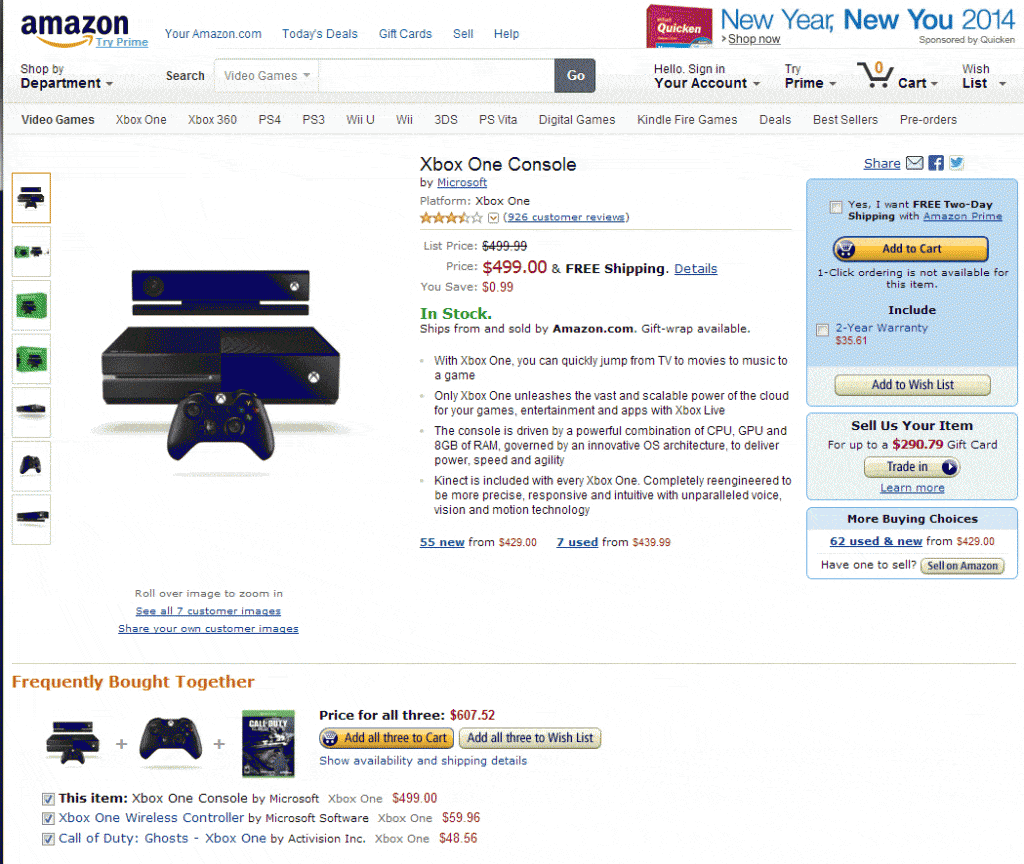 Amazon’s product page surfaces review count before price and specifications - because the bandwagon signal (thousands chose this) shapes purchase intent before rational evaluation begins. The crowd’s verdict is the first thing you see. Source: Invesp CRO
What Marketers Get Wrong
Mistake 1: Showing Vanity Metrics Without Context
“1 million downloads” means nothing unless your audience can visualize it. “Used by marketing teams at 500+ Vietnamese businesses” is more powerful because it’s concrete and specific.
Mistake 2: Using Bandwagon Only for Awareness
Most brands use social proof in brand campaigns (top of funnel) and forget it at the conversion stage. The bandwagon effect is most powerful right before the purchase decision - on product pages, at checkout, inside onboarding flows.
Mistake 3: Fake or Vague Social Proof
“Thousands of happy customers” triggers skepticism, not trust. Specific, verifiable social proof is the only kind that works: real user names, real numbers, real outcomes.
How to Apply It: A 3-Layer Framework
Layer 1: Volume signals (make the crowd visible)
- Review counts prominently displayed
- “X people viewing this right now”
- User count milestones (“10,000 users this month”)
- Download or purchase numbers
Layer 2: Identity signals (show WHO is in the crowd)
- “Used by teams at [Company A, Company B, Company C]”
- Customer logos (B2B)
- “Popular with [specific audience segment]”
- User-generated content showing real people
Layer 3: Behavior signals (show what the crowd is doing)
- “Most popular plan” label on pricing pages
- “Bestseller” in product listings
- “X people completed this today” in courses
- Live activity feeds (“Nguyen from Hanoi just signed up”)
Implement all three layers across your customer journey - not just in ads.
 The cards from Asch’s experiment. The correct answer is visually obvious - yet group pressure reliably overrides individual perception. In marketing terms: even when your product is objectively superior, the absence of crowd signals makes customers doubt the choice. Source: Wikipedia
NateCue Take
Here’s what I notice that most marketers miss: the bandwagon effect only works when the “crowd” is credible to your specific target.
If you’re selling a B2B tool to CTOs, “10 million downloads” is meaningless noise. “Trusted by engineering teams at VNG, Tiki, and Sendo” - that’s a credible crowd.
The crowd needs to look like who your prospect wants to become. A 22-year-old freelancer doesn’t care that Fortune 500 companies use your tool. They care that other freelancers who make $5k/month use it.
Match your social proof to your audience’s identity and aspiration. That’s when the bandwagon effect becomes conversion engineering, not just marketing decoration.
Frequently Asked Questions
What is a real-life example of the bandwagon effect in marketing?
Apple’s iPhone launch queues are a classic example. The visible crowd waiting outside Apple Stores creates social proof at scale - people who weren’t planning to buy perceive the product as must-have. On digital platforms, Amazon’s “bestseller” badge and Shopee’s review counts operate on the same mechanism: the crowd’s vote shapes individual decisions before any product evaluation happens.
How is the bandwagon effect different from social proof?
They’re related but not identical. Social proof is the broader principle - people look to others for validation. The bandwagon effect is specifically about the pressure to join the majority, even against your own prior beliefs. In marketing, social proof is the tool you deploy; the bandwagon effect is the psychological response it activates.
Can the bandwagon effect backfire?
Yes - when the crowd your prospect sees doesn’t match who they want to be. Showing Fortune 500 logos to a freelancer audience creates distance, not desire. The crowd signal must align with the audience’s identity and aspirations. A mismatched crowd makes the product feel like it’s “not for me.”
What's the fastest way to build bandwagon signals on a new product?
Focus on specificity over scale. “47 marketing teams signed up this week” is more credible than “thousands of users” when you’re early-stage. Real, specific numbers trigger the bandwagon effect more reliably than inflated vague claims. Early-stage brands should also use named case studies and identified logos rather than generic metrics.
TL;DR
- The bandwagon effect is the unconscious tendency to follow what others do
- It works through two mechanisms: social validation (information) and identity/belonging
- 95% of purchasing decisions involve subconscious processing (Gerald Zaltman) - bandwagon signals work at this level
- Use volume, identity, and behavior signals across the full customer journey
- Match the “crowd” in your social proof to who your audience aspires to be - not just to the biggest numbers you can show
Related
- FOMO in Marketing: Why Fear Drives More Purchases Than Discounts
- The Framing Effect: How You Present Information Changes What People Decide
- Mere Exposure Effect: The Neuroscience Behind Why Familiar Brands Win
- Perceived Value in Marketing: The Psychology Behind Willingness to Pay
Part of the NateCue Marketing Psychology Series - applying consumer psychology to real marketing decisions.