
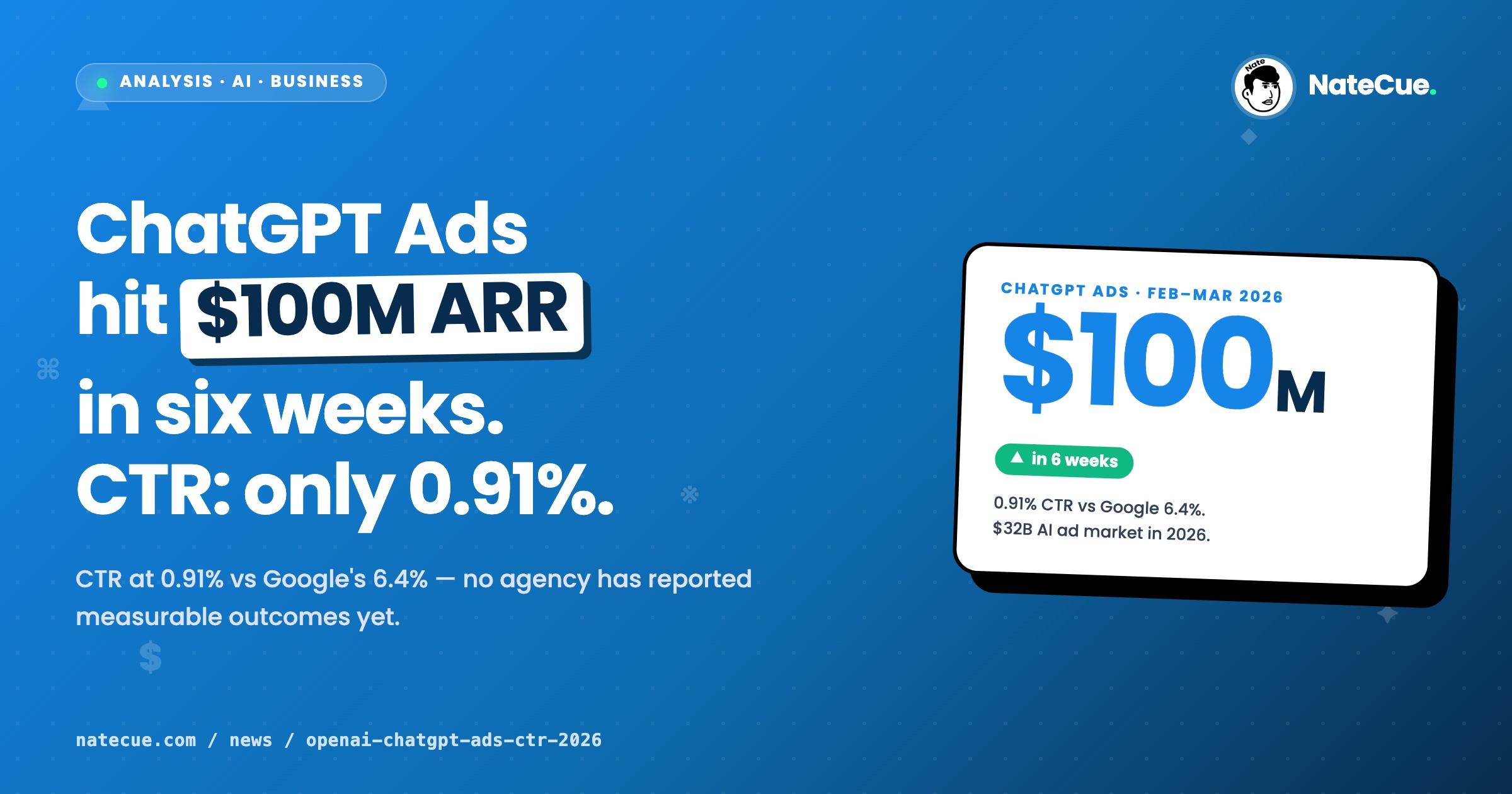
OpenAI launched ads on ChatGPT on February 9, 2026. Within six weeks, annualized revenue hit $100 million (CNBC, 2026). The click-through rate on those ads? 0.91% - compared to Google Search’s benchmark of 6.4% (eMarketer). You’re paying to reach an audience that rarely clicks, on a platform where no one can yet prove what happens after they do.
$100 Million in Six Weeks: Read the Fine Print
The $100M ARR number is real. But context matters.
OpenAI estimates 94.7 million US ChatGPT users, with 85% eligible to see ads. Yet fewer than 20% of eligible users are served ads on any given day (eMarketer). The inventory is still highly limited.
The revenue speed came from a concentrated group of major advertisers. OpenAI is working with 600+ brands, including the largest holding companies in media: Dentsu, Omnicom, Publicis, and WPP. These are the same firms that deployed budget into TikTok, Snapchat, and Threads before any of those platforms could prove scaled ROI.
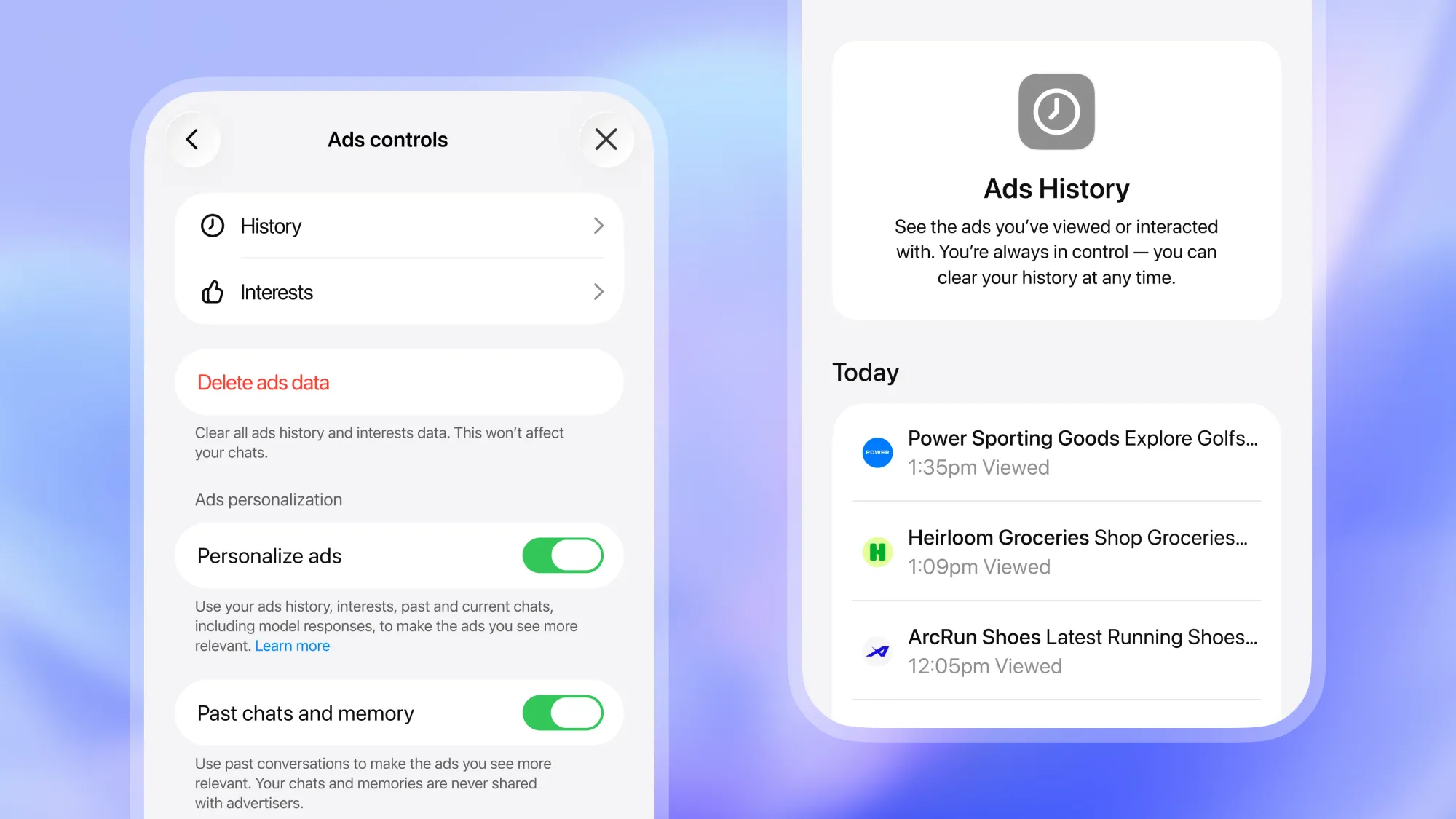
The ad format: sponsored messages appear after ChatGPT’s answers without influencing the answer content. Advertisers buy via CPC or CPM through OpenAI Ads Manager, with no minimum spend requirement as of May 2026.
CTR 0.91%: Low, But Context Changes the Calculation
The 0.91% figure comes from advertiser-reported data via Adweek - not an official OpenAI benchmark. Similarweb’s May 2026 analysis puts overall ChatGPT ads CTR at 0.68%. Some early accounts report blended CTRs of 3.8-4%, with variation by vertical (1.5-6% range).
For reference: Google Search benchmarks at 6.4%. Google Display Network sits around 0.35%. ChatGPT Ads currently land between those two - higher than display, significantly lower than search.
Here’s the more important data point: Criteo found that users referred from ChatGPT and similar AI platforms convert at approximately 1.5 times the rate of other referral channels. Fewer clicks, but higher-intent clicks?
If that conversion lift holds at scale, the real question isn’t “does CTR match Google?” but “what’s the cost per acquisition?” That math hasn’t been run publicly yet, which is part of the problem.
The Core Issue: Measurement Is Still a Black Box
Agency executives were direct with eMarketer: “no measurable business outcomes” from ChatGPT ads to date. The platform has been described as “relatively low-tech” compared to Google Ads or Meta Ads manager. Attribution tools remain underdeveloped.
Advertisers are committing budgets without proof that spend drives leads, sales, or even assisted conversions. This is not a new situation in advertising history.
Early Facebook Ads (2007-2010) ran on the same dynamic: major brands allocated budget before the platform had measurement tools to justify it. Twitter Ads (2011-2013) followed the same script. Facebook eventually proved ROI at scale. Twitter never convincingly did.
Where OpenAI ends up in that spectrum is still an open question.
The Bigger Picture: $32 Billion in AI Ad Spending
eMarketer projects US AI ad spending to reach $32.03 billion in 2026, nearly triple the prior year (Forbes, July 14, 2026).
The underreported fact: over 80% of that budget flows through traditional paid search, not chatbot interfaces. Google’s AI Overviews appear alongside paid search listings - that’s still where commercial intent is highest.
Google is under pressure. For the first time in over 20 years, Google’s search advertising market share dropped below 50% - down to 48.5% in 2026 (eMarketer). Amazon is capturing 43.4% of all new US search ad spending between 2026 and 2028, more incremental dollars than Google in the same period.
OpenAI’s internal projections: $2.5 billion in 2026 ad revenue, growing to $100 billion by 2030. That’s an ambitious target for a platform five months into its ad pilot with no published cross-advertiser performance data.
Vietnam and Southeast Asia: Still Time to Watch
ChatGPT Ads launched in the US in February and expanded to the UK, Mexico, Brazil, Japan, and South Korea by May 2026. Canada, New Zealand, and Australia are next. Vietnam and Southeast Asia have no confirmed timeline.
That doesn’t make this irrelevant. Global brands and agency holding companies are setting budget frameworks for ChatGPT Ads right now. When the platform expands to Southeast Asia, spend decisions will come from holding company mandates established in the US - not from local market teams.
Vietnam marketers have an advantage here: you are not the first mover. You can watch the measurement story develop, see whether Criteo’s conversion lift data holds at scale, and understand the platform mechanics before your agency account manager suggests adding it to the media mix.
The window to learn without spending won’t stay open forever. But right now, it’s open.
NateCue's Take
The holding companies are not dumb. Dentsu, Omnicom, Publicis, and WPP booking ChatGPT ads without solid measurement isn't incompetence - it's politics. No CMO wants to answer "why aren't we on ChatGPT?" while a competitor claims first-mover advantage. This is the exact playbook from early Facebook Ads (2007-2010) and Twitter Ads (2011-2013). First movers pay the learning tax. Some platforms go on to prove ROI at scale. Others don't. The Criteo finding - ChatGPT referrals convert at 1.5x the rate of other referral sources - is the most underreported data point in this story. If that holds at scale, a 0.91% CTR may still yield acceptable CPA. But we don't know yet. Vietnam and Southeast Asia aren't in the rollout yet, which means local marketers have time to watch the measurement story develop before committing budgets.