
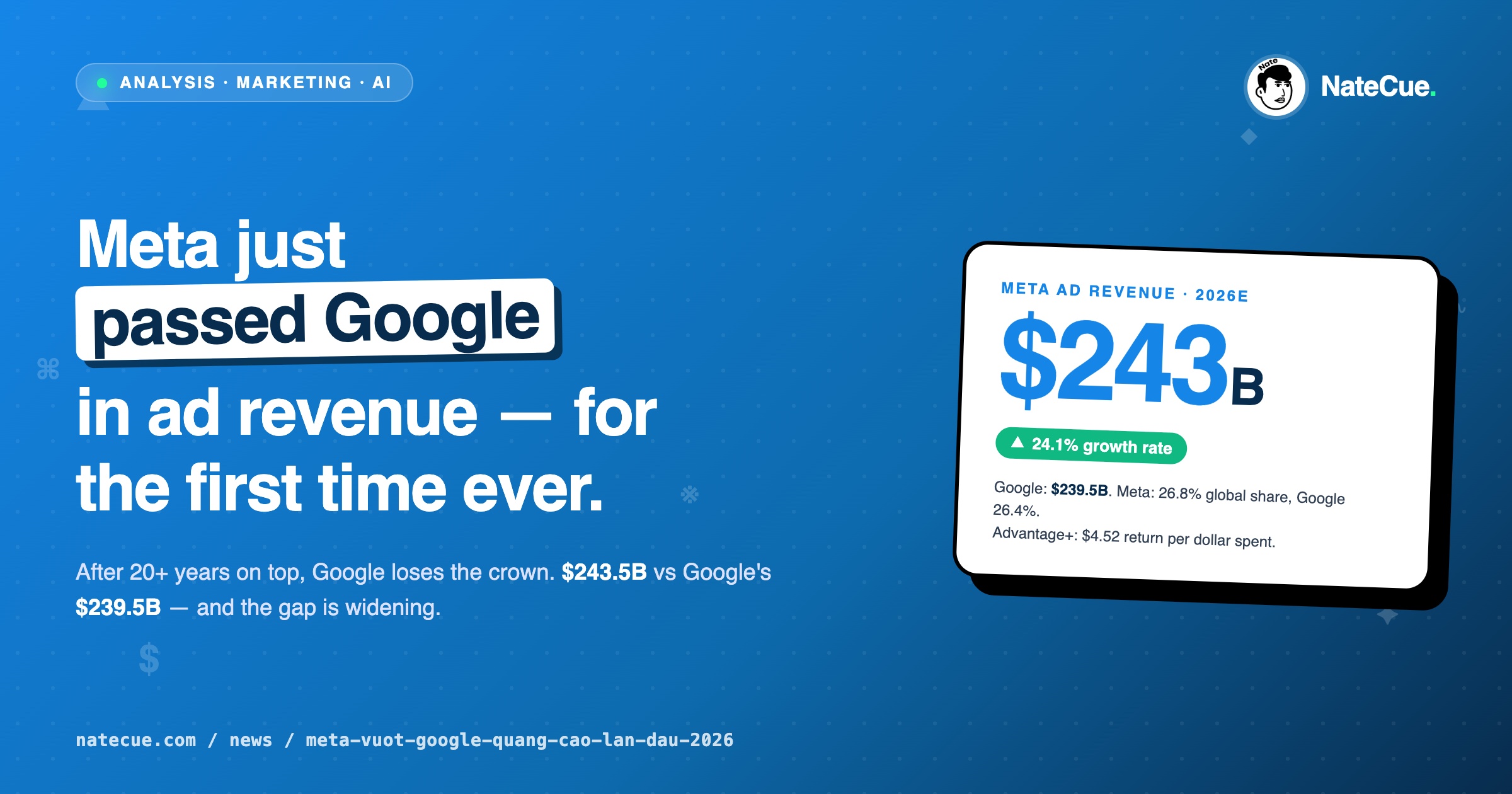
For the first time in digital advertising history, Google is not number one. eMarketer projects Meta will generate $243.5 billion in global ad revenue in 2026 - surpassing Google’s $239.5 billion. Less than 2% separates them. But what that gap signals for media buyers is significant.
The Numbers: Meta Accelerates, Google Holds Steady
Meta’s global growth rate is accelerating - from 22.1% in 2025 to 24.1% in 2026. Google holds a steady 11.9%. At those trajectories, the lead will widen.
Global digital ad market share for 2026: Meta at 26.8%, Google at 26.4%, Amazon third at 9%. Combined, these three platforms control 62.3% of worldwide digital ad spending (eMarketer, 2026).
For context: in 2025, Google still led with $214 billion to Meta’s $196 billion. One year later, the ranking has reversed.
Why Meta Is Winning: AI and First-Party Data Advantage
Meta made an early, aggressive bet on AI-powered advertising. That bet is compounding.
Advantage+ campaigns are generating approximately $60 billion in annualized revenue for Meta. The average return is $4.52 per dollar spent - 22% higher than manually configured campaigns.
Mark Zuckerberg has a clear endpoint in mind. By late 2026, Meta aims to reach full automation: advertisers provide a URL and a budget, Meta handles the rest. Creative. Targeting. Bidding. Optimization.
This isn’t a distant vision. It’s a quarterly roadmap being executed right now.
Google, meanwhile, is navigating pressure from a different direction. AI Mode changes how users interact with Search - fewer click-throughs, more direct answers. The search ads that built Google’s revenue base are adapting to shifted user behavior in real time.
eMarketer analyst Drew Spink frames it clearly: the consolidation reflects platforms’ “wealth of first-party information, reach and artificial intelligence integration.” The platform with the deepest AI integration into the ad loop wins - not necessarily the historically dominant one.
The Vietnam Lens: Google Still Leads, But the Gap Is Closing
Globally, Meta just passed Google. In Vietnam, the picture is different - for now.
Google holds 28.4% of Vietnam’s digital ad market. Meta (Facebook + Instagram) holds 19.2%. Google leads, partly because it controls over 90% of Vietnam’s search market (Vietnam Briefing, 2026).
But Facebook has 76.2 million users in Vietnam - roughly 75.2% of the total population. That’s one of the highest Facebook penetration rates in Southeast Asia (DataReportal, 2026). Vietnamese performance marketers have run Facebook-first for years, often before allocating any budget to Google Search.
Global ad market shifts typically reach Vietnam with a 12-18 month lag. Meta’s growth momentum (24.1% globally) versus Google (11.9%) will gradually materialize in the local market too. The direction is clear.
Budget Allocation in 2026: Not Either/Or, but Reordered Priorities
This data doesn’t mean abandoning Google. Both platforms serve fundamentally different intent.
Search ads - whether Google or new AI-powered search surfaces - capture existing demand. Meta - across Facebook, Instagram, Reels, WhatsApp Ads - creates and captures new demand through discovery.
What changes is emphasis: with Meta’s automation handling more campaign mechanics, marketer time and capability needs to shift toward creative quality and strategic direction. Not campaign setup.
Max Willens, eMarketer analyst, put it directly: “For the vast majority of advertisers, the question is not whether they should spend money on Meta’s apps - the question is how much.” The floor is established. The ceiling is still being discovered.
The real question for 2026 isn’t which platform to use. It’s whether marketers are spending their time on the parts of the job that automation can’t yet replicate.
NateCue's Take
Vietnamese marketers have been Facebook-first for years - not because of trends, but because of real performance. But here's the tension: many agencies still charge high management fees for Meta Ads, while Advantage+ is automating more of that work every quarter. When Zuckerberg says "give me a URL and a budget, I'll handle the rest" - that's not a pitch about efficiency. That's a signal that low-value middlemen get replaced. What survives is strategy, creative direction, and the ability to explain why the numbers changed. Markets like Vietnam will feel this shift 12-18 months after developed markets. But it's coming.