
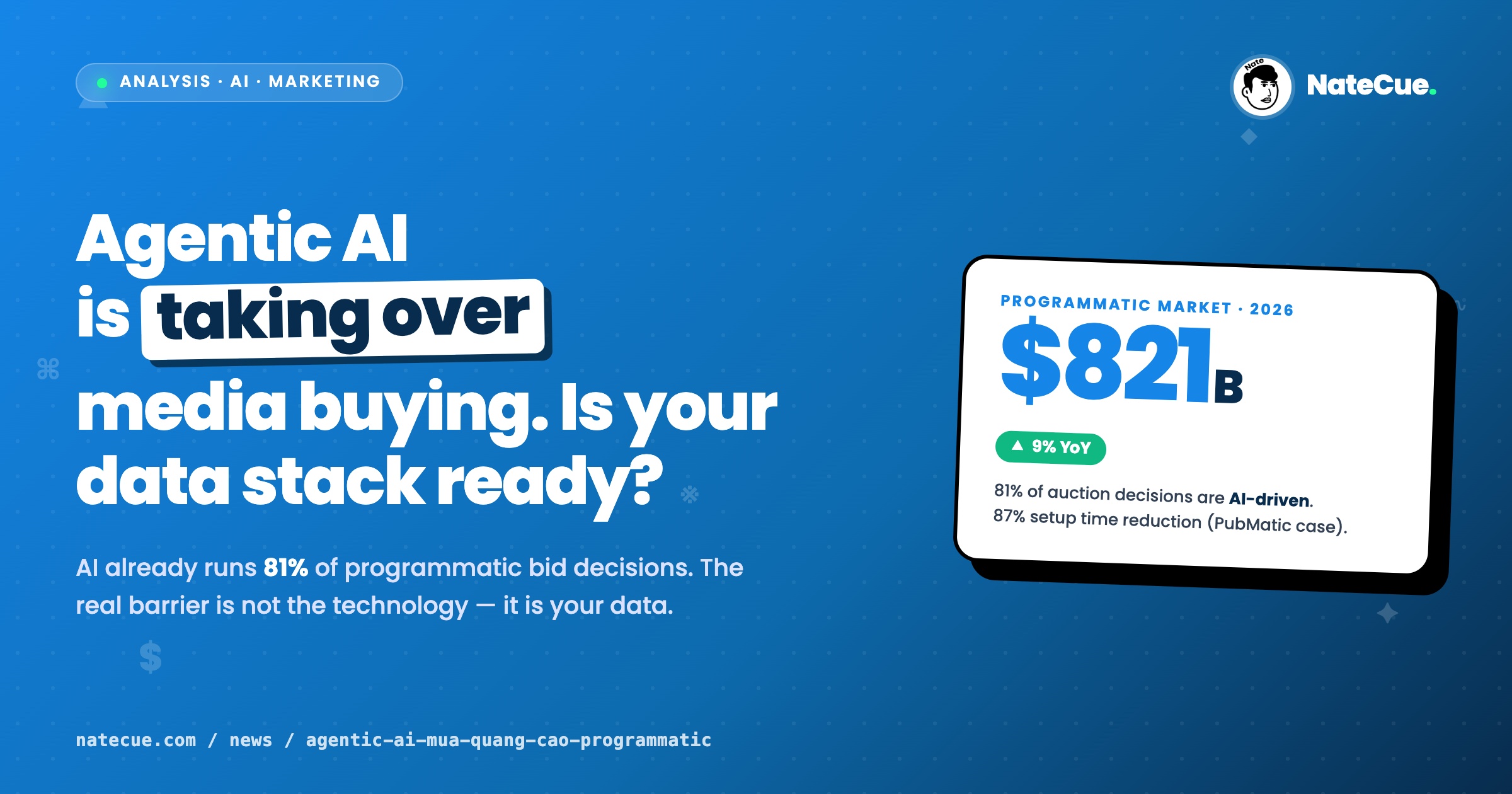
Two-thirds of US media buyers are planning to focus more on agentic ad buying in 2026 (IAB). At the same time, AI already automates 81% of bid decisions across major DSPs. This is not a future prediction - it is the current state of programmatic advertising.
The question is no longer whether agentic AI will take over media buying. The question is: when it does, which brands will benefit - and which will be left behind?
A $821 Billion Market Where AI Is Already Driving
The global programmatic advertising market reached $821 billion in 2026, up 9% year-over-year (Digital Applied). Programmatic now controls 90% of all digital display spending worldwide.
What is changing is who is running those campaigns.
AI-driven bidding now optimizes 81% of auction decisions across major DSPs. Brands report 12-18% incremental ROAS lift from AI-optimized versus rules-based bidding strategies (Digital Applied). That gap compounds over time as AI agents learn campaign-specific patterns.
The APAC region - which includes Southeast Asia - is the fastest-growing programmatic market at +11.6% YoY, reaching $263 billion (Digital Applied). The region is expanding faster than North America ($337 billion, +7.2%). This matters for Southeast Asian marketers: the infrastructure is being built right now, and early movers will define the playbook.
AI-Assisted vs. Agentic: A Distinction That Matters
Many marketers use “AI” to describe everything from Smart Bidding to fully autonomous campaign execution. The distinction matters enormously.
AI-assisted media buying is what most brands use today: AI suggests bids, optimizes targeting, recommends creative variants. Humans make the final calls.
Agentic media buying is the next step: AI receives a natural-language brief, builds the media plan, purchases inventory, optimizes mid-flight, and reports outcomes - with minimal human involvement at each step.
A real-world example: In December 2025, PubMatic and agency Butler/Till ran what they described as the industry’s first fully autonomous CTV campaign. Butler/Till submitted a creative brief. PubMatic’s agents - using Anthropic’s Claude as the AI interface - interpreted the brief, generated the media strategy, and executed the buy autonomously. Results: 87% reduction in setup time and 70% faster issue resolution.
This was not a lab experiment. It was a live campaign with a real client (Clubtails).
eMarketer (April 2026) confirms the direction: two-thirds of US ad buyers plan to prioritize agentic buying this year. But eMarketer is also clear - widespread adoption remains years away. 2026 is about building foundations, not mass deployment.
The Real Barrier: Trust and Data, Not Technology
60% of US advertising professionals cite accuracy and transparency concerns as the top barrier to AI adoption in media campaigns (IAB). Not tool availability. Not cost. Trust.
This concern is well-founded.
Agentic AI operates as a black box. It identifies patterns humans cannot see and makes buying decisions based on its own logic. When a campaign underperforms, marketers need to understand why - but agentic systems often produce opaque audit trails. “The AI decided” is not a useful post-mortem.
There is also the identity problem. Post-cookie, authenticated identifiers achieve only a 47% average match rate across major DSPs (Digital Applied). Nearly half of your audience is “unknown” to the AI agent - it will either bid on probabilistic guesses or skip those users entirely.
Three competing standards are emerging: Unified Context Protocol (UCP), Advertising Context Protocol (AdCP), and Agentic RTB Framework (ARTF). The standards competition is creating short-term uncertainty. Marketers face a real question: which stack should they build toward when the winning standard has not been determined?
What This Means for Emerging Markets Like Vietnam
APAC is the fastest-growing programmatic region, but most of that growth comes from mature markets - Japan, Australia, Singapore. Vietnam-specific data does not appear in major reports, which tells its own story.
It does not mean Vietnam is outside the game. It means the market is still being defined.
DSPs like Google DV360, The Trade Desk, and Amazon DSP are expanding infrastructure across Southeast Asia. Local agencies are learning to operate these tools. But for agentic buying to work effectively, two prerequisites are needed that most Vietnamese brands currently lack:
- Clean, structured first-party data - not a CRM with mismatched fields, but a functioning CDP with behavioral signals.
- Premium publisher inventory integrated with major DSPs - so AI agents can actually access and buy the right placements.
Both conditions are being built in Vietnam, but slower than the technology is moving.
Three Things Marketers Should Do Now
eMarketer’s April 2026 research points to three preparation priorities:
First - Data integration before AI adoption. Agentic AI is only as good as the data it is fed. Building a CDP is not a future project - it is the prerequisite for participating in agentic buying when it goes mainstream.
Second - AI literacy across the team. Not to replace media buyers, but to enable them to brief agents effectively, audit outputs, and know when to override AI decisions. The PubMatic case worked because Butler/Till knew how to write a machine-readable brief.
Third - Rebuild measurement for agentic reality. Last-click attribution becomes meaningless when an AI agent is selecting the channel mix. Multi-touch modeling and incrementality testing are required to understand what is actually driving outcomes.
Ad fraud remains a critical watch point. Sophisticated Invalid Traffic (SIVT) consumes 8.7% of total programmatic spend - approximately $71 billion in lost value globally (Digital Applied). CTV, the fastest-growing channel (+28.3% YoY to $36 billion), also carries the highest fraud risk at 12.4%. Agentic AI does not automatically eliminate fraud exposure - without proper guardrails, it can amplify it.
Automation does not eliminate risk. It amplifies risk when deployed without appropriate oversight.
NateCue's Take
The agentic media buying story is not about job displacement - at least not yet. The real story is about data moats. AI agents perform well when they have clear signals: clean first-party behavioral data, purchase history, quality lookalike seeds. Most brands in emerging markets - Vietnam included - do not have this infrastructure in a structured, usable form. They run remarketing off scattered pixels and third-party audiences that are quietly eroding post-cookie. When agentic buying goes mainstream in 2-3 years, the gap between brands with strong data stacks and those without will not be a 10-20% performance gap. It will be a wall. Brands without first-party data will pay more for the same inventory because their AI is buying blind. Investing in CDP and first-party data collection today is not "preparing for the future." It is a survival strategy for 2027.