
Perceived Value in Marketing: The Psychology Behind Willingness to Pay
Why does a Starbucks coffee justify a $6 price tag while a functionally identical cup from a diner feels expensive at $3? The answer isn’t in the beans - it’s in perceived value. This article breaks down the psychological mechanisms marketers use to shape how customers evaluate worth, and how you can apply them without cutting your prices.
Perceived value isn’t magic. It’s a well-documented psychological phenomenon that can be measured, influenced, and deliberately designed. In a competitive market, the winner is rarely the one with the objectively best product - it’s the one that makes customers feel like they’re getting the best deal.
What is Perceived Value?
Perceived value is a customer’s subjective assessment of a product or service’s benefits relative to its costs. The foundational formula is:
Perceived Value = Total Perceived Benefits - Total Perceived CostsThe critical insight: perceived value has nothing to do with production cost. A Louis Vuitton bag doesn’t cost tens of thousands of dollars to manufacture - but buyers perceive its value as justified because of what it represents: status, craftsmanship, and personal identity.
Philip Kotler - the father of modern marketing - defines Customer Perceived Value (CPV) as: “The difference between the prospective customer’s evaluation of all the benefits and costs of an offering versus the perceived alternatives.”
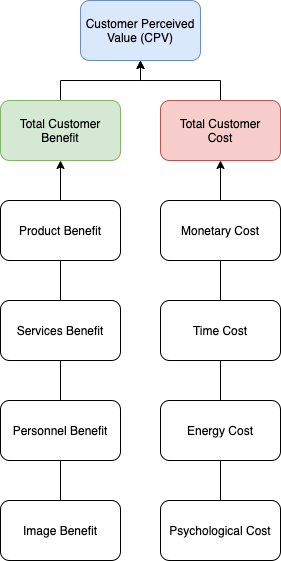 CPV = Total benefits (product, service, personnel, image) minus total costs (monetary, time, energy, psychological). Source: MBA Management Models
Benefits extend far beyond product features:
- Functional value: What the product does
- Emotional value: How using it makes customers feel
- Social value: How others perceive them as a result
- Life-changing value: How it transforms who they are
Costs go beyond price too - time, effort, risk, and inconvenience all count.
The Psychology Behind Perceived Value
Bain & Company surveyed over 10,000 US consumers to identify 30 elements of value that drive purchasing decisions. These are arranged in a pyramid that mirrors Maslow’s Hierarchy of Needs.
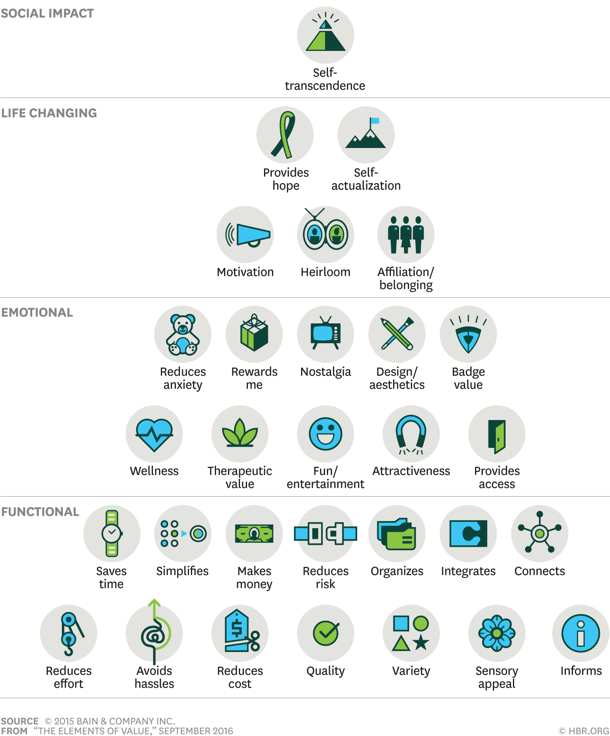 Bain’s Value Pyramid organizes 30 elements from basic functional needs up to life-changing and social impact. Companies that deliver on more elements see significantly higher customer loyalty. Source: Bain & Company / HPT by DTS
Bain’s research finding is striking: companies that perform strongly on 4+ value elements grow revenue at 3x the rate of companies focused on only 1-2 elements.
But to actively influence perceived value, marketers need to understand five specific cognitive biases:
1. Price Anchoring
This is the most powerful bias in marketing. When the brain sees a first number, it becomes an “anchor” - all subsequent prices are evaluated relative to it.
Real example: You see a jacket marked “Original price $200, now $80.” Immediately, $80 feels like a bargain - even though you had no prior sense of what the jacket was worth.
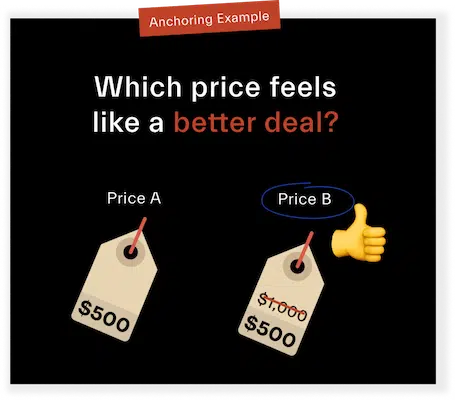 Price anchoring works by establishing a high reference point first, making any lower price feel more attractive by comparison. Source: Invesp CRO
Amos Tversky and Daniel Kahneman - the Nobel Prize-winning psychologists - proved that people don’t evaluate value in absolute terms. They always evaluate relative to a reference point. This is the scientific foundation of price anchoring.
How to apply:
- Show your most expensive plan first on pricing pages
- Use strikethrough pricing to display the “original” price
- Frame cost against alternatives (“less than one coffee a day”)
2. Scarcity Effect
“Only 3 rooms left at this price!” - Booking.com has built an empire on this.
Psychologists call this Reactance Theory: when people perceive something as becoming scarce or about to disappear, they suddenly want it more - even if they were previously indifferent.
Scarcity drives perceived value in two directions:
- Increases perceived product value (scarce = precious)
- Increases urgency to act now
One important caveat: manufactured scarcity backfires badly. If customers notice that “only 3 rooms left” is a permanent fixture, trust evaporates completely.
3. Social Proof
Robert Cialdini’s Influence (1984) established that people default to looking at others’ behavior to determine the “right” choice - especially when they’re uncertain themselves.
Perceived value rises significantly when:
- Products have substantial positive reviews
- Known experts or public figures endorse it
- Large user numbers signal market validation (“1 million customers trust us”)
- Relevant certifications and badges are displayed
Social proof isn’t just star ratings. It’s specific outcome stories - “After 30 days, my revenue increased 20%” is dramatically more persuasive than “5 stars - great product.”
4. The Halo Effect
When customers have a positive experience with one part of a brand, they tend to rate the entire brand more favorably - even aspects they haven’t directly experienced.
Apple has mastered this better than anyone: iPhone packaging is engineered with obsessive attention to detail - not to protect the product, but to create a premium unboxing experience. That first impression bleeds into how customers perceive the entire product.
In practice: A beautifully designed website signals product quality before the customer reads a single feature. Consistent visual branding raises perceived quality. Exceptional customer service makes customers willing to pay more.
5. Loss Aversion
Kahneman found that the pain of losing something is psychologically twice as powerful as the pleasure of gaining something of equivalent value. This is Loss Aversion.
Marketers exploit this by framing messages around loss rather than gain:
- “You’re losing $500/month without this tool” outperforms “Save $500/month with this tool”
- “Don’t miss the last available slot” outperforms “Claim a spot now”
How to Increase Perceived Value Without Discounting
The instinct when sales are slow is to cut prices. Perceived value marketing does the opposite - it increases the sense of worth without touching the price tag.
- Invest in packaging and presentation: Products that look expensive are perceived as more expensive - this is documented science, not just aesthetics
- Tell the process story: “This coffee is small-batch roasted by a craftsman with 20 years of experience” elevates perceived value immediately
- Use high-quality social proof: A detailed case study beats 50 anonymous five-star reviews
- Use 3-tier pricing: Budget - standard - premium. Customers consistently gravitate toward the middle option (the “compromise effect”)
- Reduce perceived cost, not just price: Simplify onboarding, offer money-back guarantees, be transparent about return policies - removing friction is as valuable as adding features
Frequently Asked Questions (FAQ)
Is perceived value different from actual value?
Yes - and understanding this gap is the core of marketing strategy. Actual value is the objective worth of a product: production cost, measurable performance, technical specifications. Perceived value is what customers feel it’s worth - shaped by branding, packaging, reviews, storytelling, and psychological biases. Customers don’t buy actual value. They buy perceived value. This is why a pair of Nike shoes sells at 5x the price of a functionally equivalent unbranded shoe.
How do you measure perceived value?
Several proven methods exist: (1) Van Westendorp Price Sensitivity Meter - ask customers 4 questions about price points that feel “too cheap,” “cheap,” “expensive,” and “too expensive” to identify the acceptable price range; (2) Conjoint Analysis - determine which features customers will trade away for a lower price; (3) NPS combined with price segmentation - compare NPS scores across customer groups paying different prices; (4) Qualitative interviews - directly ask “what’s the maximum you’d pay for this, and why?”
Does perceived value apply to B2B marketing?
Absolutely - and arguably it matters even more in B2B. Decision-makers are still humans with the same cognitive biases as any consumer. But in B2B, perceived value carries an additional layer of “organizational value”: clear ROI, risk reduction, and team productivity gains. Bain & Company also published a B2B Elements of Value Pyramid with 40 distinct elements - from functional (saves time) to inspirational (future vision alignment). Social proof in B2B means case studies from companies in the same vertical, relevant certifications, and recognizable client logos - not anonymous reviews.
Summary
Perceived value is one of the most powerful levers in marketing because it acts directly on how the brain makes decisions - not on price. Mastering price anchoring, scarcity, social proof, the halo effect, and loss aversion provides the foundation for every marketing touchpoint: pricing pages, email campaigns, product packaging, ad creative. The most important point: perceived value is not about deceiving customers - it’s about communicating your real value more clearly and compellingly than your competitors do.