
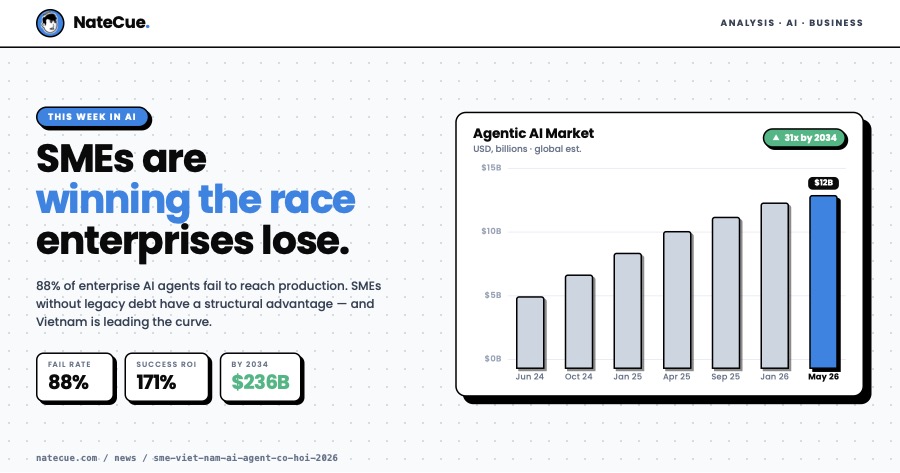
88% of AI agents deployed by enterprises globally never make it to production. This IDC statistic is being shared as a warning for the industry — but for Vietnam’s SMEs, it may be the most useful signal of 2026.

Why Enterprises Keep Failing at AI Agents
Deloitte’s Tech Trends 2026 report paints a clear picture: only 11% of organizations are actually running AI agents in production. 42% are still building strategy roadmaps. 35% have no formal plan at all.
Three patterns explain most of the failures:
Legacy system integration. More than 40% of AI agent projects collapse because existing enterprise systems lack modern APIs and real-time execution capabilities (Deloitte, 2026). Agents that work in sandbox environments break immediately when they hit real infrastructure.
Bad data architecture. 48% of organizations cite data searchability as their biggest obstacle; 47% flag data reusability as a major blocker (Deloitte, 2026). When the data foundation is fragile, agents produce unreliable outputs and lose organizational trust fast.
Governance overhead. Large organizations get stuck in approval loops, security audits, and compliance reviews for every agent deployment. This is not a technical problem — it’s an organizational one. It moves slowly, and agents need iteration to improve.
The 12% That Actually Succeed
The organizations that get AI agents into production tell a different story.
Successful deployments see an average ROI of 171%, rising to 192% for US-based enterprises (IDC). Dell Technologies reported double-digit improvements across every cost and customer satisfaction metric after redesigning their service processes around agents. Toyota eliminated 50-100 screen interactions per workflow through agent-driven real-time visibility (Deloitte, 2026).
The common thread is not budget or model quality. It’s workflow design. These organizations didn’t automate existing processes — they rebuilt workflows from scratch for agent-native environments. Deloitte frames this as the most critical distinction: “agent implementation is not about automation of existing processes but rather reimagining workflows for agent-native environments.”
Vietnam’s Structural Advantage
ICSC Vietnam, which tracks agentic AI adoption closely in the local market, noted that SMEs will “move the fastest” in this wave. Not because they have more resources — but because they don’t have what’s slowing enterprises down.
No legacy system debt. No aging data architecture to retrofit. No multilayer approval chains. When the decision is made to deploy an agent, execution can start the next day.
Vietnam is in a strong regional position. The country’s Generative AI market is projected to grow from $100.1M in 2024 to $988.2M by 2030, at a 46.47% CAGR (InvestVietnam). Across Southeast Asia, 46% of businesses have already scaled AI beyond pilot phase — outpacing the global average of 35% (SAMTA). Vietnam is above that regional curve.
Local AI infrastructure is building fast. Companies like FPT, Viettel, and VNG are expanding domestic AI capacity. NVIDIA, Qualcomm, and SAP are actively entering the market. The foundation is forming now, not in five years.
Where Vietnam’s SMEs are seeing real, measurable deployment:
- Customer service: 24/7 automated response systems handling classification and lead conversion
- Sales ops: automated pipeline monitoring, follow-up triggers, deal scoring
- Finance operations: receivables consolidation, payment reminders, cash flow forecasting
How to Stay Out of the 88%
Deloitte and IDC point to the same framework for successful deployment:
Pick the right task first. Not the most strategic task — the most repetitive one. High volume, clear success criteria, outcomes that are measurable on a short timeline. If you cannot define “correct” versus “incorrect” for the output, it’s the wrong task to start with.
Design a new workflow, don’t automate the old one. This is the single most important decision. Agent-native workflows are structurally different from human workflows. Layering agents onto legacy processes is exactly the pattern that kills 88% of enterprise deployments. SMEs starting from scratch have a natural advantage here.
Treat the agent like a product, not a project. Deployment is not the finish line. Agents need monitoring, iteration, and human-in-the-loop handling for edge cases. The projects that fail most often are those with no ongoing ownership after launch.
The global agentic AI market is expanding 31x — from $7.6B today to $236B by 2034 (IDC). Most large enterprises will remain stuck in legacy integration cycles for the next 18-24 months. Vietnam’s SMEs have a narrow, real window to enter the adoption curve ahead of them — with fewer structural barriers than at any previous technology shift.
The 12% is not a club for companies with the biggest budgets. It’s a club for organizations that pick the right task and redesign operations around it.
NateCue's Take
The pattern here is counterintuitive: companies with the biggest AI budgets, dedicated teams, and enterprise tooling are failing at AI agents at an 88% rate. Meanwhile, leaner SMEs with simpler stacks are structurally positioned to outrun them. Vietnam's GenAI market is growing at 46.47% CAGR through 2030. The window is open. But the advantage only holds if you pick the right task first — repetitive, high-volume, with clear measurable outcomes. That's not a technology question. It's a workflow design question. Get that right, and you're in the 12% that actually gets ROI.