
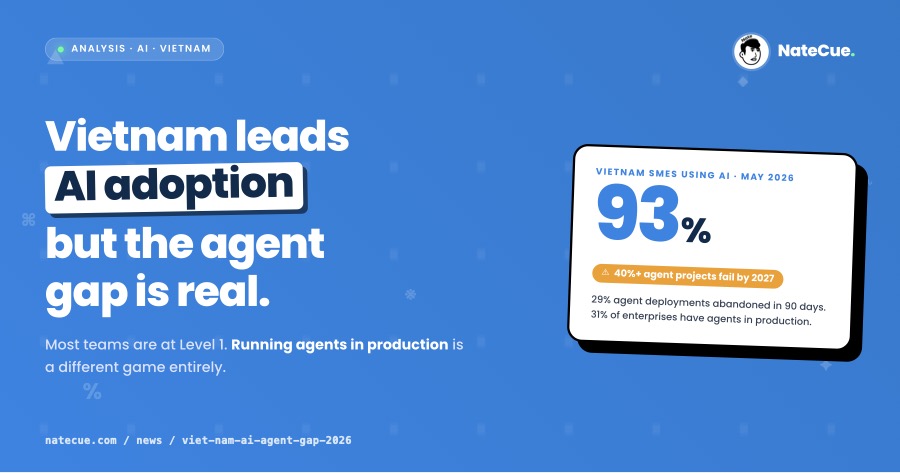
Meta reports 93% of small and medium-sized enterprises in Vietnam have already integrated AI into their operations - the highest rate in Southeast Asia. Meanwhile, Gartner is warning that more than 40% of AI agent projects currently being deployed globally will be abandoned before the end of 2027.
These two numbers don’t contradict each other. They’re measuring completely different things.
“Using AI” and “Running AI Agents” Are Not the Same
This is the distinction that most adoption reports quietly skip over.
Using AI means turning on Advantage+ in Meta Ads Manager, using ChatGPT to write captions, or generating ad creatives with AI tools. This is Level 1 - and it’s precisely what 93% of Vietnamese SMEs are doing right now (VietnamPlus / Meta Vietnam, 2026).
Running an AI agent is an entirely different operation. It means a system that autonomously analyzes data, decides on strategy, executes steps within a campaign, and adjusts budget allocations - without a human approving each individual action.
Gartner notes that currently only 31% of enterprises globally have at least one AI agent genuinely running in production. For SMEs, the number is substantially lower.
The gap between Level 1 and Level 3 isn’t primarily a technology problem. It’s a preparation and governance problem.
Why 29% of Agent Deployments Are Abandoned in 90 Days
Among marketing teams that have actually deployed AI agents, 29% cancel within the first 90 days (Landbase, 2026). The failure breakdown reveals three distinct patterns:
- 41% fail because no one defined success criteria upfront - no one specified what “agent working well” looks like
- 33% fail because the agent lacks sufficient access to the data or tools it needs to complete the task
- 19% fail due to brand voice drift - the agent starts producing content that no longer sounds like the brand
The 19% brand voice drift figure looks small, but it’s the most dangerous failure mode long-term. When an AI model drifts from your brand’s voice, the damage doesn’t show up immediately. It quietly erodes customer trust across months of output before anyone catches it.
McKinsey surveyed 35 CMOs of Fortune 250 companies and found that brand and legal governance - not cost, not technology - was the primary concern when deploying AI agents in marketing.
Gartner’s 2027 Warning
Gartner projects that more than 40% of current agentic AI initiatives will be abandoned by end of 2027. The three cited causes: governance failures, unclear ROI, and internal policy violations.
At the same time, Gartner also forecasts that by end of 2026, 40% of enterprise applications will embed at least one AI agent - up from under 5% in 2025. And 93% of business leaders believe scaling AI agents in the next 12 months will generate competitive advantage (OneReach.ai, 2026).
Deployment speed is outpacing governance readiness. That’s the formula for the failures Gartner is predicting.
Where Vietnam Sits in This Landscape
Vietnam is leading Southeast Asia in AI adoption for e-commerce. 42% of Vietnamese e-commerce merchants already use AI - surpassing Singapore and Thailand (VietnamNet, 2026). Businesses using AI-assisted advertising solutions report an average 22% improvement in ROAS, with some enterprises reporting up to four-fold gains in campaign efficiency (Meta Vietnam, 2026).
These are strong signals. Vietnam’s market is clearly open and moving fast on AI integration.
But that same speed creates specific exposure. The two things that autonomous agent deployment absolutely requires - a detailed, documented brand voice guide and a structured approval workflow before agent output reaches customers - are precisely what most fast-moving teams skip.
Vietnam’s e-commerce merchants who are leading on Level 1 adoption are well-positioned to make the Level 3 leap. But the ones who skip the governance infrastructure will be well-represented in Gartner’s 40%.
The Right Questions Before Deploying an Agent
If you’re considering the move from AI tools to autonomous agents, the first question isn’t which platform to choose. It’s these three:
- Is your AI style guide documented? Not a generic brand guideline - specific examples of what the agent is and isn’t allowed to produce.
- Does an approval workflow exist? Who reviews agent output before it reaches customers?
- Are success criteria defined per workflow? No clear metrics means no way to know when to stop or adjust.
The 60% of AI agent projects that don’t fail aren’t succeeding because they chose better models. They’re succeeding because they prepared these three things before deploying. That’s the real gap Vietnam’s marketers need to close.
NateCue's Take
Most AI adoption reports conflate two very different things: using AI features and running autonomous agents. The 93% Vietnam SME figure from Meta reflects Level 1 adoption - AI-assisted ad targeting, AI copywriting tools, AI image generation. Level 3 is an agent that autonomously analyzes data, decides strategy, executes campaign steps, and adjusts budgets without human approval at each step. Vietnam's strong Level 1 numbers are genuinely encouraging. But they also create a false sense of readiness for the agent leap. The teams that will succeed aren't necessarily the ones who deploy fastest - they're the ones who build governance infrastructure first: documented brand voice guides, structured approval workflows, and measurable success criteria per agent workflow. Gartner's 40% abandonment forecast isn't a technology problem. It's a preparation problem. And Vietnam's market, moving fast on adoption, is particularly exposed to this pattern.