
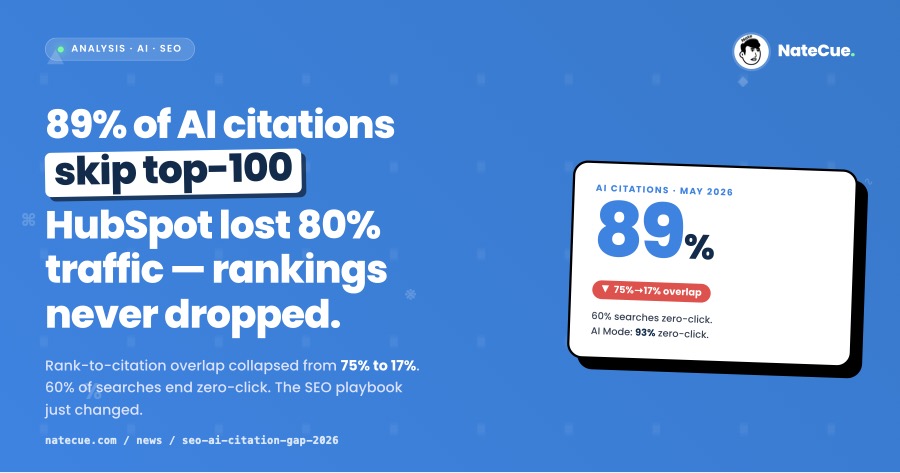
HubSpot ranked #1 for hundreds of thousands of keywords. In 2026, their organic traffic dropped 70-80%. Their rankings didn’t fall. Google didn’t penalize them. The problem is that AI now answers the question directly - and the answer doesn’t cite HubSpot.
Rankings and Citations Are Divorcing
BrightEdge documented a shift the SEO industry didn’t want to acknowledge: the overlap between top-10 organic results and AI Overviews citations collapsed from 75% in mid-2025 to 17-38% by early 2026 (Mersel AI / BrightEdge, 2026).
At the same time, 89% of AI Overviews citations now come from pages outside the top 100 organic results - with BrightEdge recording a 400% increase in citations pulled from positions 21-30.
The two systems are no longer correlated. A page that ranks #1 can receive zero AI citations. A page sitting at #45 can be cited in the majority of AI answers in its category. Ranking and citation now follow separate logic.
The Numbers as of May 2026
Seer Interactive analyzed 53 brands, 5.47 million tracked queries, and 2.43 billion organic impressions from January 2025 to February 2026. Key findings:
- Organic CTR when AI Overview is present: 0.61% versus 1.62% without AIO (ALM Corp, 2026)
- 60% of all Google searches end without a click (The Digital Bloom, 2026)
- In Google’s AI Mode, that climbs to 93% zero-click (Mersel AI, 2026)
- Gartner forecasts a 50% decline in website organic traffic by 2028
The most overlooked number: Position 2 organic lost 39% CTR (from 20.8% down to 12.6%) per Seer Interactive. Position 1 lost 18%. The second-ranked result took a harder hit than the top result.
Median publisher traffic is down 10% year-over-year while search volume continues growing. Google processes 9-13 billion searches daily - but the clicks are staying inside the SERP.
The HubSpot Case
HubSpot built their SEO empire on high-volume TOFU content: “What is…”, “How to…”, “Best practices for…” - exactly the query types AI Overviews handles best. The result was a 70-80% drop in organic traffic. Not from an algorithm penalty. Not from a competitor outranking them. But from AI stepping between the question and their page.
This is a structural problem, not a tactical one. It affects any brand whose content strategy leans heavily on informational TOFU content - which describes most content marketing programs built between 2018 and 2024.
Not every site suffered. People.com grew 27%. Men’s Journal grew 415% (The Digital Bloom, 2026). The difference: editorial content with perspective, experience, and specificity - not generic explainers.
The Vietnam Angle: Higher Risk, Open Window
There’s no Vietnam-specific AI Overviews data yet because the feature hasn’t fully rolled out for Vietnamese-language search. That’s not a reason to relax - it’s a reason to move early.
When AI Overviews expand to Vietnamese search:
- Real estate and restaurants - two of Vietnam’s largest digital verticals - are seeing AIO growth rates of 258% and 273% in markets where it has rolled out
- Mobile search dominates at 75%+ in Vietnam, and mobile zero-click is already at 77% globally
- Brand authority signals - the strongest predictor of AI citation - are underdeveloped for most Vietnamese brands compared to global competitors
Vietnamese language content has one clear advantage right now: AI platforms have very thin Vietnamese coverage. The brands that build genuinely authoritative, structured, factual content today will own that namespace before the competition arrives.
How to Get Cited (Not Just Ranked)
The good news: AI-referred traffic converts 4.4x better than standard organic, with visitors spending 8-10 minutes on-site versus 2-3 minutes for traditional organic sessions (Mersel AI, 2026).
Brands cited in AI Overviews also show 35% higher organic CTR and 91% higher paid CTR (The Digital Bloom, 2026). A citation lifts the entire funnel - not just AI traffic.
The path to citation is different from the path to rankings:
- Content needs to be structured for extraction - factual, source-cited, answerable in paragraphs an AI can quote directly
- Cross-platform presence matters because AI systems cross-validate sources
- The metric to track is AI Share of Voice, not keyword ranking
Ramp achieved 7x AI visibility in 30 days. Popl went from #5 to #1 AI Share of Voice with 38.85% month-over-month lead growth (Mersel AI, 2026). These aren’t outliers - they’re early movers.
The question is no longer “does my page rank?” The question is: “When a potential customer asks an AI about my category, does my brand show up in the answer?”
NateCue's Take
Most SEO teams are still running the same playbook from 2022: publish volume, build links, chase rankings. But BrightEdge's data shows that the mechanism connecting "ranked page" to "AI-cited page" has collapsed. 75% overlap in mid-2025. 17-38% by early 2026. For Vietnam, where AI Overviews haven't fully rolled out in Vietnamese yet, this is both a warning and a window. The content farms built to capture informational TOFU traffic today are the same ones that will take the hardest hit when the rollout reaches Vietnamese search. The brands building genuine authority now - structured, factual, cross-platform - will own AI search in Vietnamese before anyone else gets serious about it. Citation isn't about volume. It's about being the most answerable source in your category.