
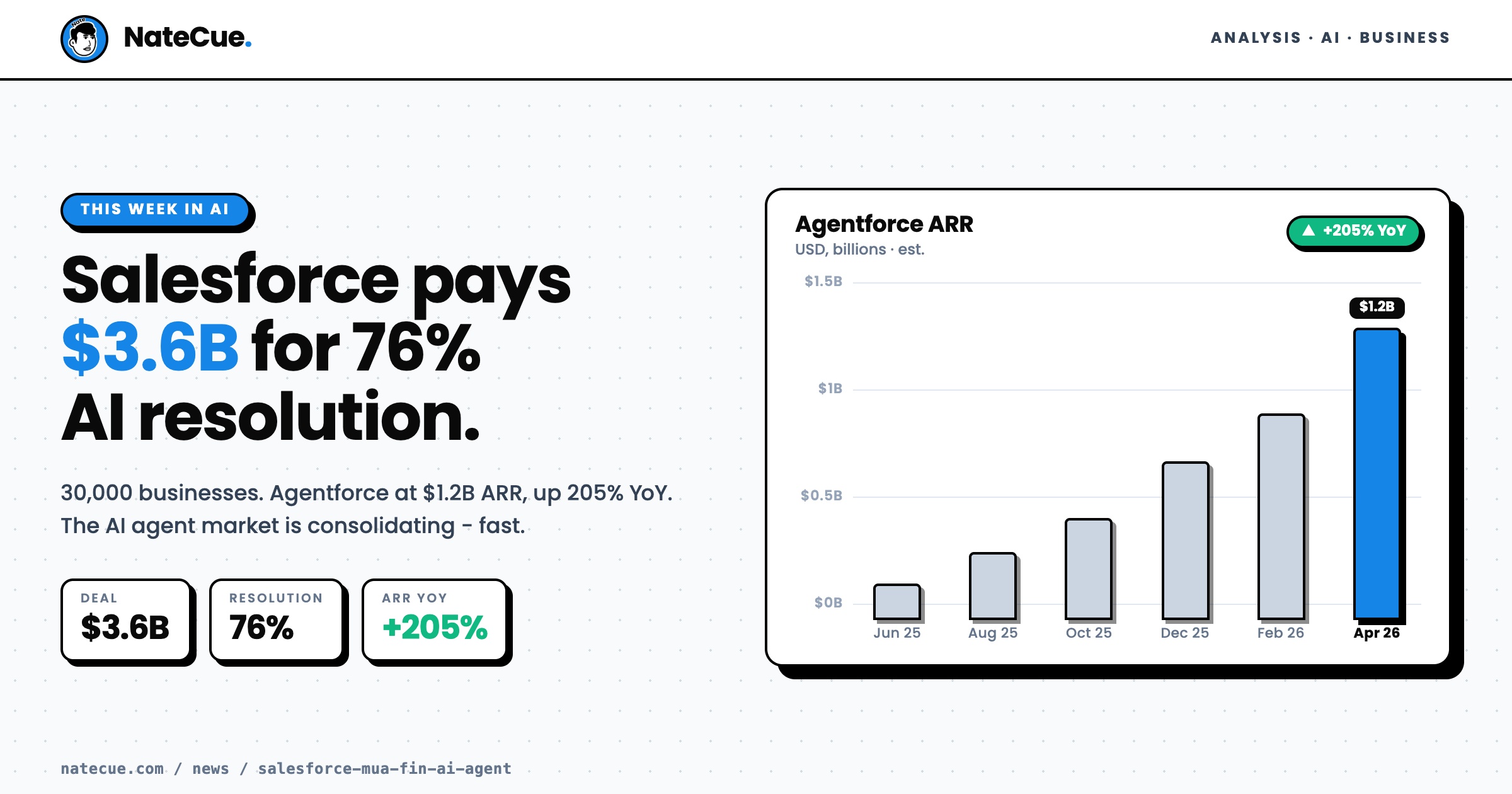
Salesforce paid $3.6 billion for a company most people knew as Intercom. The reason isn’t the brand, the customer base, or even the technology stack. It’s one number: 76% autonomous end-to-end resolution rate - nearly double the industry average of 40%. In a market where AI agent software spend is growing 139% year-over-year, this is the most expensive proof point in enterprise CX history.
The Number Salesforce Actually Bought
Fin - rebranded from Intercom roughly a year ago - serves more than 30,000 businesses worldwide. Its AI agent runs across chat, email, WhatsApp, SMS, phone, and Slack. Not a scripted bot. Not a FAQ deflector. A system that closes tickets end-to-end using its proprietary Apex model, without human handoff.
Industry benchmark: ~40% automated resolution. Fin: 76%. That’s a 1.9x gap Salesforce just paid $3.6 billion to own.
Agentforce, Salesforce’s enterprise agent platform, hit $1.2B ARR in Q1 FY27 - up 205% year-over-year (CMSWire, 2026), serving 18,500 customers. This acquisition isn’t a pivot to AI. It’s an acceleration of a trajectory already in motion.
$4.55 Billion in Agentic CX M&A - In 12 Months
Salesforce isn’t alone. NICE acquired Cognigy for $955 million in September 2025. Add the Fin deal: $4.55 billion in agentic customer experience acquisitions in under a year (CMSWire, 2026).
Global AI agent software spending is projected to reach $206.5 billion in 2026, up 139% from $86.4 billion in 2025 - the fastest-growing segment in enterprise software. When M&A moves this fast in a single category, the technology conversation is over. The consolidation conversation has started.
The pattern is clear: big platforms are buying proven capability rather than building it. The highest-resolution-rate proof point gets acquired at the highest multiple. Fin is proof that performance at scale is the moat.
Outcome-Based Pricing Changes Everything
The underreported implication of the acquisition: Fin’s resolution rate creates the foundation for a fundamentally different pricing model.
Before: $X/month/seat. After: $X/ticket resolved autonomously.
When an AI agent demonstrably handles 76% of support volume without human intervention, per-seat licensing loses its logic. Salesforce is pushing enterprise software toward pay-for-outcomes pricing - and Fin is the product that makes that story credible to CFOs.
This changes how procurement works. Instead of fixed software budgets, enterprises pay against resolved volume. For buyers, it’s easier to approve. For Salesforce, it ties revenue directly to customer success - a very different competitive position than licensing alone.
Vietnam and Southeast Asia: The Readiness Gap
Vietnam’s IT outsourcing market is forecast to reach $880 million in 2026 (Software Outsourcing Journal, 2026). Local vendors including KMS Technology and Savvycom are already shipping production AI agents for enterprise clients. Demand for agent-based automation has overtaken traditional chatbot projects.
But most Vietnamese enterprises are still in pilot mode. The barrier isn’t technology access - it’s data quality and process definition. High-resolution AI agents require clean historical support data and clearly defined escalation logic. Most regional companies haven’t structured their support operations to feed that infrastructure.
When the global enterprise benchmark shifts toward 76% autonomous resolution, running at 20-30% isn’t just an efficiency gap. It’s a customer retention gap, an operational cost gap, and increasingly a competitive positioning gap. The Salesforce-Fin deal sets a new standard. The question for regional teams is how quickly they can close the readiness gap before their competitors do.
NateCue's Take
The 76% resolution rate isn't the product Salesforce bought - it's the permission slip. Permission to price per outcome. Permission to deprecate per-seat licensing. Permission to tell every enterprise buyer: "your 40% chatbot is now a competitive liability." From a Vietnam market lens: the gap isn't tech access, it's readiness. Most local enterprises lack the clean historical data and defined escalation paths that let an AI agent perform at scale. The Fin acquisition sets a new benchmark that makes "we have a chatbot" sound like "we have a fax machine." The window to close that gap is shrinking faster than most regional teams realize.