
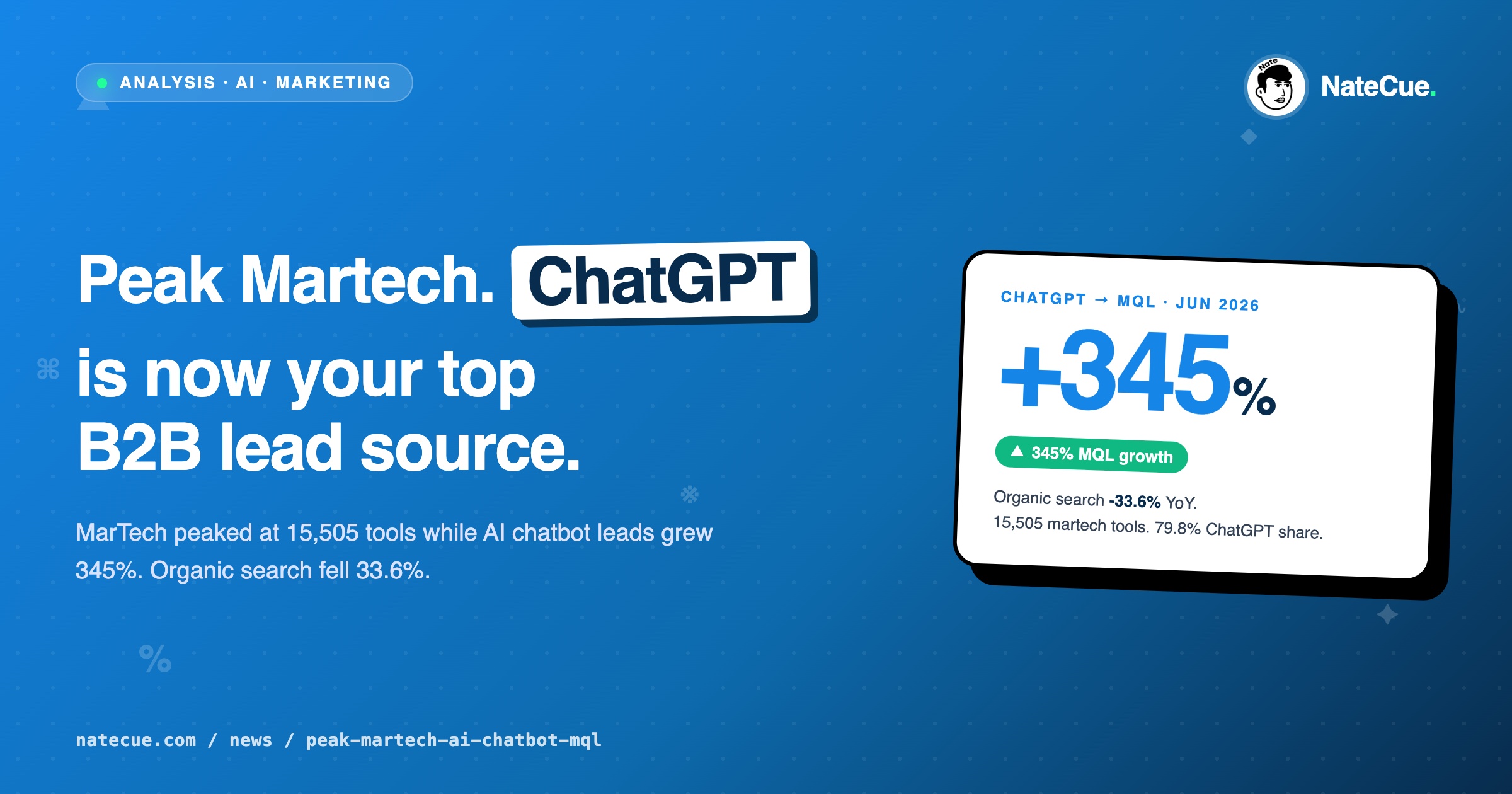
After 15 years of 100x growth, the martech landscape effectively stopped expanding in 2026 - up just 0.79% to 15,505 tools. At the same time, traffic from AI chatbots grew +345% as a last-touch source for marketing qualified leads (Cognism, 2026). Organic search fell 33.6%. These two data points aren’t unrelated. They’re telling the same story.
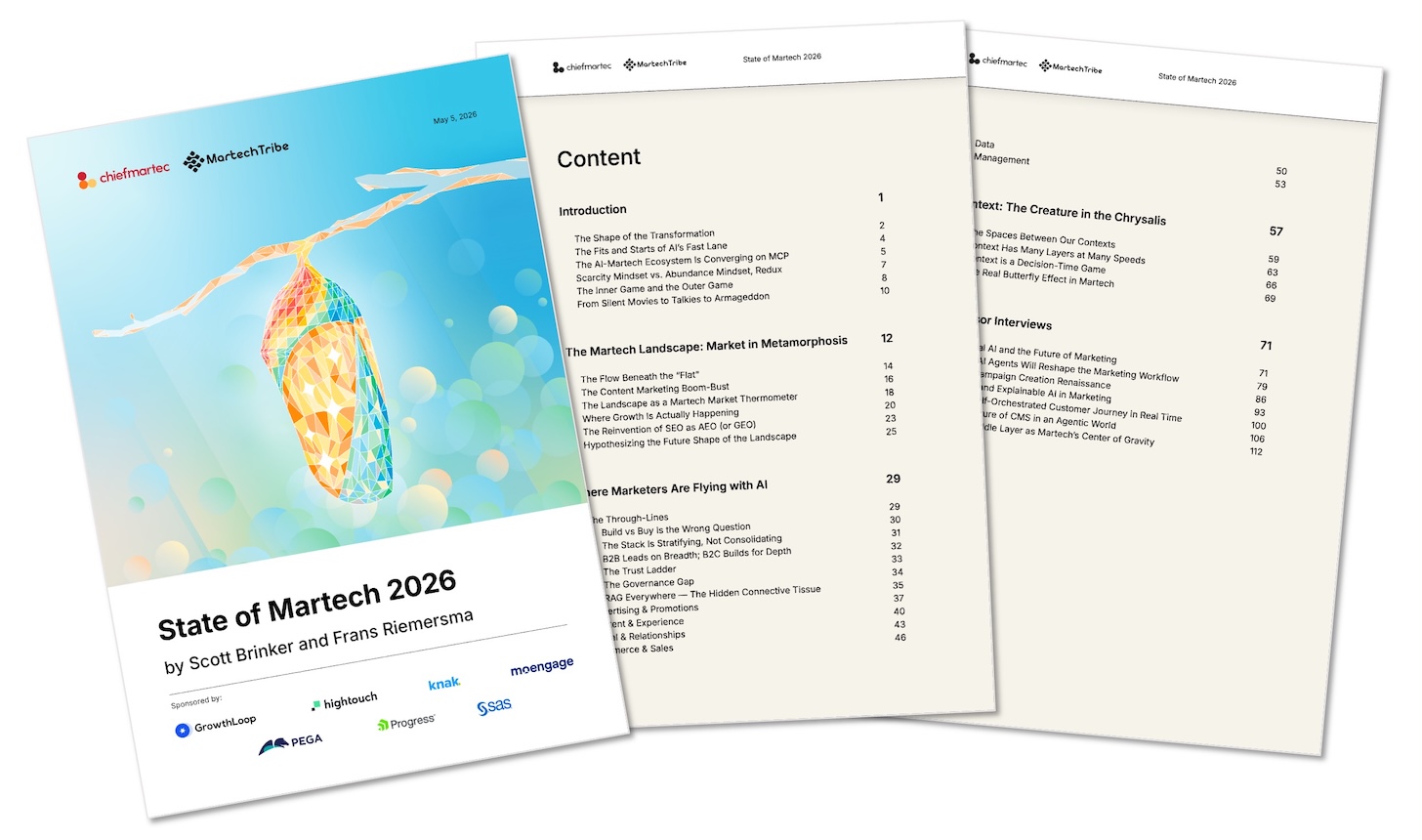
Peak MarTech: 15,505 Tools, 0.79% Growth
The 2026 chiefmartec.com landscape supergraphic lands at 15,505 products - a net increase of just 121 from 2025. After growing from 150 products in 2011 to more than 15,000 today, the market has almost completely stalled.
But the headline number hides a more turbulent reality beneath it. In 2026, 1,488 new products were added while 1,367 were removed - removals up 13% year-over-year. The companies exiting skew small: $1-10M in revenue, 1-50 employees. These are the SaaS tools that many teams currently pay for on a monthly basis.
What’s actually growing fast isn’t new tools - it’s infrastructure. CMS and Web Experience Management is up 21.4%. Ecommerce Platforms up 19.9%. Data Integration up 8%. These are the layers that AI agents need to operate on top of, not another point solution on the marketing dashboard.
Scott Brinker puts it plainly: AI is reorganizing martech, not expanding it. Model Context Protocol (MCP) has accumulated 29,000+ AI agent connections in just 18 months - nearly double the entire martech landscape built over 15 years.
ChatGPT as MQL Source: The Channel Nobody’s Tracking
While the tool count flatlines, a new channel is compounding fast. Cognism’s Inside Inbound 2026 report measured AI chatbot traffic at +345% growth as a last-touch MQL source. ChatGPT alone accounts for 79.8% of all chatbot referrals to B2B websites.
In the same period: organic search declined 33.6% (GA4 measurement), and Google Search Console clicks fell 23% over six months. Zero-click searches have become the default outcome for most queries.
The practical translation: buyers are asking ChatGPT instead of searching Google. When ChatGPT recommends your brand, that’s a new inbound lead - generated without any click to a search result, without finding your SEO-optimized content.
One more data point that connects the dots: Bing Paid Search now shows the highest closed-won conversion rate across paid channels at 8.9%, ahead of Google Paid Search (6%) and LinkedIn Paid (2.7%). That’s not random. Bing powers Microsoft Copilot - and every Copilot query pulls in Bing ads.
The Real Crisis: “Oops, Your Stack Is Showing”
CMSWire and chiefmartec converge on one insight: the bottleneck in marketing has fundamentally shifted. The old constraint was production - creating enough content, connecting enough systems, building enough automations. The new constraint is context engineering: which content reaches which customer at which moment.
When AI agents mediate customer interactions instead of just drafting copy, data quality and governance stop being best practices and become business-critical. Only 37% of organizations verify their AI-generated content. Data lineage adoption sits at just 49%. As Brinker describes it: organizations are making the sausage with AI, but almost nobody’s bought a labeling machine.
Regulatory pressure is adding urgency. The Colorado Consumer Protections for Artificial Intelligence Act takes effect June 30, 2026, requiring risk management programs and annual impact assessments for high-risk AI deployments. EU AI Act compliance is already in motion. Governance investments that were “on the roadmap” are now overdue.
The Southeast Asia Angle: Building Yesterday’s Stack
Vietnam’s martech market is still growing at 9.1% annually, with digital ad spend projected to reach $5.39 billion in 2026. Around 89% of Vietnamese SMEs have begun adopting AI for chatbots, predictive analytics, and automation (Vietnam Briefing, 2026).
Here’s the paradox worth naming: businesses in Vietnam are actively building martech stacks exactly as the global market declares “peak martech.” The small SaaS tools being deleted from the global landscape include categories that Southeast Asian teams are still evaluating and onboarding. And the fastest-growing new lead source - AI chatbot referral - is entirely absent from traditional stack architectures.
Vietnam’s market has its own shape. Zalo, TikTok Shop, and Shopee dominate consumer behavior in ways that make tight integration with those platforms more valuable than a full CDP buildout. But even within that context, the question every marketing team should ask: when a buyer asks ChatGPT “best [your category] service in Vietnam,” does your brand appear in the answer?
AEO - Answer Engine Optimization, the practice of shaping what AI models say about your category - is a skill most Vietnam-based marketers haven’t built yet. It’s not a future trend. The 345% growth number says it’s already happening.
NateCue's Take
The pattern I keep seeing — in Vietnam and globally — is teams spending months building a "proper" martech stack (CRM, automation, analytics) right as their organic traffic drops 30% and their best leads start coming from ChatGPT citations nobody can track. The fix isn't fewer tools. It's sequencing: data governance and AI readiness need to come before stack decisions, not after. For marketers in Southeast Asia specifically, the question isn't "what tool should I buy next" — it's "when someone asks ChatGPT about my category in Vietnamese, does my brand show up?" AEO is not a future skill. It's a present gap.