
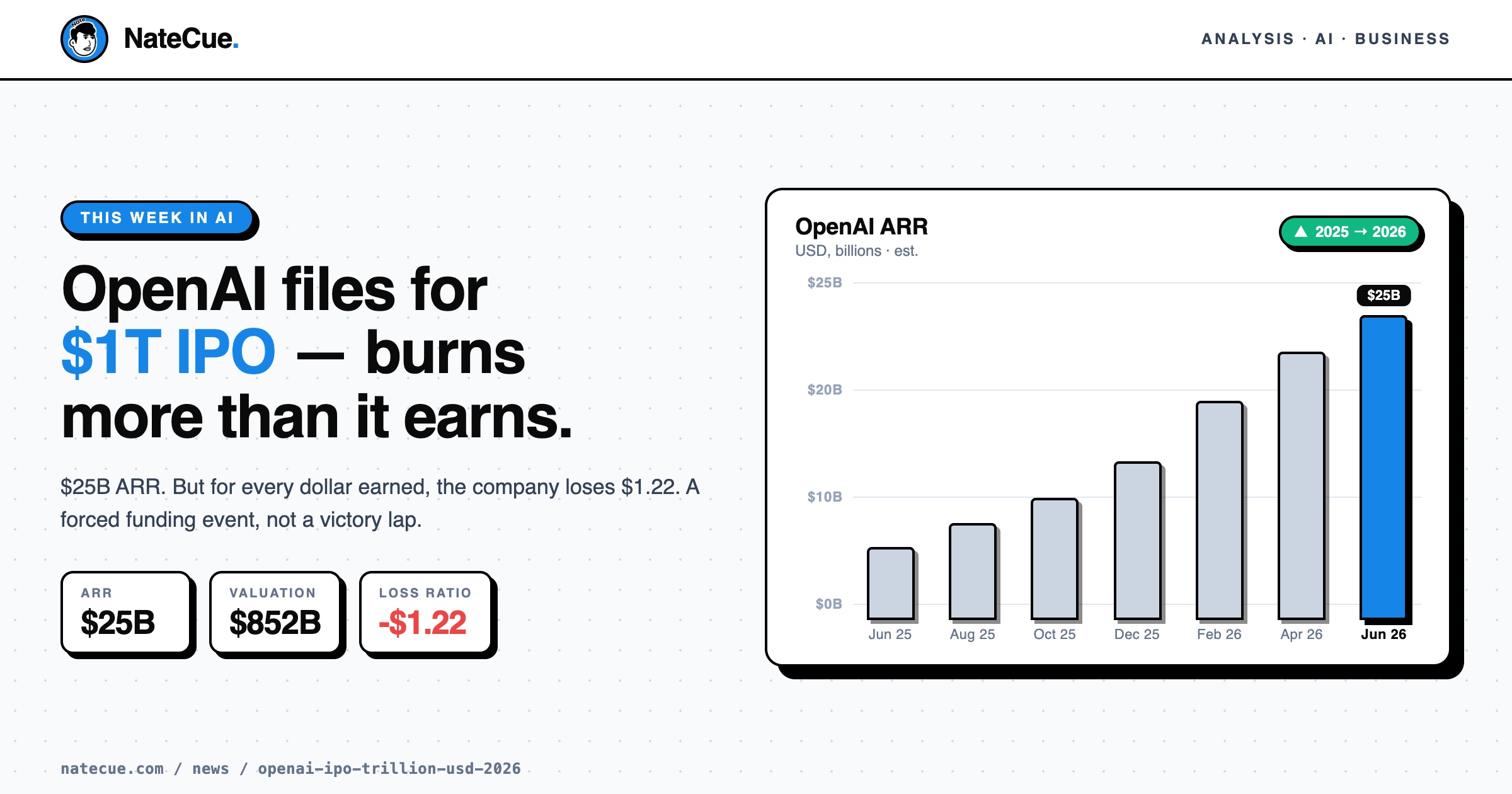
OpenAI just crossed $25 billion in annualized revenue. But for every dollar it earns, it loses $1.22. On May 22, 2026, the company quietly filed a confidential S-1 with the SEC - the first step toward an IPO targeting a $1 trillion valuation.

What the $25B Number Actually Means
OpenAI’s revenue growth is historically unprecedented in tech:
- 2023: $1B ARR
- 2024: $3.7B
- Q1 2026: $25B ARR
But the headline number masks the real story: in 2025, OpenAI burned $22 billion while generating only $13.1 billion in revenue. In Q1 2026 alone, losses totaled $6.95 billion - a loss ratio of $1.22 per dollar of revenue (FutureSearch AI, 2026).
Goldman Sachs, Morgan Stanley, and JPMorgan are underwriting what could be the largest public market debut in US history, targeting a Q4 2026 listing at $852B to $1T valuation.
The Real Reason: A $207 Billion Capital Gap
This IPO isn’t a celebration. Analysts are calling it a “forced funding event” (Tech Market Briefs, 2026).
OpenAI estimates it needs $207 billion in additional capital through 2030 to fulfill compute commitments. The Stargate program - its alliance with Microsoft and SoftBank - carries $600 billion in infrastructure obligations over five years. Private funding rounds are approaching valuation ceilings: April 2026’s $122B raise pushed the company to $852B. Public markets are the only realistic next chapter.
CFO Sarah Friar has publicly warned that if infrastructure spending outpaces revenue growth, the company might not be ready for a 2026 listing. That signal hasn’t been walked back.
Where the Real Risks Live
Three risks matter more than the burn rate:
Market share erosion. ChatGPT held 86.7% of AI web traffic in 2025. Today: 64.5%. Google Gemini has climbed to 21.5%. Anthropic has reportedly surpassed OpenAI in enterprise revenue (Tech Market Briefs, 2026).
Musk litigation. Trial began April 27, 2026. Musk is seeking $130 billion in damages and wants OpenAI’s for-profit restructuring unwound. An adverse ruling would be, in the words of analysts, “catastrophic” for IPO prospects.
Talent flight. Ilya Sutskever, John Schulman, and multiple senior researchers have left for competitors. In AI, talent is a deeper moat than any benchmark.
Southeast Asia Angle: Ambition With Caveats
OpenAI is betting on Southeast Asia. In May 2026, the company announced a S$300 million Applied AI Lab in Singapore - its first overseas hub, positioned as a regional enterprise gateway. Vietnam appears in plans as a primary manufacturing hub for Jony Ive’s upcoming AI hardware lineup (Kavout, 2026).
But developers and businesses in the region who rely on OpenAI’s API need to read this carefully. Enterprise revenue is growing from 40% to a targeted 50% of total business by end-2026. Internal projections suggest 80% of ChatGPT Plus subscribers ($20/month) could churn if free tiers get compressed post-IPO (RoboRhythms, 2026).
Public market pressure for profitability arrives faster than VC timelines. Individual users and small startups will feel this first.
This Isn’t the Google or Facebook IPO
Google and Meta went public with clear paths to profitability. OpenAI projects it won’t be profitable until 2029 - after accumulating $44 billion in cumulative losses.
The real question isn’t whether OpenAI can reach a $1 trillion market cap - it’s whether public investors will tolerate this burn rate long enough to find out. Public shareholders are far less patient than venture capital.
Sam Altman is targeting $100 billion ARR by 2027. If he’s right, this is the greatest company in modern history. If he’s wrong, this is the most expensive IPO story of the decade.
NateCue's Take
From a marketer and product builder's perspective: the most overlooked signal here is what happens to API pricing after the IPO. Public markets demand profitability timelines. When a company needs $207B through 2030 and loses money at scale, that pressure flows directly to end users - higher API costs, compressed free tiers, and enterprise prioritization. If your workflow is single-vendor dependent on OpenAI, now is the right time to audit that. Southeast Asia is watching: OpenAI's $300M Singapore Applied AI Lab and Vietnam manufacturing hub signal serious regional ambition - but the economics of the product still have to work.