
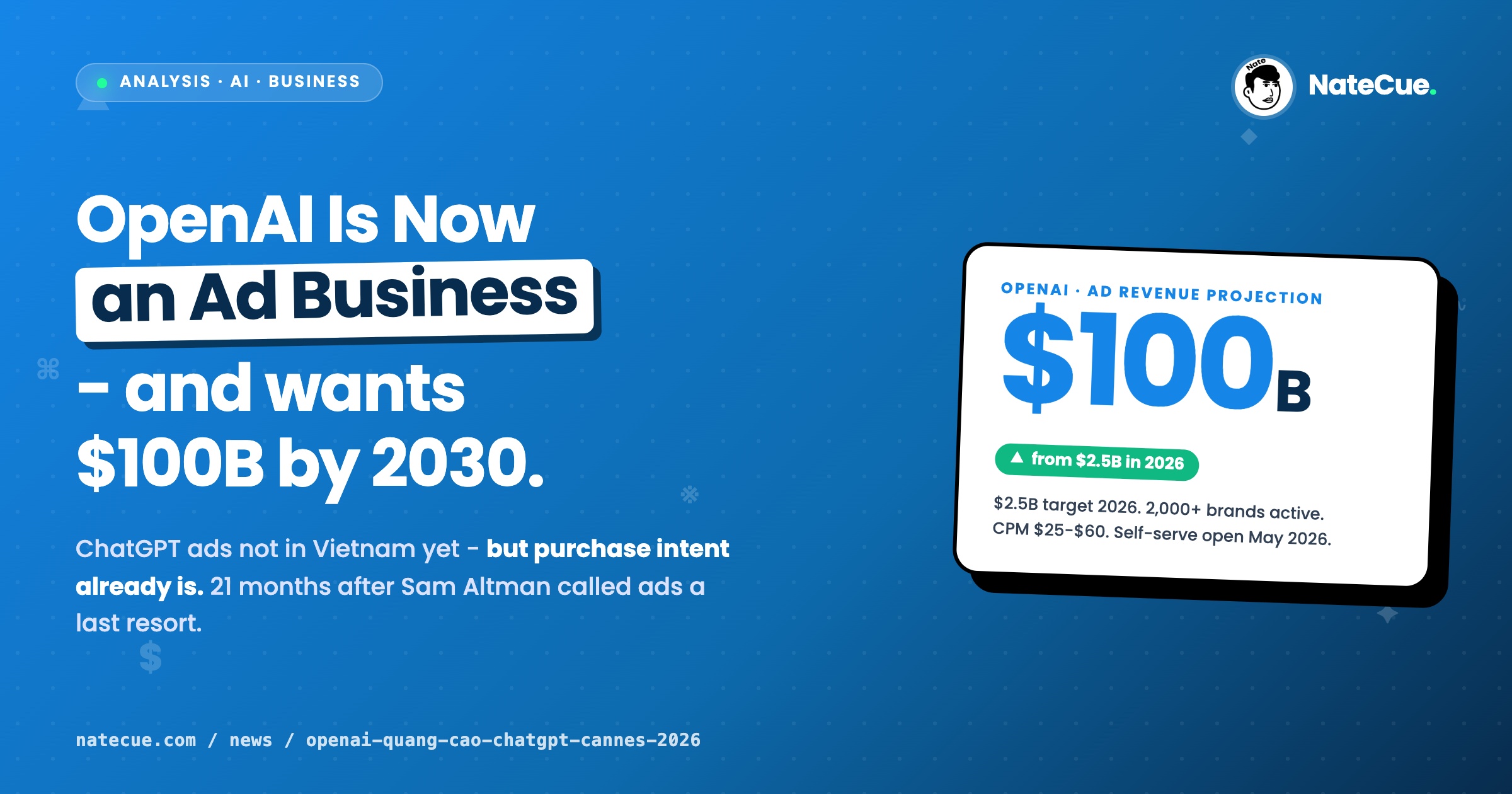
Twenty-one months ago, Sam Altman called advertising “a last resort” and described ads inside AI as “uniquely unsettling.” This week at Cannes Lions 2026, OpenAI took its first-ever booth on the Croisette, and CRO Denise Dresser told the room: “We are clearly in the advertising business now.”

The Fastest Pivot in Advertising History
ChatGPT Ads launched February 9, 2026. Less than five months later, OpenAI had 2,000+ brands running ads through Criteo, CPM rates of $25-$60, a CPC floor of $3-$5, and a self-serve Ads Manager open since May 5 with no minimum spend.
Revenue target: $2.5B in 2026. Then $11B in 2027. Then $100B by 2030 - roughly half of Meta’s current annual ad revenue.
To hit $100B, OpenAI needs ChatGPT to reach 2.75 billion weekly users by 2030. The current figure is approaching 1 billion. Meta took 17 years (2004-2021) to reach $100B in ads. OpenAI is betting it can do that in four.
The context that makes this urgent: OpenAI filed a confidential S-1 with the SEC on June 9, with an IPO target as early as September 2026. Advertising revenue is no longer a nice-to-have - it’s the public-market story. The company reported just under $8B in losses in 2025. It needs a second revenue line that Wall Street can model.
ChatGPT as the “Third Gatekeeper”
OpenAI is positioning ChatGPT as a new intent surface alongside Google Search and Meta. The internal claim: approximately 20% of ChatGPT queries carry commercial intent (OpenAI’s own figure, not independently verified).
For advertisers, the implication is straightforward. Users are asking ChatGPT “best water filter for a family of four” instead of searching Google. They get one answer, not ten blue links. If a brand isn’t in that answer, it doesn’t exist in that search session.
But the structural gap is hard to ignore. ChatGPT Ads currently lacks standardized viewability metrics, independent audience verification, mature brand-safety tooling, and cross-channel attribution. Over 2,000 brands are running ads in measurement darkness.
And according to an Ipsos Q1 2026 survey, 63% of US adults trust AI search results less when ads appear - regardless of how clearly those ads are labeled. Trust is the core value proposition OpenAI is selling to advertisers. Ads are eroding the thing being monetized.
Agentic Advertising: Everyone’s Building It Now
OpenAI wasn’t the only headline at Cannes. The broader theme was an industry-wide shift toward agentic advertising - systems that make and execute advertising decisions autonomously.
Google Marketing Live (just before Cannes) launched Business Agent for Leads: a Gemini-powered chat agent embedded directly inside an ad, replacing lead forms entirely. WPP Media built buyer agents for video with interoperability standards connecting Disney, Netflix, NBCUniversal, and Paramount. Amazon Ads automated campaign planning, optimization, and creative execution end-to-end. Horizon Media’s ad-buying agents now communicate directly with adtech partner agents.
This isn’t “AI helping marketers place ads.” It’s AI replacing a layer of what marketers do.
Southeast Asia: Purchase Intent Is Already There
ChatGPT Ads currently run in seven markets: the US, Canada, UK, Australia, New Zealand, Japan, and South Korea. Vietnam, Indonesia, Thailand - not on the list yet.
But in Vietnam, ChatGPT weekly active users tripled over 12 months (Mission Media Asia, 2026). ChatGPT commands 81% of AI assistant usage in Vietnam. ChatGPT Go launched at ₫132,000/month (~$5) - among the lowest-priced access in Asia.
More concretely: the Shopee-ChatGPT integration already deployed in Vietnam across eight regional markets, enabling product discovery and purchasing through conversational search (Tech Wire Asia, 2026). Purchase intent is flowing through ChatGPT in Vietnam. It just isn’t trackable for most marketers yet.
The position for Vietnam marketers right now: customers are searching on ChatGPT, Shopee has inventory inside that search, and Google Analytics sees none of it.
The Competitors Winning by Refusing Ads
Perplexity abandoned advertising entirely in February 2026, switching to subscription-only. ARR grew 50% the following month to approximately $450 million (Digital Applied, 2026). Anthropic ran a Super Bowl LX ad explicitly positioning Claude as ad-free - and reported an 11% jump in daily active users after the game.
Both of OpenAI’s direct competitors are betting users will pay to avoid ads in AI. OpenAI is betting the opposite.
Both bets can be simultaneously correct - the market segments. Premium users willing to pay move to Anthropic and Perplexity. Free-tier users on ChatGPT see ads. The question for marketers is which segment their customers live in - and whether the measurement infrastructure will ever catch up to the spend that’s already flowing.
NateCue's Take
The $100B projection isn't the story - that's an investor deck number. The real story is that ChatGPT handles an estimated 20% of queries with commercial intent, on a platform with no standardized viewability, no independent measurement, and fragmented brand-safety tooling. Marketers are optimizing Google Ads while a growing share of purchase intent flows through a channel they can't track. For Southeast Asia, Vietnam included, ChatGPT users tripled in 12 months. Shopee already deployed ChatGPT-powered discovery in Vietnam. Ads aren't live yet - but the discovery behavior is already shifting. That said, OpenAI's biggest risk isn't Google's counter-moves. It's the trust equation. Anthropic gained 11% daily active users by positioning Claude as ad-free at the Super Bowl. If OpenAI erodes trust faster than it gains revenue, the whole bet collapses.