
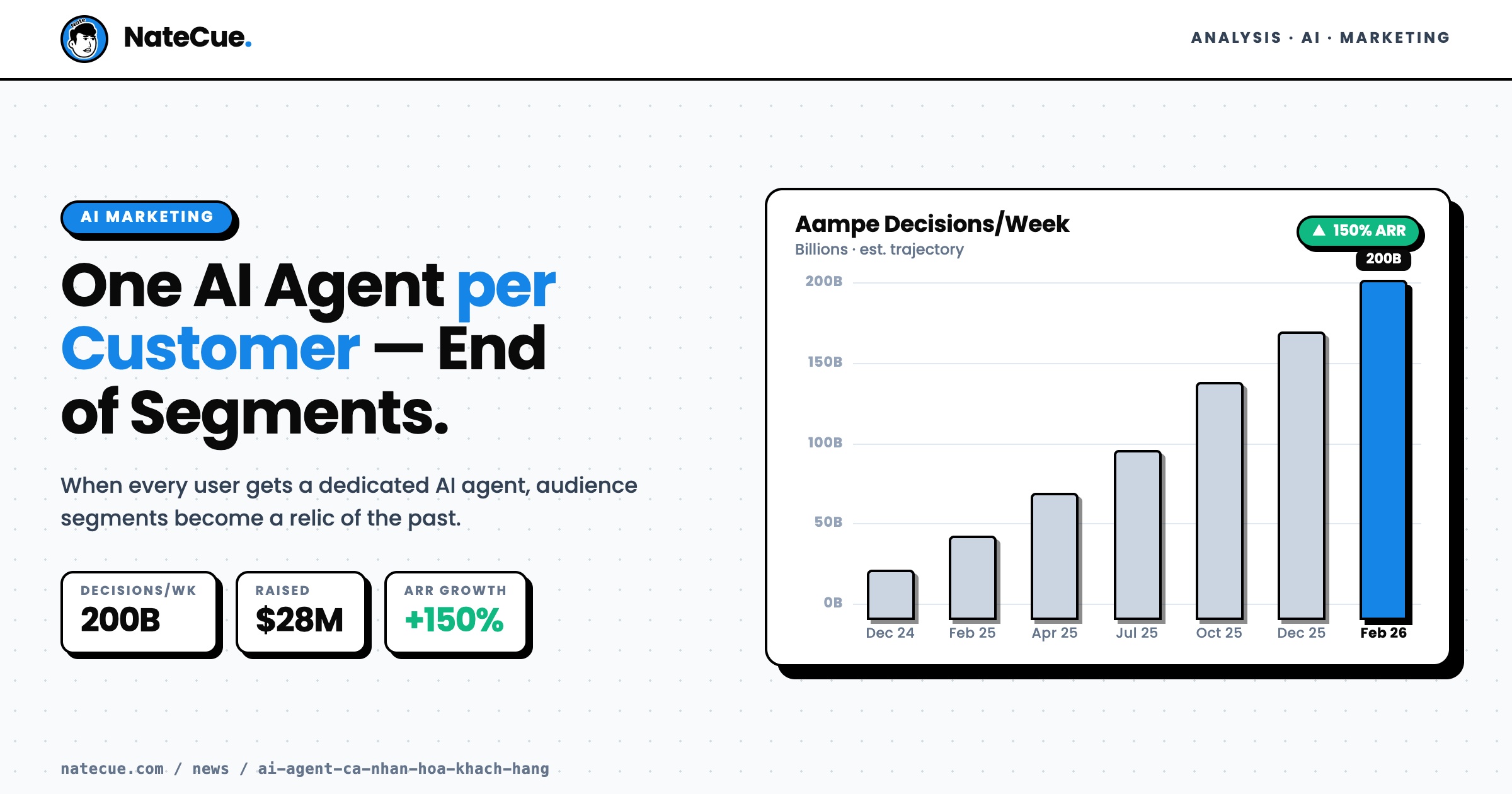
200 billion marketing decisions executed every week. Not by a team - by millions of AI agents, each responsible for exactly one customer.
From Segments to 1:1: The Biggest CRM Shift in Years
On June 24, 2026, MoEngage - an Indian customer engagement SaaS company - announced the acquisition of Aampe, a San Francisco startup founded in 2020. Financial terms weren’t disclosed officially, but TechCrunch reported the all-cash deal was worth “tens of millions of dollars.”
Aampe isn’t traditional marketing automation. Instead of letting marketers build audience segments like “users 25-34 interested in sports,” Aampe assigns a dedicated AI agent to each individual user. That agent uses reinforcement learning - specifically Thompson Sampling and multi-armed bandit models - to continuously optimize content, timing, frequency, and channel for that specific person.
The result: 200 billion decisions processed every week across Aampe’s customer base (MoEngage, 2026). Each decision amounts to: “Should I send this user a push notification tonight at 8 PM? Or email in the morning? Or hold entirely because they’ve shifted to in-app browsing?”
Why 150% ARR Growth Signals Real Market Pull
Aampe was founded in 2020 and raised $28 million across three funding rounds. Achieving 150% year-over-year ARR growth with 30+ enterprise customers isn’t a typical B2B SaaS trajectory at this stage (TechCrunch, 2026).
It signals the problem Aampe solves - true 1:1 personalization at scale - is urgent enough that enterprises pay without heavy convincing.
MoEngage entered this deal from a position of strength. The company closed $280 million in funding six months prior and serves 1,350+ consumer brands across 75 countries. Crucially, MoEngage is actively winning enterprise migrations from Salesforce Marketing Cloud and Adobe Experience Cloud through multimillion-dollar annual contracts. Aampe fills the missing layer: moving from campaign management to agentic customer engagement that can compete at the highest tier.
The Southeast Asia Signal: Grab Already Runs This
Among Aampe’s customers is Grab - Southeast Asia’s dominant super app with 52 million+ monthly transacting users across 8 markets, including Vietnam.
At GrabX 2026, Grab unveiled 13 AI-powered experiences, positioning AI as Southeast Asia’s “Intelligent Everyday Guide” - from restaurant discovery to personalized mobility routing based on individual habit patterns (Grab Newsroom, 2026).
What this means practically: every push notification you receive from Grab wasn’t approved by a campaign manager making segment decisions. An AI agent is processing your individual behavioral history to determine whether, when, and with what content to reach you. Not your cohort. Not your segment. You, specifically.
This isn’t a preview of the future. It’s already running on tens of millions of Southeast Asian users - including Vietnam’s Grab userbase.
The Infrastructure Gap for Emerging Markets
Most marketers in Vietnam and comparable Southeast Asian markets still operate at broadcast-level automation: a single email blast to the full database, segmented at best by city or gender.
The gap to agentic 1:1 personalization isn’t purely a technology gap. It’s a data infrastructure gap. Models like Aampe’s require sufficient behavioral history for reinforcement learning to converge meaningfully. Brands with fewer than 100,000 active users and incomplete event tracking won’t get optimization - they’ll get noise.
But this isn’t an argument for ignoring the shift. G2’s 2026 AI Decision Intelligence in Marketing report shows 51-75% of enterprises actively using AI decisioning at meaningful scale. As MoEngage integrates Aampe and systematically lowers the entry threshold for 1:1 agentic personalization, competitive pressure will cascade to every market segment and region.
The question has stopped being “should we use AI personalization?” It has become: how long until not using it means losing ground to brands that do?
NateCue's Take
The alarming part isn't 200 billion decisions a week. It's that Grab - the super app tens of millions of Southeast Asians open daily - is already running this. Every push notification you get from Grab wasn't approved by a campaign manager making segment calls. A dedicated AI agent tracked your individual behavior and chose the moment, content, and channel. For marketers in Vietnam and Southeast Asia: the gap between segment-based and agent-per-user personalization isn't 2 years away. It's in market now. The question is whether your brand is deploying it or just on the receiving end of competitors who are.