
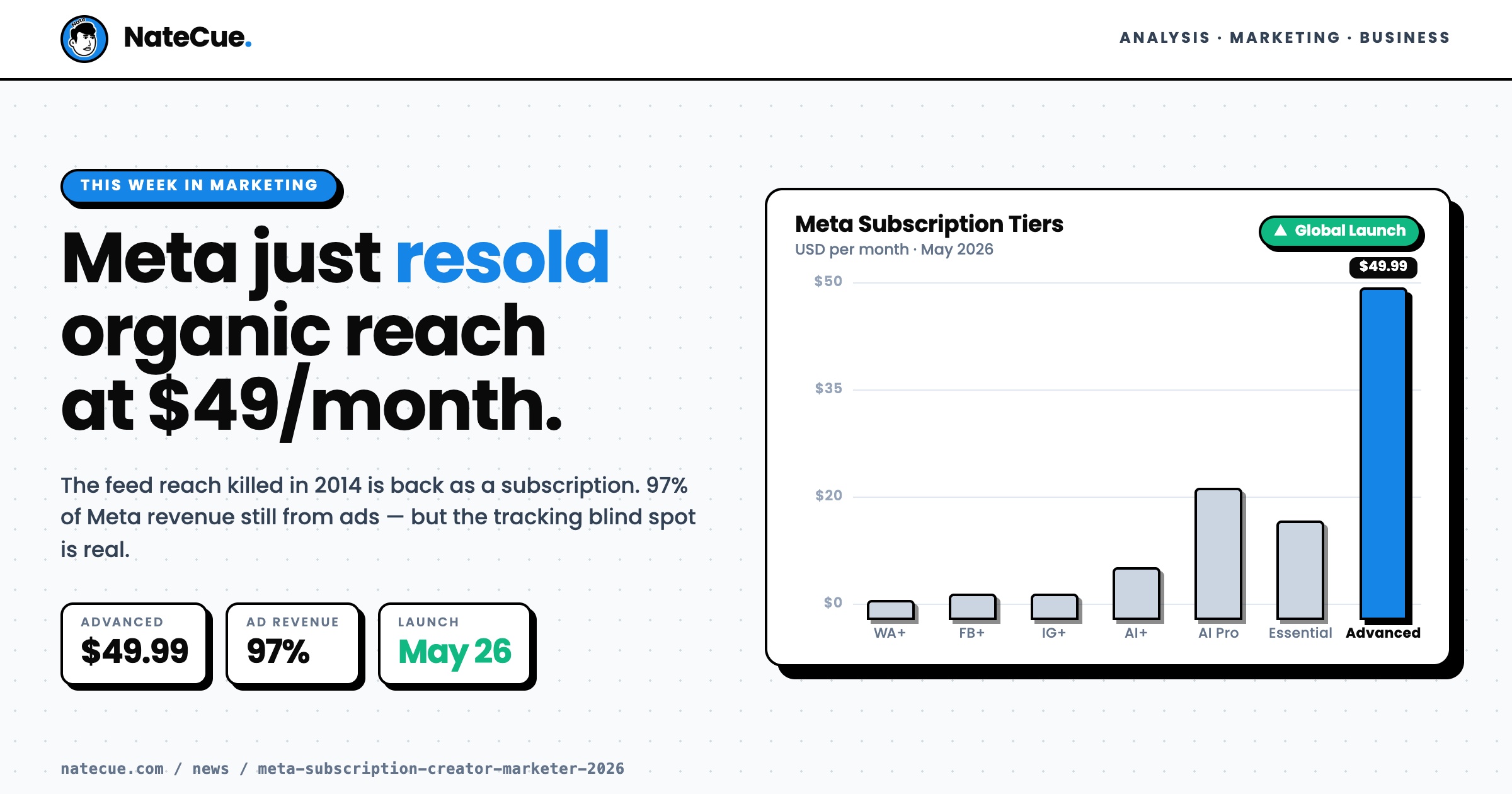
On May 27, 2026, Meta officially launched subscriptions globally across Instagram, Facebook, and WhatsApp. The cheapest tier starts at $2.99/month. The most expensive - Meta One Advanced at $49.99/month - sells creators something Meta took away for free in 2014: natural reach in the feed.
This is not a typical tech story. It is a marketing story.

Three Subscription Tiers and What Actually Matters
Meta structured subscriptions into three distinct groups targeting different segments.
Consumer tiers (live globally immediately):
- Instagram Plus: $3.99/month
- Facebook Plus: $3.99/month
- WhatsApp Plus: $2.99/month
Features are primarily customization - detailed Story analytics, custom reactions, themes, extended vanishing posts. Nice-to-have, not need-to-have.
Creator/Business tiers (testing in Saudi Arabia, Morocco, Thailand, Bangladesh):
- Meta One Essential: $14.99/month - verified badge, impersonation protection, enhanced analytics
- Meta One Advanced: $49.99/month - featured placement in Facebook feeds, higher visibility in search results, competitive analytics, content scheduling tools
AI tiers (testing next month in Singapore, Guatemala, Bolivia):
- Meta One Plus: $7.99/month
- Meta One Premium: $19.99/month - “deeper reasoning for complex tasks,” enhanced video/image generation
The number that matters most is not any of those prices. It is the phrase “featured placement in Facebook feeds” at $49.99/month. That is what marketers need to read carefully.
When Premium Users Disappear from Ad Tracking
Meta currently derives 97% of revenue from advertising (Mobikasa, 2026). Subscriptions will not replace that. But they create a tracking gap that most coverage is missing entirely.
When users pay for a subscription and opt out of ad personalization, they disappear from pixel tracking. These users are:
- Higher-spending (they are willing to pay $4-50/month for social media)
- More privacy-conscious than average
- High-value by every performance marketing metric
The result: when these users convert after encountering your ad somewhere in their journey, that conversion shows up as “direct” or “organic” in your Meta Ads dashboard. Your ROAS looks lower than it actually is. Budgets get cut based on incomplete data.
As Mobikasa analyzed, “server-side tracking is now essential infrastructure for ecommerce brands relying on Meta Ads” - no longer optional. This is the hidden cost that disappears in coverage focused on subscription pricing.
The Vietnam and Southeast Asia Picture
Vietnam has over 70 million Facebook users and 25 million Instagram users - one of Meta’s largest markets in Southeast Asia. WhatsApp sees limited adoption there because Zalo dominates local messaging.
Consumer subscription tiers ($3.99/month) will likely see minimal adoption in Vietnam. Three barriers:
- Payment infrastructure (international cards remain a barrier for most users)
- Cultural expectation that social media is free
- Features not compelling enough to change that expectation
But creator and business tiers are different. Meta is testing Meta One Advanced in Thailand - the Southeast Asian market closest to Vietnam in creator economy behavior and purchasing patterns. If those tests succeed, Vietnam is a logical next market.
For KOLs and agencies in the region, the practical question becomes: will you pay $49.99/month to maintain feed reach you currently get organically?
The 2014 Pattern Is Back
In 2014, Facebook changed its algorithm to reduce Pages’ organic reach. Brands that once reached 15-20% of their followers suddenly reached 2-5%. The only fix: pay to boost posts.
In 2026, Meta created “featured placement in Facebook feeds” as a subscription tier at $49.99/month. Mechanically, both are the same thing - you pay money to reach your own audience.
The difference: this time Meta is not changing the algorithm without warning. They are offering a “choice.” But that choice establishes a clear precedent - reach has a price, and that price is becoming visible.
The Vietnam market lived through the organic reach death of 2014-2016. Brands and creators who remember that shift won’t be surprised this time.
The question to answer now is not “should I subscribe?” - it is “which platforms am I building my audience on, and how much of that audience do I actually own?”
NateCue's Take
Meta isn't abandoning ads - 97% of revenue still comes from advertising. But subscriptions create a dangerous tracking blind spot: premium users - higher spending power, more privacy-conscious - will opt out of ad personalization. Their conversions show up as "direct." Your ROAS looks lower than reality. In Vietnam specifically, the consumer tiers ($3.99/month) will see minimal adoption due to payment infrastructure barriers and the cultural expectation that social media is free. But the creator tier ($49.99/month) is being tested in Thailand - the Southeast Asian market closest to Vietnam in creator economy behavior. The pattern here is recognizable: Meta is reselling the organic reach they removed in 2014, this time as a monthly subscription. Brands and KOLs who remember 2014 won't be caught off guard again.