
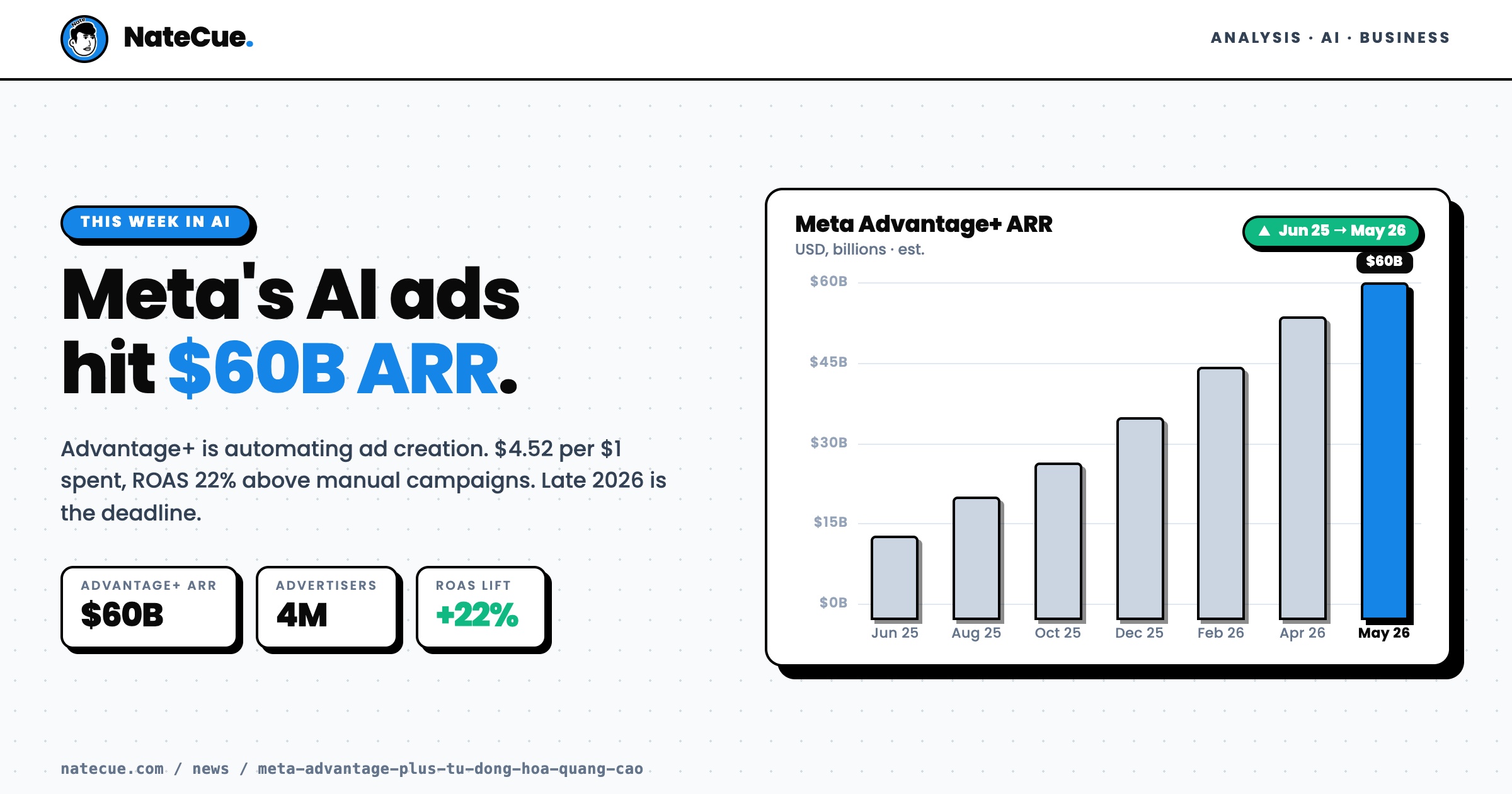
$60 billion a year. That’s the annual run-rate of ad spend Meta’s Advantage+ AI system is now managing in 2026. Not Meta’s revenue. This is advertiser money - billions of dollars in campaign budgets handed to an AI to allocate, optimize, and iterate without a human touching the dashboard.
And Mark Zuckerberg has set a hard deadline: by late 2026, Meta will fully automate the entire advertising creation and delivery process.
The Real Numbers Behind Advantage+
Advantage+ isn’t new. But its growth trajectory over the past twelve months is worth paying attention to.
According to Dataslayer research and Meta’s own newsroom disclosures, Advantage+ now delivers an average $4.52 return per $1 spent across advertisers using the system. That’s 22% higher ROAS than comparable manually managed campaigns. Not a theoretical benchmark - this is aggregated across millions of real campaigns.
The adoption curve is steep. The number of advertisers using Meta’s generative AI tools jumped from 1 million to 4 million in just six months. Meta’s video generation tools crossed a $10 billion annual run-rate in Q4 2025, growing quarter-over-quarter at nearly three times the pace of overall ad revenue.
This is unusually fast adoption even by Silicon Valley standards.
What Full Automation Actually Means
Zuckerberg’s vision for the end state is stark in its simplicity: give Meta your website URL and a budget, walk away. The AI generates creatives - images, video, copy - selects audiences, optimizes placement across Facebook and Instagram, and adjusts bids in real time. No manual audience segmentation. No A/B testing. No optimization rules.
This raises a direct question for performance marketers and agencies: what skills remain valuable when AI handles the optimization layer?
The broader martech landscape tells a similar story. Data from MarTech (Scott Brinker, 2026) shows 90.3% of marketing organizations now use AI agents in some capacity. But only 23.3% have full production deployment. The gap between “experimenting with AI” and “AI actually running operations” remains significant - and that gap is where real competitive advantage is being built or lost.
Vietnam and Southeast Asia: The Adoption Curve Reality
Vietnam’s position in this shift is particular. ICSC Vietnam’s March 2026 report frames the current moment as “no longer experimental, not yet mature.” Major players like FPT, Viettel, and VNG have invested heavily. But most of the market - especially SMEs - remains in early stages.
The counterintuitive insight from ICSC: SMEs actually have a structural advantage here. Lean operations, fewer legacy systems, and real cost pressure create conditions for faster adoption than large enterprises bogged down in procurement cycles and change management.
Agentic AI - autonomous systems that execute multi-step workflows - could let a 5-person team match the output of a 20-person operation, if deployed correctly. “Correctly” being the operative word. The ICSC report is clear: success depends less on which tools you choose and more on having process clarity before tool selection, and measuring against real business outcomes rather than AI usage metrics.
Across Southeast Asia, the scale of consumer AI adoption is already significant. Deloitte data shows nearly three-quarters of Asia Pacific consumers are already using AI to discover, compare, and evaluate products. Agentforce is now available in Vietnamese for the first time - a sign that enterprise AI vendors are betting on this market moving fast.
What Marketers Actually Need to Do
Gartner projects that by end of 2026, 40% of enterprise applications will include task-specific AI agents. Capgemini found 93% of business leaders believe scaling AI agents within 12 months is a competitive survival necessity.
At the advertising layer, the shift isn’t gradual. Meta, Google, TikTok are all pushing AI automation as the default, not the premium option.
This doesn’t mean manual campaign managers get replaced overnight. But the skill set needs to shift. From “knowing how to set up a campaign” to “knowing how to define objectives, evaluate creative direction, and read AI outputs to make strategic calls.”
That’s the difference between operator and strategist. AI becomes the operator. Marketers need to be the strategist.
The advertisers who figure out that divide - and invest in building the strategic layer while letting AI handle the execution layer - are the ones who’ll still be relevant in 2027.
Sources: Meta Newsroom (2026), Dataslayer Research, MarTech / Scott Brinker, ICSC Vietnam, Gartner / Capgemini / OneReach.
NateCue's Take
The $60B ARR is impressive. But the number that actually matters is 4 million advertisers already using Meta's GenAI tools - meaning millions of your competitors handed over creative and targeting decisions to AI six months ago. From what I see in Vietnam and Southeast Asia, two camps are diverging fast: performance agencies that have adapted their workflows around Advantage+, and brand/SME teams still running manual campaigns because they "want control." The irony is the second group thinks it's in control while falling behind the algorithm. The question is no longer whether to use AI. It's what you can do that AI can't. Creative strategy, brand positioning, cultural nuance - those are the irreplaceable human layers. Everything else is becoming infrastructure.