
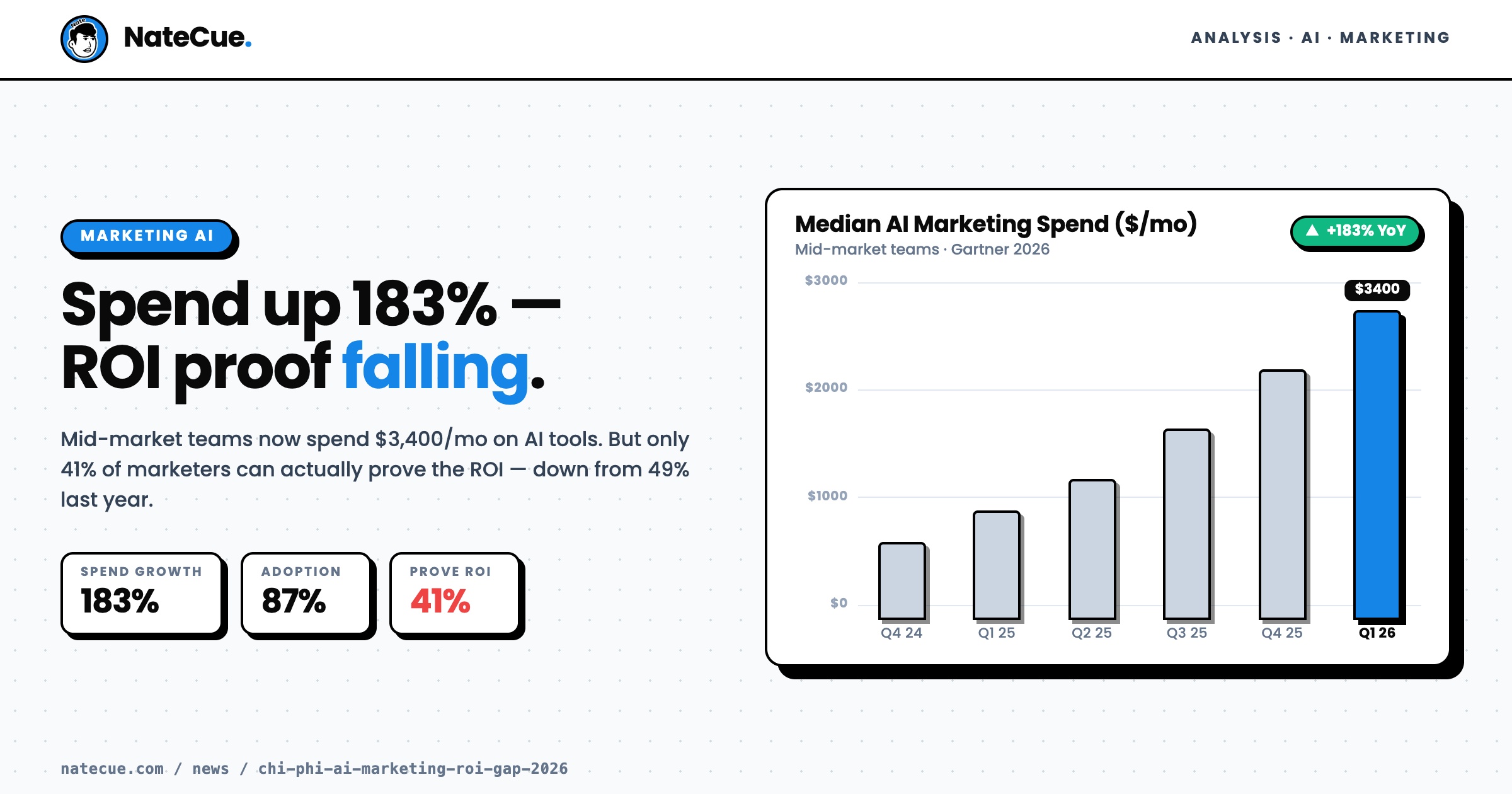
87% of marketers globally now use AI in at least one workflow (Salesforce State of Marketing 2026) - well past the “early majority” threshold. The median mid-market marketing team’s monthly AI tool spend jumped from $1,200 to $3,400 in just 12 months, a 183% increase (Gartner CMO Spend Survey 2026).
Then there’s the number moving in the opposite direction: only 41% of marketers can actually prove ROI from their AI investments - down from 49% last year (Company of Agents, 2026).
More spending. Less clarity. That’s the central tension in marketing AI right now.
Adoption Exploded. Measurement Didn’t Keep Up.
Two years ago, 51% of marketers used AI in their work. Now it’s 87%. That’s a 36 percentage point jump in 24 months - faster than any marketing technology adoption curve of the past decade.
But that adoption velocity is masking a structural problem. Most AI adoption is happening at the execution layer - writing content, generating images, drafting emails - not at the measurement layer.
HubSpot AI Trends 2026 reports that marketers save an average of 6.1 hours per week with AI tools and publish 4.1x more content per month. But when content output quadruples without equivalent upgrades to conversion tracking, you end up with more output and less clarity about what’s working.
The ROI Numbers That Are Real - And Why They’re Not Enough
McKinsey Global AI Survey 2026 shows clear ROI in specific applications: AI content drafting delivers 3.2x ROI, personalization engines 2.7x, audience research 2.4x. Average payback period has compressed to 4.2 months, down from 7.8 months in 2024.
These numbers are real. But they come from organizations that already had strong measurement foundations before adopting AI.
Most of the market isn’t there. Gartner predicts 40% of agentic AI projects will be cancelled before end of 2027 - primarily due to “unclear ROI and weak data governance.” Not because the AI failed to run, but because nobody could prove it was working.
The real question isn’t “does AI have ROI?” It’s “does your organization have the measurement infrastructure to see it?”
The True Cost of Marketing AI: Enterprise vs. SMB
Enterprise marketing organizations globally are now budgeting $24,000 to $48,000 per month on AI-specific tooling. Mid-market teams are at a $3,400/month median - which sounds smaller, but represents a 183% increase in 12 months.
For marketing teams operating on startup or SMB budgets - common across emerging markets including Vietnam - these figures are a useful reality check. The global benchmarks assume data infrastructure, attribution tooling, and dedicated AI operations staff that most teams don’t have.
The Vietnam Angle: Late Entry Is an Advantage Here
Vietnam ranks second in Southeast Asia for AI adoption, with 26.5% of the population using AI tools (Microsoft, 2026) - ahead of Malaysia at 21.8% and the Philippines at 20.1%.
But the business structure is different. Most marketing teams in Vietnam are SMB-scale or early-stage. AI tool budgets can’t scale the way global averages suggest.
That’s not a disadvantage in this context.
Vietnam’s AI Law, effective March 2026, introduced governance requirements around data privacy and usage transparency. Organizations that comply have to build the measurement and data governance infrastructure that the global market is currently missing. External regulatory pressure is forcing the foundational work that global enterprise teams are voluntarily skipping.
The market is spending 183% more on AI tools, but fewer people can prove those tools are working. For marketers operating with real budget constraints, the lesson isn’t “spend more to catch up.” It’s: build your measurement model before your next subscription renewal.
Because without attribution clarity, AI doesn’t fix your marketing. It just scales your uncertainty.
NateCue's Take
The trap isn't that AI doesn't work. The trap is that marketing teams are using AI to produce more - content, campaigns, reports - without building the attribution infrastructure to know what's actually driving revenue. 4.1x more content doesn't compound if you can't trace which content converts. For teams in markets like Vietnam with tighter budgets, this constraint is actually an advantage: you can't afford to run tools you can't measure. Fix your attribution model before buying another AI subscription. If you don't know what's driving revenue today, AI will just help you do the wrong thing faster.