
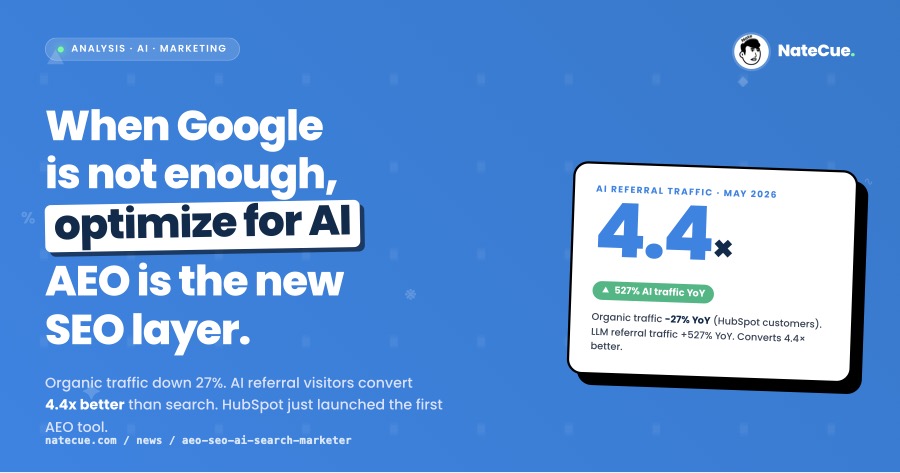
HubSpot just published a number that should make every marketer uncomfortable: organic traffic across their customer base fell 27% year-over-year. At the same time, AI referral traffic grew 527%.
That is not noise. It is the clearest data signal yet that the search landscape is being restructured around AI answer engines - ChatGPT, Gemini, Perplexity - not just Google.

The Traffic Shift Has Arrived
AI-referred traffic currently represents roughly 1% of total site traffic across the industry. That sounds small until you look at the conversion data.
LLM-referred visitors convert 4.4 times better than organic search visitors (CMSWire, 2026). People who find your brand through an AI answer engine arrive pre-sold. The AI already recommended you. They are clicking through to confirm or act - not to browse.
The 527% year-over-year growth rate puts that 1% in context. At that compounding pace, AI referral traffic could represent 5-10% of total traffic within 18 months. Brands building AEO presence now accumulate citation history and entity authority before that inflection - the same compounding advantage that early movers in organic SEO enjoyed in the 2010s.
Why AEO Breaks Traditional SEO Logic
Standard SEO playbook: rank top 10 for target keywords. Protect those positions with backlinks and authority.
AEO does not work that way.
Ahrefs research found that ChatGPT Search primarily cites pages ranked at position 21 and below - roughly 90% of citations come from outside the conventional top-20 results. AI answer engines care about content directness, structural clarity, and topical authority - not raw domain metrics.
To appear in AI answers, content needs to:
- Answer the question in the first sentence, not after a preamble
- Use H2/H3 headers framed as questions with direct answers beneath
- Build named entity recognition - brand, product, founders cited consistently across sources
- Earn cross-source citations that signal expertise to AI training and retrieval systems
This is a fundamentally different discipline from traditional backlink-and-authority SEO. The playbook needs to be rebuilt, not tweaked.
What HubSpot AEO Actually Offers
At their Spring 2026 Spotlight event, HubSpot launched HubSpot AEO - positioning it as the first dedicated Answer Engine Optimization product integrated into a major marketing platform.
The key differentiator from general SEO tools: HubSpot uses each customer’s own CRM and marketing data to surface the prompts their actual buyers are likely using in AI search. Not keyword research guesswork - signals from your real pipeline.
Core capabilities:
- Competitor benchmarking: See where your brand appears in AI search results compared to direct competitors
- Citation analysis: Understand which AI engines cite your content and in what context
- CRM-powered prompt intelligence: Prompts derived from real customer behavior, not assumptions
- Prioritized recommendations: Ranked list of content improvements by estimated AEO impact
Pricing: $50/month standalone or included in Marketing Hub Pro and Enterprise.
Early beta users reported 20% higher AI referral traffic compared to brands not using AEO strategies (HubSpot, 2026).
The Southeast Asia Opportunity Window
Vietnam and broader Southeast Asia are still in early-stage AI search adoption. Google remains dominant for the vast majority of searches. ChatGPT usage is growing but has not reached the saturation levels seen in the US or Western Europe.
This is not a reason to wait. It is a reason to move faster.
When AI referral traffic is still nascent in a market, the competitive landscape for AI citations is sparse. There are fewer brands actively building AEO infrastructure, which means lower competition for the same citation opportunities. The authority compounds before the rush arrives.
Three practical starting points:
- Content audit for Q&A structure: Find existing articles that answer specific questions. Restructure them with question-format H2/H3 headers and direct answers in the first sentence of each section.
- Entity consistency sweep: Ensure your brand name, products, and key people are referenced uniformly across your website, social profiles, and any third-party coverage.
- AI visibility monitoring: Tools like HubSpot AEO, Semrush’s AI Visibility feature, or Brand24 can track where and how your brand appears in AI-generated answers.
AEO is not a replacement for SEO. It is the next layer being built on top of it. The infrastructure choices made in the next 12 months will determine who owns AI search visibility in the following five years.
The window for low-competition AEO positioning is open. That will not be true indefinitely.
NateCue's Take
The 4.4x conversion rate from AI referral traffic is the number that matters most here. It means users who find you through ChatGPT or Perplexity are arriving pre-qualified - they've already received an AI-generated answer and are clicking through to act. Brand visibility in AI answers is now a conversion channel, not just a branding play. The twist most marketers miss: ChatGPT Search cites pages ranked position 21 and below roughly 90% of the time. This breaks traditional SEO logic entirely. For smaller brands with direct, well-structured content that answers specific questions - AEO is genuinely more democratized than Google ever was. From the Vietnam and Southeast Asia angle: AI search penetration is still lower here, which means the competitive landscape is emptier. Brands that build AEO infrastructure now are planting flags before the rush. That window will close - the question is how fast.