
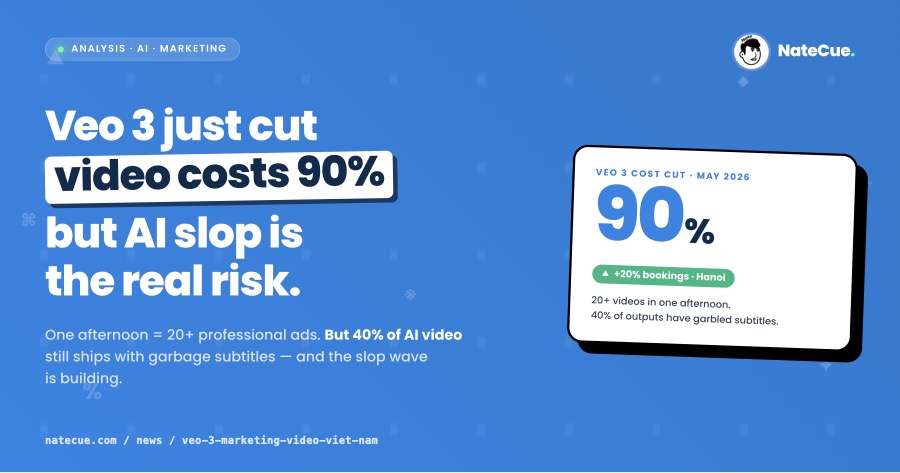
A Hanoi transport company increased bookings by 20% after switching to Veo 3 for marketing videos. A UK organic food brand generated 20+ commercial videos in one afternoon at less than 10% of traditional agency cost. Google’s Veo 3 just reset the baseline for what video marketing production requires.
But 40% of those outputs still carry unwanted garbled subtitles. And when production barriers drop, the AI slop wave follows fast.

One afternoon instead of three weeks
The Wild Hare Group needed launch content for 53 Tesco locations with a two-week deadline. Budget: £20,000. Normal agency timeline: 3 weeks to source animation partners, scope the work, and run revisions.
With Veo 3: first video in 30 minutes. Over 20 video assets - from short GIFs to 30-second clips - in one afternoon. Production cost: under 10% of traditional animation agency rates (Think with Google, 2026).
This is Google’s own published case study, which means it represents an ideal scenario. But the underlying dynamic holds: the threshold to test a video idea just dropped to near zero for any marketer with a Gemini account.
What Veo 3 actually does and doesn’t do
Veo 3 generates 4-8 second clips at up to 4K resolution in both 16:9 and 9:16 - native aspect ratios for Reels, TikTok, and YouTube Shorts. Its key differentiator: audio is generated inline alongside the video. Background music, sound effects, and dialogue are produced in a single pass, not synced afterward.
On Meta’s MovieGenBench (1,003 prompts), Veo 3.1 leads on visual quality, prompt adherence, and overall preference versus competing models (Google DeepMind, 2026). This is a competitor’s benchmark - not Google’s - which makes the data more credible than most AI performance claims.
In Vietnam, Veo 3 is accessible via the Gemini app. A Vietnamese auto accessories retailer generated 60 million VND in monthly revenue from Veo 3-powered marketing content (RMIT Vietnam, 2026). The free tier offers 10 generations per month with an 8-second cap per clip.
The subtitle problem - and the slop risk underneath it
MIT Technology Review documented a persistent and damaging bug: Veo 3 adds random nonsensical subtitles to generated clips even when explicitly prompted not to include captions. An advertising creative cited in the report estimated up to 40% of outputs have garbled subtitles that render clips unusable (MIT Technology Review, 2025).
The technical root cause: the model was trained on YouTube and TikTok content where embedded captions are common, so it learned that subtitles are normal. Fixing this would require retraining from scratch - not a quick patch. Google announced a fix in June, but the issue persisted a month later.
The deeper problem is what low-cost production does to the content ecosystem. Al Jazeera documented cases of Veo 3 being used to generate realistic protest footage and fake disaster videos - convincing enough to spread before fact-checking caught up (Al Jazeera, 2025). For brands, this creates a genuine brand safety risk: when AI-generated content occupies the same feed as deepfakes, users lose trust in legitimate content too.
What the Vietnam market tells global marketers
RMIT Vietnam frames the right question: not “will AI replace creators?” but “what will creators do that AI can’t?”
The Vietnam results are instructive on both sides. A Hanoi transport company saw a 20% booking increase - not because video was cheap to produce, but because the message matched what customers needed to see. An auto accessories retailer hit 60M VND monthly - not from volume, but from content relevance.
Two practical limits for teams considering Veo 3 at scale: the free tier’s 10 videos per month and 8-second clip cap are enough for concept testing but not campaign execution. Scaling to 1,000 videos per month requires a Google AI Ultra subscription - meaningful cost for smaller teams. The per-generation cost structure pushes toward quality over quantity, which is exactly the right constraint.
For marketers: Veo 3’s real value is compressing the concept validation loop. Test 10 different visual directions in a day before committing to a shoot. Iterate on hook formats, talent options, and visual styles without agency timelines. That feedback compression is what actually changes output quality - not replacing production with unlimited AI-generated volume that nobody asked for.
NateCue's Take
Veo 3 isn't a threat to video agencies - it's a test of creative direction. Production cost is approaching zero, but the cost of bad ideas just went up. When anyone can generate a visually polished video from a text prompt, the only differentiator is judgment: knowing what's worth making, and what isn't. The Vietnam data is instructive - a Hanoi transport company saw 20% more bookings not because the video was cheap, but because the message was right. The marketers who win with Veo 3 will be the ones who use it to pressure-test 10 concepts in a day, not the ones who use it to flood their channels with 100 pieces of content nobody asked for.