
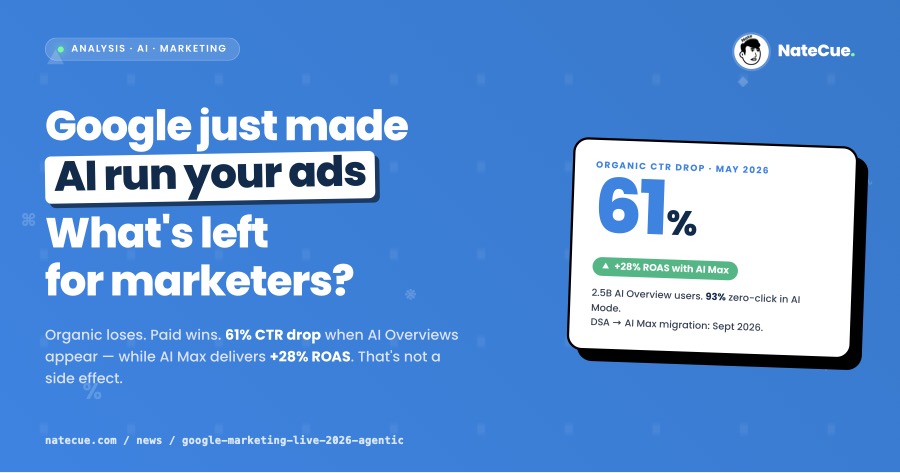
Organic click-through rate drops 61% when an AI Overview appears (Dataslayer, 2026). At the same time, Google is reporting ROAS gains of 15-28% for AI Max adopters. These two numbers aren’t contradictory - they’re the same plan, viewed from opposite sides.
Ask Advisor: One Agent Across the Entire Stack
Google Marketing Live 2026 (May 20) introduced Ask Advisor - a Gemini-powered agent that runs continuously across Google Ads, Analytics, Merchant Center, and Marketing Platform.
Previously, each product had its own AI assistant. Now there’s one unified agent. You ask “find new customers for my hair care products” - Ask Advisor pulls product data from Merchant Center and builds the campaign in Google Ads automatically.
It positions directly against Meta Advantage+ and Microsoft’s Copilot. Google’s differentiator: cross-product orchestration across ads, analytics, commerce, and measurement simultaneously - not just within one platform.
Ask Advisor is currently in beta for English-language accounts. Non-English markets, including Vietnam, have no announced timeline.
Paid Traffic Wins, Organic Loses - By Design
Place the numbers from Google I/O and Marketing Live side by side:
- 2.5 billion monthly active AI Overview users (Google, 2026)
- 1 billion AI Mode users, with 3x longer average sessions
- 60% of all Google searches now end without a click - in AI Mode, that climbs to 93% (Search Engine Land)
- Organic CTR drops 61% when an AI Overview appears (Dataslayer, 2026)
- HubSpot lost 70-80% of organic traffic between November 2024 and Q2 2025
Meanwhile, on the paid side:
- AI Max and Performance Max deliver 15% more conversions at the same ROAS (Google, 2026)
- Lufthansa Group saw 24% ROAS improvement with AI Max
- IKEA achieved 65% non-branded click lift and 28% incremental ROAS boost
Google is engineering a system where organic traffic gets squeezed while paid traffic benefits from increasingly capable AI optimization. That’s a business model decision, not a technical side effect.
September 2026: The Forced Migration Most Advertisers Don’t Know About
The most significant announcement from GML 2026 isn’t Ask Advisor:
Dynamic Search Ads (DSA) will automatically upgrade to AI Max in September 2026.
No opt-in required. No option to stay on the old DSA format. And per VP Vidhya Srinivasan: “You can’t choose keywords anymore.”
Starting September, appearing in new AI Search experiences - Direct Offers, AI-powered shopping ads, Business Agent for Leads - requires either AI Max for Search or Performance Max with text customization.
Advertisers running DSA without awareness of this migration face sudden performance shifts when it happens. No warning, no gradual rollout.
Where Vietnam Fits in This Shift
Google AI Mode hasn’t launched in Vietnam. AI Overviews haven’t fully rolled out there either.
That means:
- Organic SEO in Vietnam hasn’t taken the same hit as US markets - yet
- But AI Max and Performance Max are fully operational in Vietnam today
- The September DSA migration will affect all accounts globally - including Vietnam
The practical gap: most small-to-medium advertisers in Vietnam run Google Ads with manual CPC or basic target CPA. First-party data infrastructure is underinvested. Conversion tracking is often incomplete.
AI Max needs strong signal to perform well. With weak data foundations, AI Max doesn’t rescue you - it optimizes harder in the wrong direction, with less transparency than manual campaigns. That’s a compounding problem.
What Remains When AI Handles Execution
Selin Song, speaking at GML 2026, offered a line worth sitting with: “When the technical side becomes easier for everyone, your true edge comes back to what only you can provide: your strategy.”
This is both true and Google’s marketing copy. Both can be correct.
AI is genuinely better than most humans at bidding, targeting, and creative rotation for many tasks. And Google needs advertisers to believe they’re still valuable - so they keep buying ads.
The real question isn’t which side to pick. It’s understanding the boundary: what AI does better, and which business judgment still requires humans.
Universal Cart, Universal Commerce Protocol, Business Agent for Leads - Google is building infrastructure for a world where intent-to-purchase happens inside the Google ecosystem. Every transaction within that loop generates more data, which makes the AI better, which makes the paid ecosystem more attractive.
Where marketers stand in that loop depends entirely on the quality of data they’re feeding into it.
NateCue's Take
The September 2026 DSA-to-AI-Max forced migration tells you everything about where this is heading. Google isn't asking for your permission to hand execution over to AI - it's doing it anyway. The real question for marketers isn't "will AI replace me?" It's "what do I actually own that AI can't replicate?" First-party data, genuine business context, and knowing which decisions should never be automated - those are the defensible edges. For Vietnam specifically: most advertisers I see are running basic manual CPC or target CPA with incomplete conversion tracking. AI Max needs clean signal to perform. If your data foundation is weak, AI Max doesn't save you - it just optimizes harder in the wrong direction, invisibly. That's a harder problem than the AI itself.