
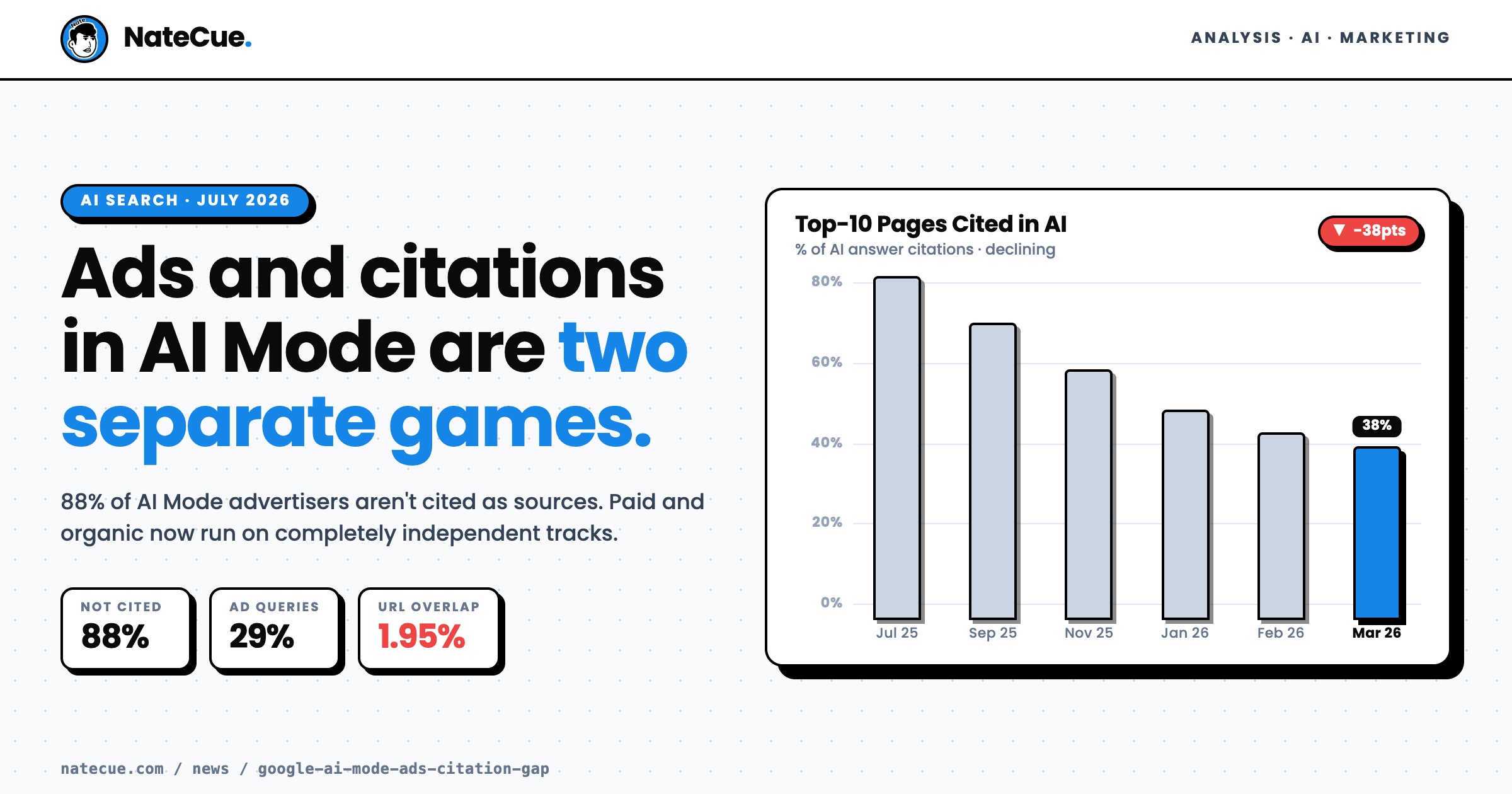
On June 30, 2026, SE Ranking analyzed 50,032 commercial keywords in Google AI Mode and found this: 88% of advertisers paying for ad placements were not cited as sources in the AI-generated answer on the same page. Not 20%. Not 50%. 88%.
One in Three Commercial Queries Now Shows Ads
29.45% of the 50,032 keywords analyzed returned text ads in AI Mode (SE Ranking, 2026). That’s higher than most marketers expected - and enough to force every PPC team to reassess how they think about AI search.
The distribution is nothing like traditional Google Search. Cost-per-click is the strongest predictor of ad presence, far outweighing search volume or keyword difficulty:
- Sub-$2 CPC keywords: 24.33% ad presence
- $2-$10 CPC keywords: 32.45%
- $10+ CPC keywords: 53.56%
When ads do appear, 71.1% of results show two competing ads in the same block simultaneously. Vertical matters enormously - Pets tops the chart at 72.38%; Healthcare sits at 2.64%.
The access requirement is strict: only Performance Max and AI Max for Search campaigns can place in AI Mode ad slots. Standard Search campaigns are excluded.
Buying Ads Doesn’t Get You Cited - And Ranking Doesn’t Get You Ads
This is the finding that upends the most assumptions.
Only 11% of advertising domains appeared as cited sources for the same keyword they bid on. At the exact-URL level, that drops to 1.95%. Meanwhile, 85% of AI Mode advertisers had no organic ranking for the keywords they were paying to advertise on (SE Ranking, 2026).
The practical read: you can run AI Mode ads without any SEO presence. You can be cited as an AI source without buying any ads. The two systems do not influence each other.
The study’s conclusion: “The ad slot is a paid-media decision; being cited is an authority-and-content decision, and neither one moves the other.”
This isn’t a new principle in digital marketing - paid and organic have always been separate. But the assumption many brands still carry into AI search is that their existing brand authority will automatically translate into AI citations, or that ad spend signals relevance to the AI system. Neither holds up.
Vietnam’s Window: Leading Southeast Asia Adoption
AI Mode is currently US-only. But data from the Google Gemini Southeast Asia Report 2026 gives context for why Southeast Asian teams - particularly in Vietnam - should be thinking about this now.
Vietnam leads Southeast Asia in Gemini adoption speed. 89% of Vietnamese users’ prompts are submitted in Vietnamese, the highest native-language rate in the region. Active Gemini users across Southeast Asia more than doubled in a single year. YouTube ads deliver 2.9x higher ROI than traditional TV for Vietnamese audiences.
When Google extends AI Mode into Southeast Asia, the demand-side behavior is already there. The gap is in preparation, not in user intent.
Marketers in Vietnam have a brief window where this plays out in a foreign market. The right move is to understand the mechanics before it arrives on home ground - not to wait and adapt.
Two Budgets, Two Strategies, Two Sets of KPIs
The practical output from this research: paid AI Mode ads and organic citation should never share a budget line, a reporting dashboard, or an optimization strategy.
To run ads in AI Mode: Bid aggressively on high-CPC keywords, run Performance Max or AI Max campaigns, track ad frequency by vertical. This buys immediate visibility without requiring domain authority.
To earn citation in AI answers: Invest in content authority, brand mentions across platforms, YouTube presence (YouTube mentions predict AI citation likelihood at 0.737 correlation - versus backlinks at 0.218). This is a long-term build that can’t be bought with ad spend.
The brands that keep measuring AI search performance through a traditional SEO lens will be misreading their own numbers. Google has created two distinct types of visibility inside the same search interface - and they respond to entirely different inputs.
NateCue's Take
The implication most brands will miss: domain authority no longer predicts either paid or organic performance in AI search. A high-CPC keyword in the right campaign type gets you into AI Mode ads, regardless of whether your SEO is strong. Being cited as a source in AI answers depends on brand authority signals like YouTube mentions and cross-web presence - not backlinks, not ad spend. For lean teams and SMEs, this is actually an opening. You can compete in AI Mode ads without winning at SEO first. But the opposite trap is real too: brands that assume their established organic authority will auto-translate into AI citations are in for a rough quarter. Vietnam is watching this play out from the outside right now - but given the fastest Gemini adoption pace in Southeast Asia, that window won't stay open long.