
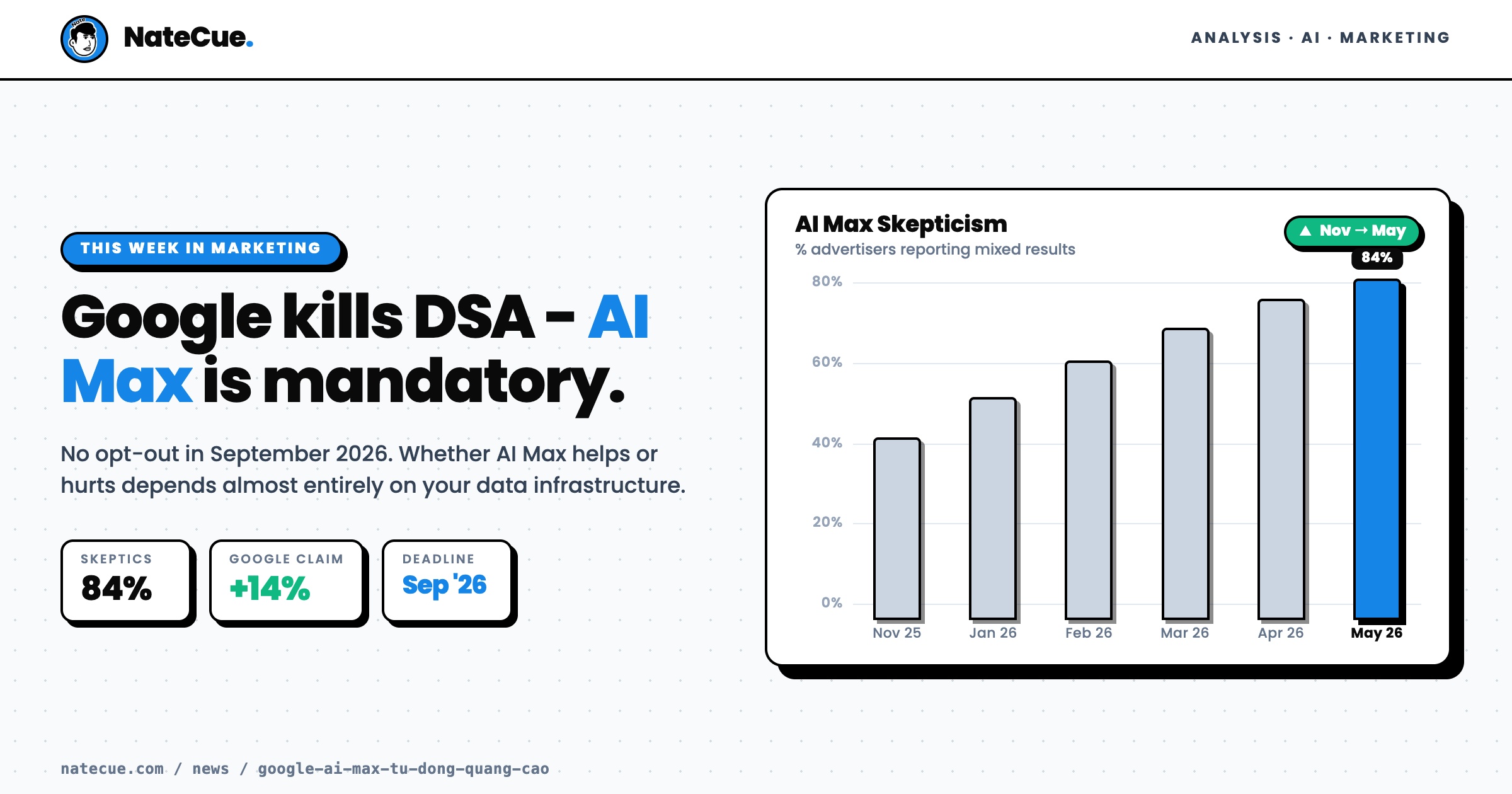
In September 2026, Google will retire all Dynamic Search Ads - with no opt-out. If you don’t migrate yourself, Google will do it for you, with default settings you never chose.

What Google AI Max Is and Why the Timing Matters
AI Max for Search launched at Google Marketing Live in May 2025. One year later, Google calls it “the fastest-growing AI-powered Search ads product” in its history (Google Blog, 2026), with hundreds of thousands of advertisers now running it globally.
The core mechanism differs fundamentally from DSA: instead of crawling your website and matching queries by rigid rules, AI Max combines broadened match, AI-generated ad copy, and final URL expansion into a single system. You configure less. The algorithm decides more.
In April 2026, Google introduced AI Brief - a new way to steer AI Max using plain language. Instead of adjusting individual settings, you write a brief describing your business, desired messaging, target audiences, and what the AI should never say. Gemini translates that into campaign parameters across three layers: Messaging Guidelines, Matching Guidelines, and Audience Guidelines.
AI Max has also expanded to Shopping campaigns via Merchant Center feeds and consolidated travel ad formats - booking links, promotion ads, and text ads - under unified AI-driven reporting.
The Performance Gap: Official Claims vs. Independent Testing
Google’s internal data shows strong numbers: advertisers using the full AI Max feature suite see an average 7% increase in conversions at similar CPA or ROAS - with some campaigns hitting 14% lift (Google Blog, 2026).
Independent testing from JumpFly (April 2026) tells a different story: CPCs tend to drop, but conversions come in “flat to incrementally better” - a long way from the 14% Google reports. An industry survey found 84% of advertisers report neutral or negative results after switching.
This contradiction doesn’t mean AI Max is broken. It means performance depends almost entirely on account data quality: conversion tracking depth, audience signals, first-party data feed. Strong-data accounts see the lift. Thin-data accounts get AI making expensive guesses.
September 2026: The Forced Cutover With No Off-Ramp
This is the most critical fact most advertisers haven’t fully processed.
From September 2026:
- No new DSA campaigns can be created via Google Ads, Google Ads Editor, or the API
- Any campaigns not manually migrated will be automatically upgraded by Google with default settings
- Ad group structures may be flattened in the process
Phase 1 (voluntary migration) is open now. Google provides tools to carry over campaign history, settings, and data into standard ad groups. This is the controlled window.
Industry analysts flag that high-volume accounts where DSA represents more than 50% of the search mix - particularly non-ecommerce accounts without Shopping as a fallback - face “disproportionate operational complexity” during forced migration.
Google VP Brendon Kraham stated plainly: “The future is definitely more automated.” AI Brief is Google’s way of keeping marketers feeling like they’re still in control. But 25 exclusion terms and 40 messaging restrictions aren’t keyword-level control - they’re guardrails on a vehicle you no longer drive (Marketing Brew, 2026).
What This Means for Vietnam and Emerging Markets
The stakes are real for markets like Vietnam, where Google holds 28.4% of digital advertising market share and search advertising generates $622.7 million annually - the primary performance channel for most SMBs (Digital in Asia, 2026).
DSA became popular in Vietnam for practical reasons: fast setup, automatic website crawling, no need for a dedicated PPC specialist. That’s exactly the profile of businesses most exposed to a forced migration with poor default settings.
The actual risk breakdown:
SMBs running DSA at $500-1,000/month with basic tracking: When AI Max optimizes on thin conversion data, it will optimize toward the wrong signals. Budget gets spent in the wrong direction at scale.
Agencies without AI Max experience: September becomes crisis management, not planned migration. Phase 1 is open now - this is the moment to build experience under controlled conditions.
Advertisers with strong Merchant Center feeds and reliable conversion tracking: This is the ideal window to test AI Max for Shopping before the forced cutover.
89% of Vietnamese businesses have integrated AI into marketing according to MMA Vietnam (2024) - but most of that is content AI: chatbots, copywriting tools. Paid ads AI is different territory. It requires data infrastructure: reliable conversion events, CRM integration, first-party audience feeds. Without these, AI Max’s “optimization” is guesswork with your budget.
The question to answer before September isn’t about campaign structure. It’s simpler: does your conversion tracking have enough signal volume for AI Max to optimize responsibly? If not, that’s the real deadline.
NateCue's Take
The real issue isn't whether AI Max performs better than DSA - independent tests show mixed results at best. The issue is choice: you no longer have it. Google is doing what Meta did with Advantage+ - wrapping the entire ad stack in AI and calling it optimization. AI Brief sounds like a concession to marketer control. It isn't. 25 exclusion terms and 40 messaging rules aren't keyword-level control. They're guardrails on a car you no longer steer. The winners in the AI Max era aren't those with better creative. They're brands with clean CRM data, reliable conversion tracking, and first-party signals to feed the algorithm. For SMBs running DSA on thin data - especially in markets like Vietnam where many businesses lack proper tracking infrastructure - September is a hard deadline to get data-ready, not just campaign-ready.