
One developer on Copilot Pro+ paid $39 a month. On June 1, they opened their laptop and found 82% of their monthly AI Credits gone — after a single work session. GitHub had changed how it charges, and the math no longer worked the way anyone expected.

How the new billing model works
Effective June 1, 2026, GitHub replaced Premium Request Units with AI Credits across all Copilot plans. The rate: 1 AI Credit = $0.01 USD, metered against token consumption — input, output, and cached tokens — “according to the published API rates for each model” (GitHub Blog, 2026).
Surface prices stayed the same: Pro at $10/month, Pro+ at $39/month, Business at $19/user/month, Enterprise at $39/user/month. But these numbers are now monthly allowances, not uncapped ceilings. Run through your allotment and you either pay more or stop.
What remains free: inline code completions and next-edit suggestions — the basic autocomplete layer. Everything more interesting — Copilot Chat, agentic coding sessions, Cloud Agents, code review — costs credits.
Agentic workflows are expensive by design
The tension here is not the price change itself. It is that agentic AI consumes compute in a fundamentally different way than a chatbot does.
When you ask a chatbot a question, the model makes one call and responds. When you ask Copilot to “write unit tests for this entire module” in agent mode, it reads the codebase, plans the approach, writes code, runs tests, catches errors, iterates. Each step consumes tokens. Each token spends credits.
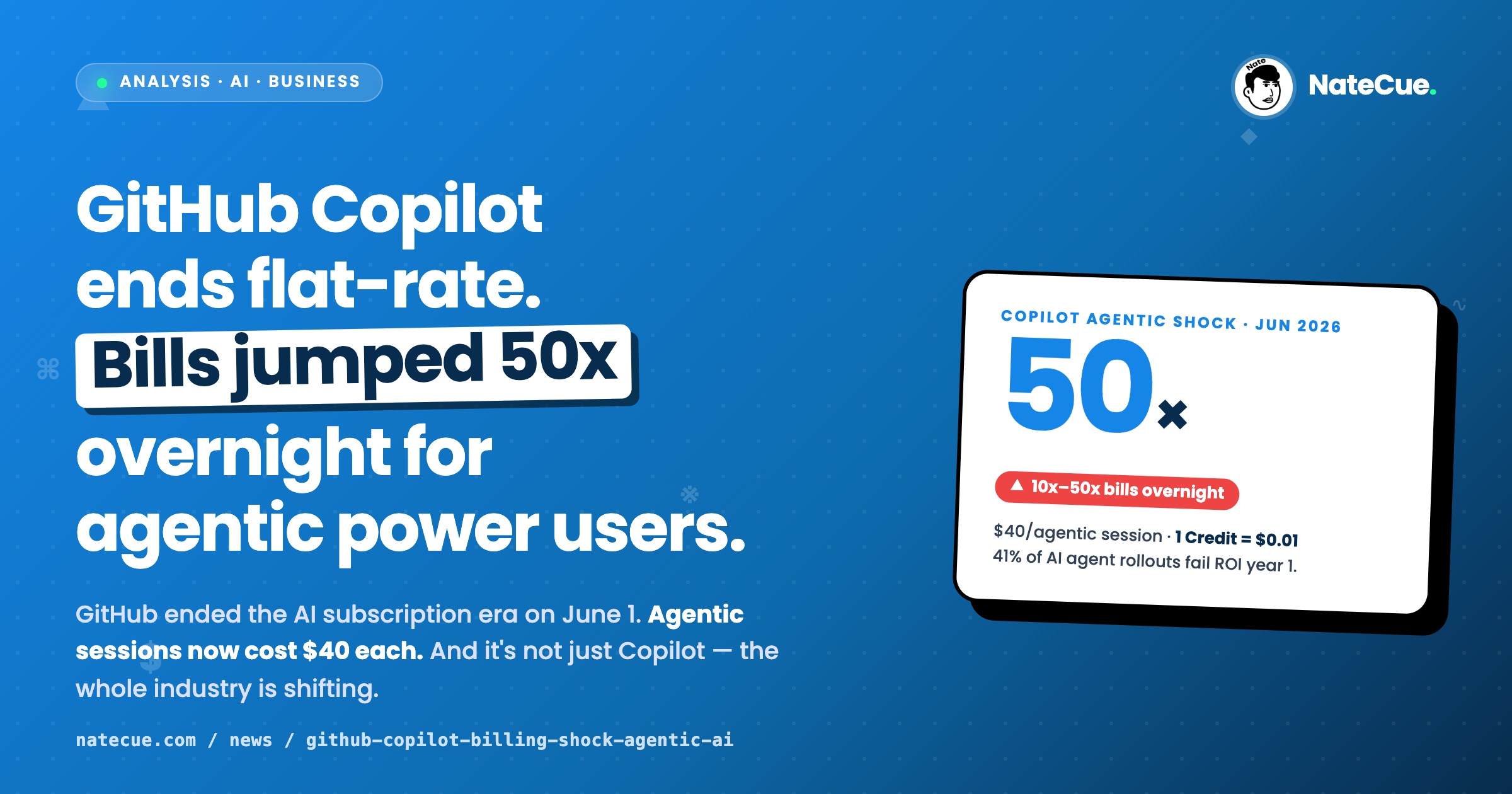
The result: developers using agentic workflows are seeing bills jump 10x to 50x versus expectations (TechTimes, 2026). A single complex agentic session can cost $40. A 50-person engineering team could now spend $5,000-$15,000 per month on AI coding tools alone — before cloud infrastructure costs (Developers Digest, 2026).
GitHub’s own explanation: the “current premium request model is no longer sustainable” given Copilot’s evolution into “an agentic platform capable of running long, multi-step coding sessions.” Translation: flat-rate pricing cannot cover the real inference cost of agentic AI at scale.
GitHub is not alone — the whole industry is moving this direction
Cursor made the same shift from request-based to credit-based billing in 2025. Windsurf overhauled its pricing twice over the same period. Claude API and OpenAI API have always been usage-based. The transition is already complete across most of the AI coding stack.
The underlying economics are straightforward. Longer context windows, multi-step reasoning loops, repeated model calls per task — inference costs compound quickly. No provider can sustainably absorb those costs into a fixed monthly fee once agentic workflows become standard usage, not edge cases.
The pattern is clear: the all-you-can-eat AI subscription era is ending. What is replacing it looks like cloud infrastructure billing — metered, capable of genuine surprises at month-end if unmanaged, and requiring the same governance discipline that mature engineering teams already apply to compute spend.
What this means for teams in Vietnam and Southeast Asia
Most tech startups and agencies in Vietnam chose GitHub Copilot Business ($19/user/month) precisely because it was predictable. That predictability is now conditional on how developers use the tool.
Common patterns in regional teams: no one tracking AI usage, developers running agent mode freely across all tasks, AI budgets calculated per seat rather than per token. All three of these assumptions now carry real financial risk.
Three adjustments worth making immediately:
Audit before scaling. GitHub launched a preview billing dashboard in May — check your team’s actual credit consumption rate before adding seats or expanding agentic features organization-wide.
Match model intensity to task complexity. Use powerful models and agent mode for high-stakes work — complex debugging, large-scale refactors. Default to inline completion (still free) for routine autocomplete tasks.
Set spending caps. Budget controls exist at the enterprise, cost-center, and user level in Copilot Business. These are no longer optional settings with usage-based billing in place.
The underlying data reinforces the urgency: only 41% of agentic AI rollouts achieve positive ROI within 12 months (Digital Applied, 2026). The primary failure mode is untracked usage costs eroding the productivity gains. Teams that learn to optimize AI spend — not simply maximize AI usage — will hold a durable structural advantage.
NateCue's Take
This billing shock was predictable. The subscription fee was never the real cost of AI — it was the surface. The real cost is token consumption inside agentic loops, context windows reloaded across multiple steps, and the compounding inference bill from what looks like "one simple task." The broader signal matters more than the GitHub-specific change: Cursor, Windsurf, Claude Code, OpenAI Codex — everything is moving to metered billing. Flat-rate was always a user acquisition phase, not a sustainable model. For teams in Vietnam and Southeast Asia, this is a forcing function to build actual AI cost governance: budget owners, spending caps, usage dashboards. The teams that learn to get more ROI per credit — rather than simply consume more — are the ones who will compound over time. Speed of adoption no longer matters as much as efficiency of adoption.