
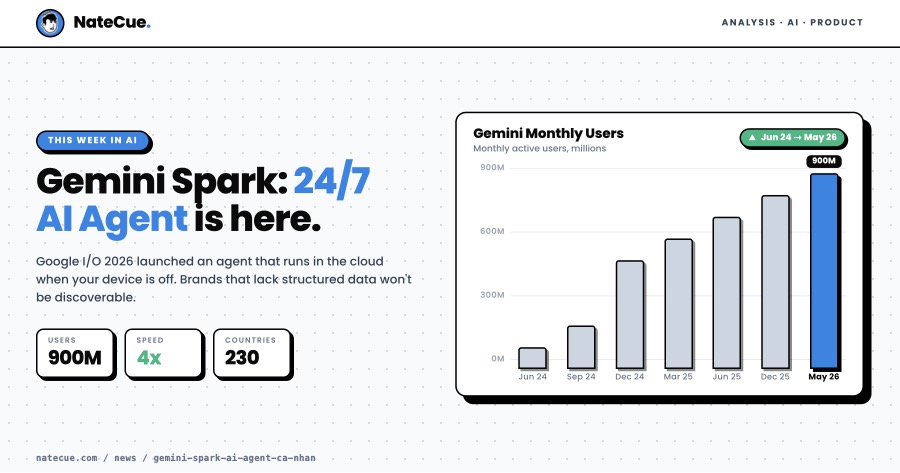
Google has 900 million monthly Gemini users across 230 countries. As of May 19, 2026, it wants all of them to have a personal AI employee - running 24/7, cloud-side, even when their device is off.
Gemini Spark is not a chatbot upgrade. It is a fundamental shift from question-answering to execution.
Not a Chatbot - A Cloud-Running Agent
The core distinction: Spark runs on dedicated Google Cloud virtual machines, independent of any user device. You close your laptop, Spark keeps working.
Google’s I/O 2026 demos were specific. Spark can synthesize notes across multiple emails and meetings, create a polished Google Doc, and draft a follow-up email - all in one uninterrupted workflow. It monitors inboxes for customer inquiries. It scans monthly credit card statements to surface hidden subscription fees. It extracts school deadlines from emails and delivers scheduled digest summaries to parents.
The model underneath: Gemini 3.5, running on Google’s Antigravity agentic harness. Performance data from Google DeepMind puts Gemini 3.5 Flash at 4x the speed of comparable frontier models, outperforming its predecessor Gemini 3.1 Pro on nearly all benchmarks. An optimized variant hits 12x faster while maintaining quality.
Control mechanism: Spark requests user confirmation for high-stakes actions - spending real money, sending emails from your account. Users opt in per-app. Nothing runs without explicit connection approval.
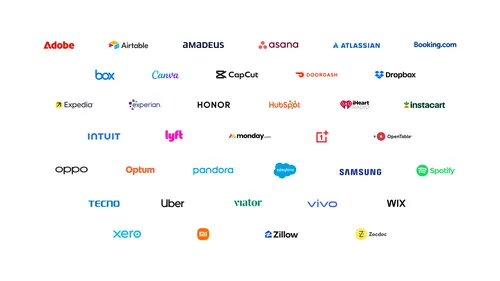
MCP Ecosystem: Canva, OpenTable, Instacart
Spark launches with full Google Workspace integration - Gmail, Docs, Sheets, Slides. The strategic move is the MCP protocol layer that connects it to third-party apps.
Three launch integrations signal the direction:
- Canva: Spark creates design assets from a brief, without opening the app.
- OpenTable: Books restaurants based on your calendar and preferences.
- Instacart: Shops for groceries based on your list or past purchase patterns.
The Summer 2026 roadmap adds browser operation - Spark browses the web autonomously - plus direct text and email sending from your accounts, and a macOS app with local file access.
Current availability: beta for Google AI Ultra subscribers in the US only ($250/month). Broader trusted tester access begins the week of May 26.
When the Agent Becomes the Customer: What Brands Need Now
This is the part that gets the least airtime and deserves the most.
When Spark buys through Instacart instead of a user visiting your website, you lose the first-touch moment entirely. No hero banner, no social proof timed to hesitation, no retargeting when they leave. The agent reads structured data and decides - without emotion, without distraction.
Industry analysts project AI agents will influence 30% of e-commerce transactions in developed markets by end of 2026 (Sanbi AI, 2026). This is creating a new optimization discipline: Agent Engine Optimization (AEO) - making your products legible to the agents making purchase decisions.
The technical requirements are concrete:
- Schema.org Product markup with full attribute coverage: material, dimensions, sustainability ratings - not just title and price.
- Machine-readable product descriptions: unambiguous, no marketing hyperbole, no adjectives that mean nothing to a classifier.
- API-first catalog architecture: real-time inventory and pricing query capability, not a locked CMS export.
“If an AI agent cannot read your product specs through structured data, your brand simply doesn’t exist in the agent’s decision loop” (Netranks AI, 2026). The first-mover advantage belongs to brands that build this infrastructure before agent commerce becomes mainstream in their market.
Vietnam: A 12-18 Month Window to Build Readiness
Spark is US-only at launch. But Gemini covers 230 countries in 70+ languages - and Google Workspace is already the dominant email and document platform in Vietnamese enterprises.
When Spark expands globally - estimated 12-18 months out - Gmail integration will be the most frictionless adoption path for Vietnamese teams. Enterprise Gmail users will have Spark available inside their existing inbox, with no separate onboarding.
The readiness gap in Vietnam is real:
- Most e-commerce players lack comprehensive Schema.org markup beyond basic product titles.
- Product descriptions are written for human emotion, not machine comprehension.
- Catalog architecture is typically flat-file or CMS-locked, not API-queryable.
The Ramp AI Index shows Vietnam leads Southeast Asia in AI adoption enthusiasm, but enterprise tooling depth still lags. High adoption intent plus low structured data quality is a specific type of vulnerability when agent commerce arrives.
The 12-18 month window is not a waiting period. It is the competitive window. Brands that invest in clean product data, machine-readable catalogs, and agent-compatible infrastructure now will have a measurable advantage when Spark arrives outside the US. The ones that wait will be building catch-up infrastructure after the adoption curve has already moved.
NateCue's Take
The real story isn't the feature list. It's that Google is inserting an agent layer between its 900 million users and every brand they interact with. When Spark buys through Instacart on someone's behalf, that brand never got to run a retargeting ad or A/B test a landing page - the agent decided based on structured data alone. For Vietnam specifically: Google Workspace dominates enterprise email and documents here. When Spark rolls out globally - likely in the next 12-18 months - Gmail integration will be the most natural adoption driver for Vietnamese teams. The readiness gap is real: most Vietnamese e-commerce players still lack clean Schema.org markup and machine-readable product catalogs. That gap is being priced into future market share right now. The window to close it is open, but not indefinitely.