
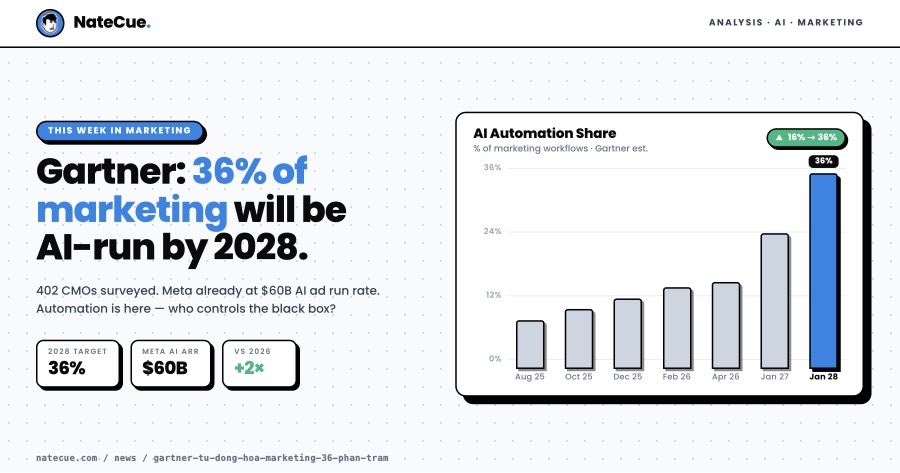
16% of marketing work is currently handled by AI automation. Gartner’s May 2026 survey of 402 CMOs puts the 2028 figure at 36% - more than double, in just two years. Meta isn’t waiting for the forecast to materialize. The platform is already running $60 billion in AI-driven ad revenue annually while most marketing teams are still debating which AI writing tool to add to their stack.
What Gartner Actually Measured
The survey ran from August through October 2025, targeting CMOs at enterprise organizations. The headline finding: marketing leaders expect AI-driven automation of marketing work to more than double by 2028.
Gartner’s longer-range prediction is sharper: by 2028, 60% of brands will deploy agentic AI for streamlined one-to-one customer interactions (Gartner, January 2026). This isn’t AI-assisted copywriting. It’s AI replacing entire customer engagement workflows - from awareness to conversion to retention.
Gartner analyst Emily Weiss called this “the end of channel-based marketing.” Planning by channel - separate strategies for social, email, search - gives way to AI that orchestrates touchpoints based on individual customer journeys. The channel stops being the unit of strategy; the customer’s path becomes the system.
Meta Is Already Running the Numbers
Q1 2026: Meta reported $56.31 billion in revenue - a 33% year-over-year increase (ContentGrip, 2026). The primary driver: AI ad automation at scale.
Meta’s end-to-end AI campaigns - including Advantage+ and automated creative tools - hit a $60 billion annual run rate in 2025. Ad impressions grew 19%. Average ad pricing increased 12%. Family daily active people rose 4% to 3.56 billion.
Zuckerberg’s stated target: full ad creation automation by late 2026. Marketers input a URL and a budget. Meta’s AI handles creative generation, audience selection, and placement optimization across Facebook and Instagram. No brief. No manual A/B test required.
In May 2026, Meta opened an open beta for AI Connectors - letting advertisers integrate campaign workflows directly into third-party AI tools without developer credentials. The automation layer is expanding beyond Meta’s own interface.
The Black Box Problem
This is the tension most automation coverage skips: more automation doesn’t automatically mean more advantage for advertisers.
ContentGrip’s Q1 2026 analysis flagged four real risks:
- Platform dependence: Meta’s AI optimization grows Meta’s revenue - ad impressions up 19%, pricing up 12% - not advertiser efficiency.
- Reduced transparency: When Advantage+ runs, marketers lose visibility into how targeting decisions are made.
- Measurement lock-in: Attribution data lives inside Meta’s systems. No independent verification is possible.
- Eroding negotiating power: When every advertiser uses the same automation, the only consistent winner is the platform.
Google is tracking the same trajectory. AI Overviews now appear in 25.8% of all US searches (May 2026), and organic CTR has declined as much as 61% on queries that trigger AI Overviews (B2the7, 2026). Platform automation is compressing organic reach while pushing spend toward paid channels - both controlled by the same companies.
The Vietnam Gap
MMA Vietnam reports 89% of Vietnamese businesses have implemented AI in marketing - a striking adoption rate. The breakdown is less impressive: 70% use chatbots, 63% use AI-generated content, 59% deploy personalized recommendations.
This is AI at the execution layer. Not system-level automation. Only 28% of Vietnamese companies have active AI training programs for marketing staff (DecisionLab, 2026). Another 34% are planning to build them.
The gap cited most often: difficulty selecting the right tools and writing prompts that produce usable results. Vietnam’s marketing AI adoption is real but remains surface-level. The 89% figure includes any AI touchpoint. Gartner’s 36% refers to automated marketing workflows - campaign optimization, customer journey orchestration, cross-channel execution. These are categorically different.
In practice, both global enterprise brands and Vietnamese brands are defaulting to Advantage+ and Performance Max - handing optimization decisions to Meta and Google algorithms without fully understanding the tradeoffs. Less control. Less attribution clarity. Deeper platform dependence.
When automation reaches 36%, the valuable skill isn’t knowing how to use an AI tool. It’s knowing what questions to ask the system, when to override it, and how to build measurement infrastructure that doesn’t rely entirely on the platform telling you whether your ads worked.
NateCue's Take
The 36% figure is a global average led by enterprises with mature data infrastructure. For markets like Vietnam - where 89% AI adoption still mostly means chatbots and AI-assisted copywriting - the gap is larger than the headline suggests. But the more dangerous trend isn't the adoption gap. It's that the real automation is happening inside Meta and Google's systems, not yours. When brands adopt Advantage+ without understanding the transparency tradeoff, they're not automating their marketing - they're outsourcing the decision layer entirely. The skill this creates demand for isn't prompt engineering. It's knowing what questions to ask the black box, when to override it, and how to build attribution that doesn't depend solely on the platform's own reporting.