
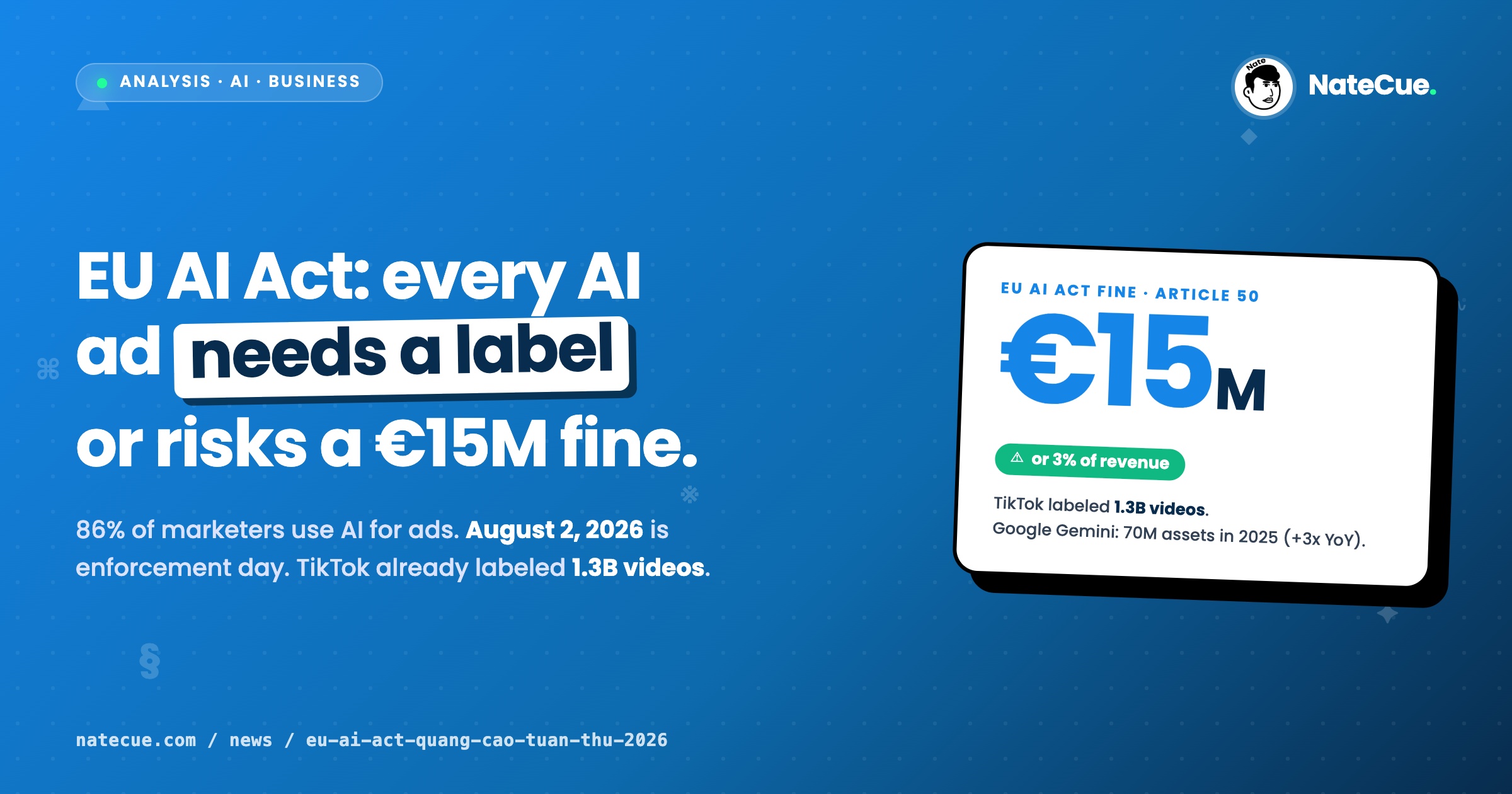
TikTok has already labeled 1.3 billion AI-generated videos. Meta auto-detects and flags “Made with AI” across its entire platform. YouTube uses SynthID watermarks on every ad it reviews. The major platforms didn’t wait for regulators - they moved first. The question is whether your marketing team has.
August 2 Is a Real Deadline - Not a Guideline
EU AI Act Article 50 reaches full enforcement on August 2, 2026. That’s not a sandbox phase or a grace period. It’s an enforcement date with real penalties and national competent authorities in every EU member state coordinating oversight.
The fine structure:
- Transparency violations (Article 50): €15M or 3% of global annual turnover
- High-risk AI system violations: €15M or 3% of revenue
- Prohibited practices (manipulative AI): €35M or 7% of revenue
The extraterritorial scope is what catches most non-EU brands off guard. Any brand whose AI-generated ads reach EU consumers falls under the Act - regardless of where the company is incorporated. If you run Meta Ads with any European targeting, you’re already in scope.
86% of Marketers Are Using AI Creative - Most Haven’t Configured Compliance
86% of media buyers are using or planning to use generative AI for video ad creative (IAB, 2026). Google reported advertisers used Gemini to generate nearly 70 million creative assets in late 2025 - a 3x year-over-year increase. The scale is enormous. The compliance infrastructure has not kept pace.
Article 50 gets specific about what’s required:
- Visible labels: “AI-generated,” “AI-manipulated,” or standardized AI icons in minimum 12pt equivalent
- C2PA metadata: embedded in the file itself - a social caption does not satisfy this
- Video: persistent label throughout the full duration, not just the opening frame
- Audio: spoken disclosure at the beginning or end, in the ad’s own language
- Deepfakes or AI avatars resembling real people: enhanced disclosure required before the user forms any impression
Platforms are automating parts of this. TikTok scans for C2PA metadata and has tagged 1.3 billion videos. Meta uses “AI info” tags combined with watermark detection. YouTube’s SynthID flags content during ad review. LinkedIn uses Content Credentials plus self-declaration.
But platform automation does not equal compliance. Legal responsibility rests with the advertiser in all cases, regardless of whether the platform adds a label automatically.
Human Content Has Become a Compliance Advantage
The EU AI Act is inadvertently building a competitive moat for human creator content - and few people are saying it plainly.
Content made by real people - real faces on camera, real voices in audio - requires no AI labels. No C2PA metadata. No compliance overhead. The exceptions are narrow: standard editing (color grading, noise removal, auto-captions) is fine. Only synthetic generation triggers Article 50.
The compliance workflow for AI creative now includes:
- Audit the full creative pipeline before Q3 2026
- Verify AI tools embed C2PA metadata natively
- Build disclosure workflows into production approval steps
- Update agency and creator contracts with AI disclosure obligations
- Train teams on what Article 50 actually covers
Consumer sentiment is already moving the same direction. 50% of consumers now prefer brands that avoid AI-generated content (Canva 2026 Marketing AI Report). In influencer marketing specifically, consumer preference for AI creator content has dropped from 60% in 2023 to just 26% in 2026.
Southeast Asia Is Already in This Fight
Vietnam became the first country in Southeast Asia to pass a comprehensive AI law, effective March 1, 2026. It includes disclosure requirements that closely mirror EU AI Act Article 50: mandatory labeling for AI-generated content, especially deepfakes, and required disclosure when users are interacting with an AI agent instead of a human.
For marketing teams running campaigns across both markets, this creates a dual compliance layer:
- Vietnam market: comply with Vietnam’s AI Law (effective March 1, 2026)
- EU market: comply with EU AI Act Article 50 (effective August 2, 2026)
- Global campaigns: if targeting includes both regions, both frameworks apply simultaneously
C2PA is the shared technical standard. That’s the practical action point: choose AI creative tools with native C2PA metadata support now. Tools without it will create significant retrofit costs later.
The regional expansion is already visible. Indonesia, Thailand, and the Philippines are actively studying Vietnam’s framework. FinregE’s 2026 APAC regulatory report projects EU-style AI legislation to spread across the region within 18 to 24 months. Building one control stack that meets EU-level requirements is faster and cheaper than adapting separately to each new local law as it lands.
NateCue's Take
Here's what most compliance write-ups miss: EU AI Act is reversing the economics of AI creative. For two years, AI content won because it was cheap - fast to generate, easy to scale. But now the compliance stack is adding real cost: audit your pipeline, verify C2PA tool support, rebuild disclosure workflows, update every agency contract. That's time and money, every campaign cycle. Human creator content carries none of this. No labels required. No metadata to embed. No regulatory exposure. For teams in Vietnam and Southeast Asia running global campaigns: choose AI tools with native C2PA support now. Vietnam's own AI law (effective March 1, 2026) has parallel disclosure requirements, and Indonesia, Thailand, and the Philippines are watching. EU-style frameworks will be the APAC baseline within 18 to 24 months. Build one control stack that meets EU requirements - it's cheaper than retrofitting for every local market separately.