
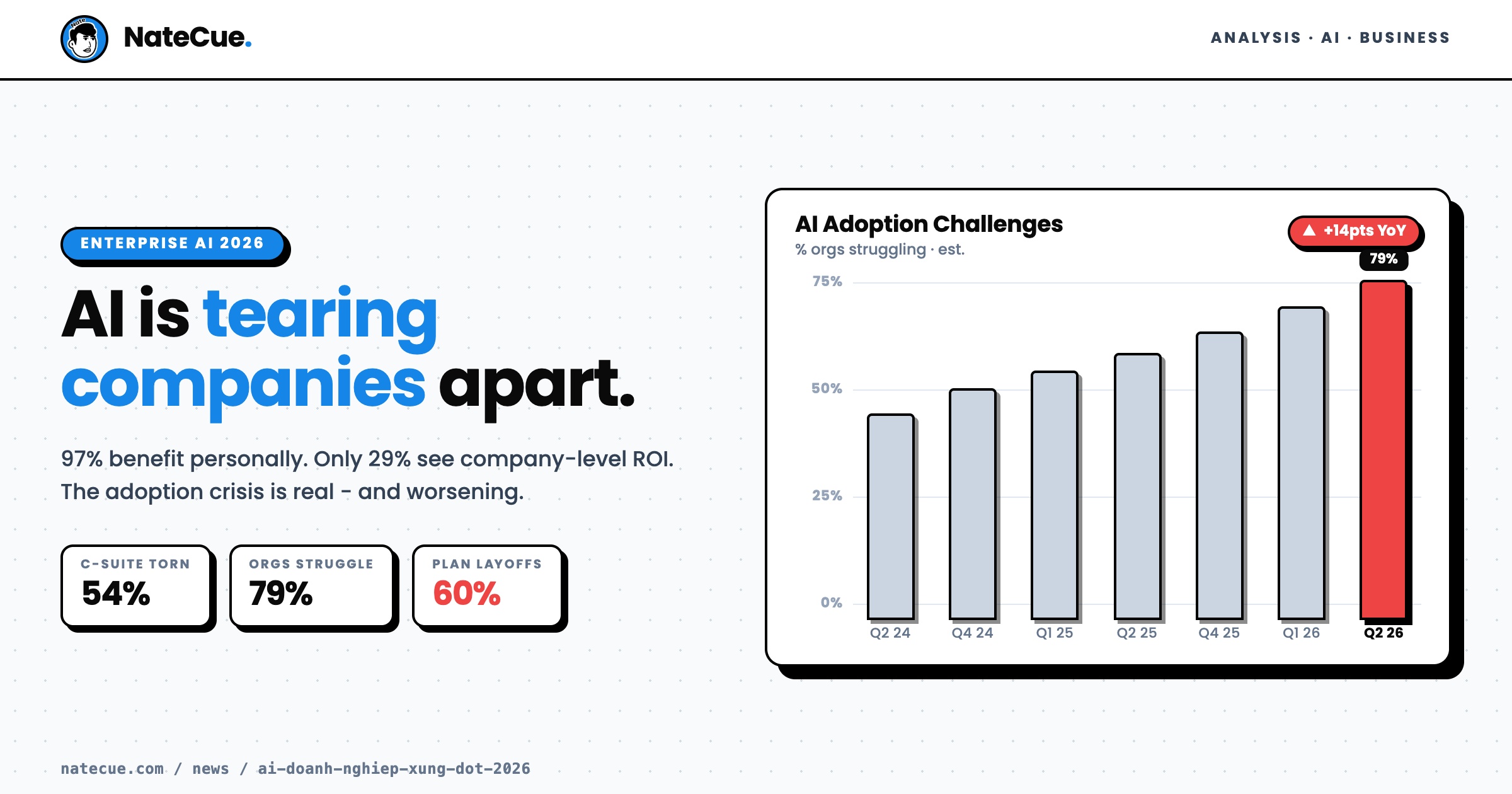
97% of employees say AI helps them personally. Just 29% of companies are seeing meaningful ROI. That gap - between individual productivity wins and organizational outcomes - is what’s fracturing leadership teams across the globe in 2026.
54% of C-Suite: “AI Is Tearing Us Apart”
Writer and Workplace Intelligence surveyed 2,400 C-suite executives and knowledge workers across five countries. The findings are unambiguous.
79% of organizations struggle with AI adoption - a double-digit increase from 2025 (Writer, 2026). 54% of C-suite executives admit that AI is “tearing their company apart.” 56% say it has created power struggles and internal disruption.
What makes this worse: 75% of executives admit their company’s AI strategy is “more for show” than actual internal guidance. 48% say AI adoption at their company has been a “massive disappointment.” And 39% have no formal plan in place to drive revenue from AI tools.
The Productivity Paradox: Individual Wins, Organizational Losses
This is the most interesting tension in the data. AI is clearly boosting individual output. Knowledge workers who use AI proficiently are 5x more productive than slower adopters. 97% of employees report personal benefits from AI.
But those individual gains aren’t converting to organizational ROI. Deloitte’s 2026 State of AI report finds 66% of organizations report productivity and efficiency gains - but only 20% are experiencing actual revenue growth from AI, while 74% merely hope to achieve it.
The gap between “high individual productivity” and “low organizational ROI” is a textbook change management failure, not a technology failure. Only 34% of organizations are truly reimagining their business through AI, per Deloitte. 37% apply AI at surface level with minimal process changes. Injecting intelligence into a broken process just makes the broken process faster - not better.
The “AI Elite” Class - and the Layoffs Coming for Everyone Else
92% of C-suite are actively cultivating a class of “AI elite” employees - those fluent in AI tools, rewarded with raises and promotions at 3x the rate of slower adopters (Writer, 2026).
The flip side: 60% of executives plan to lay off employees who refuse to adopt AI. 69% say their company is already doing AI-related layoffs. And a striking 29% of employees are actively sabotaging their company’s AI strategy.
Not because they hate the technology. Because they fear losing their jobs.
Top-down pressure is creating bottom-up resistance. This is a trust problem, not a skills problem. When employees believe adoption leads to their own replacement, they will find ways to slow it down - and 29% apparently already are.
Vietnam and SEA: An Additional Layer of Difficulty
While 46% of Southeast Asian businesses have successfully scaled AI beyond pilot phases - above the global average of 35% (SAMTA, 2026) - Vietnam faces additional headwinds within this regional picture.
Only 13.8% of Vietnamese AI-adopting firms have actually deployed AI at scale. Just 36.5% had a documented AI strategy as of 2025. And 46.4% lacked sufficient internal AI skills to execute.
Vietnam’s Law on Artificial Intelligence took effect March 1, 2026 - an important regulatory milestone. But regulation doesn’t solve talent gaps or data foundations. 70% of Asian enterprises now prioritize AI-driven transformation at boardroom level (SAMTA, 2026). Board pressure is generating adoption theater: tool purchases, strategy decks, no real execution underneath.
This isn’t uniquely a Vietnam challenge. It’s a global one. But in Vietnam, the cost of getting the foundation wrong is higher - because the margin to fail-and-iterate is smaller.
NateCue's Take
The "tearing apart" headline is really a change management story, not an AI story. Companies are buying tools but refusing to redesign the workflows, incentive structures, and data foundations that would actually make them work. You can't inject intelligence into a broken process and expect transformation. For Vietnam and similar emerging markets, there's an extra layer: most organizations haven't solved their customer data problem yet. Fragmented CRMs, siloed data, no clear first-party signal. Deploying AI agents on top of that doesn't create new value - it amplifies existing dysfunction. The 75% of global C-suite who admit their AI strategy is "for show" - in Vietnam, that number is likely higher, because board-level pressure to "have AI" is outpacing the actual capability to use it.