
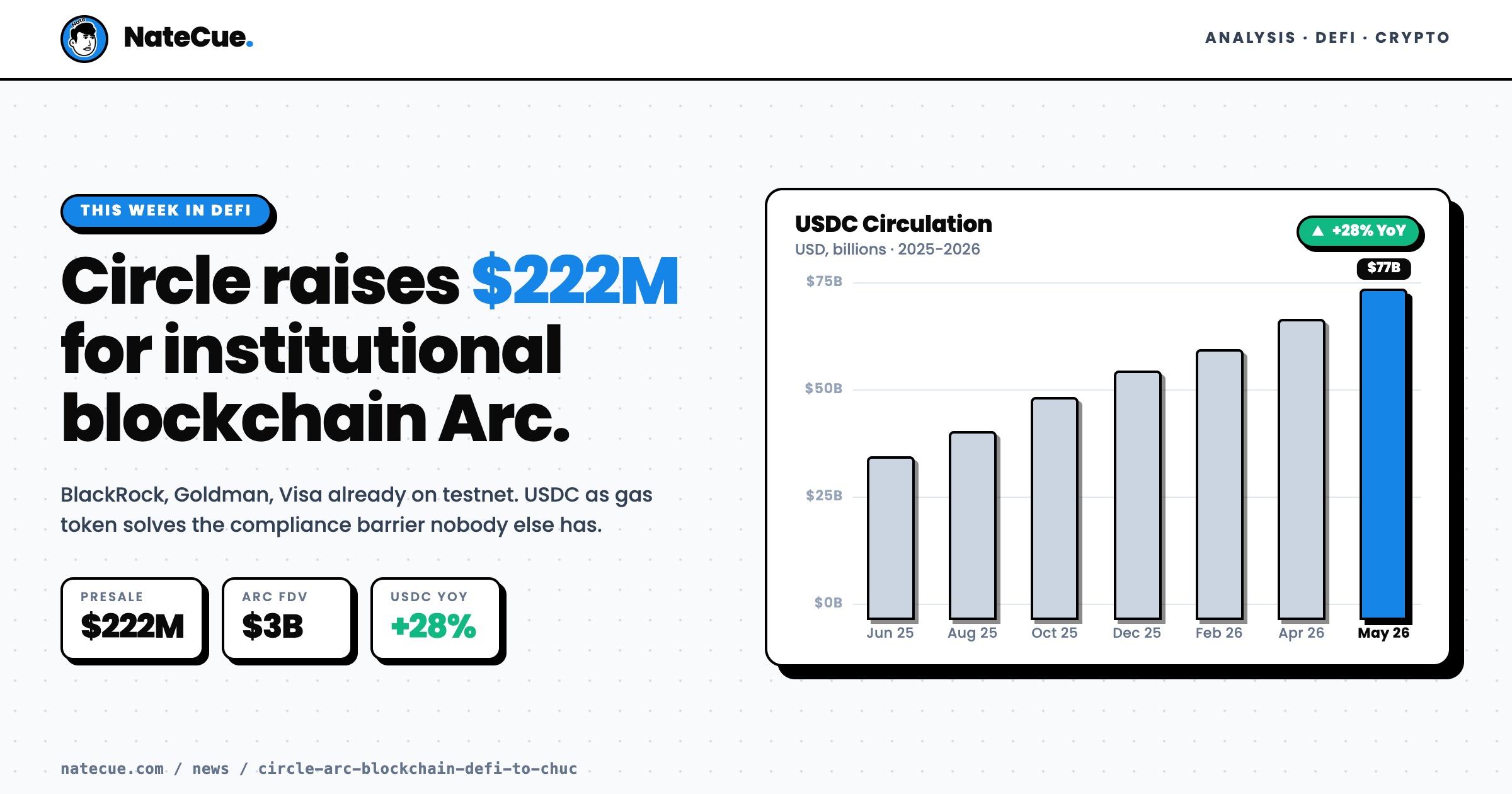
100+ of the world’s largest financial institutions - BlackRock, Goldman Sachs, Visa, Deutsche Bank, State Street - have been running on a blockchain that hasn’t launched mainnet yet. This week, that blockchain closed a $222 million presale at a $3 billion valuation.
Circle - the company behind USDC - just closed the presale for Arc, a Layer-1 blockchain built from the ground up for institutional finance.
Arc Is Not Another L1
Arc is positioned as the “Economic Operating System” for global finance. Not a Layer 2. Not a sidechain. A full institutional-grade L1.
Its most important technical decision: USDC is the native gas token. Users pay transaction fees in dollars - not in volatile ARC tokens or any other asset.
Sub-second deterministic finality, full EVM compatibility, opt-in privacy, and quantum-resistant architecture round out the spec (Crypto.news, 2026). But the USDC-as-gas decision is the most strategically significant.
Most blockchains require holding native tokens to pay gas - this is the primary barrier for traditional financial institutions. Not because of technical complexity. But because compliance teams cannot classify a volatile asset on the corporate balance sheet for operational purposes.
USDC-as-gas removes that barrier entirely.
The $222M Investor List Says Everything
Andreessen Horowitz led the round with $75 million (The Block, 2026). Other investors include BlackRock, Apollo, Intercontinental Exchange (NYSE’s parent), SBI Group, Standard Chartered Ventures, ARK Invest, Janus Henderson, Goldman Sachs, and Haun Ventures.
This is not a crypto-native list. This is the list of organizations managing global financial infrastructure.
Arc’s testnet processed 244 million transactions since its October 2025 launch. Over 100 institutions participated in testnet, including State Street, Deutsche Bank, HSBC, and Goldman Sachs - organizations whose job is explicitly to not take risks.
On Circle’s financials: Q1 2026 revenue and reserve income hit $694 million, up 20% year-over-year (Crypto.news, 2026). USDC circulation reached $77 billion, up 28%. Adjusted EBITDA came in at $151 million, up 24%.
Arc is not a gamble from a company running out of options. It’s an expansion from stablecoin dominance into the infrastructure layer above it.
The Real Risk: Stablecoin Law and the Dollar Token Wars
The picture isn’t entirely clean. The US CLARITY Act passed the Senate Banking Committee 15-9 on May 14 (CoinDesk, 2026), clearing a path for bank-issued stablecoins with formal regulatory backing.
When JPMorgan or Bank of America can legally issue dollar tokens - regulated, insured, familiar to institutional clients - USDC loses its default-option status. If those banks issue tokens running on their own proprietary chains, Arc faces a competitive scenario that investors haven’t fully priced in.
Circle’s bet: Arc becomes the chain that bank tokens run on - not a competitor to them. CEO Jeremy Allaire called Arc “infrastructure as critical as mobile operating systems or cloud platforms” (Crypto.news, 2026). The framing is correct. Execution determines whether the bet pays.
Southeast Asia: The Market Nobody Is Talking About
Two investors on the Arc cap table matter particularly from a regional angle: SBI Group and Standard Chartered.
SBI Group handles cross-border payments across Asia. Standard Chartered runs corporate banking in 50+ jurisdictions. Both were already Circle partners in Asian markets before Arc existed.
Vietnam consistently ranks among the highest crypto-adoption countries globally (Chainalysis). USDC already flows through B2B payment rails for Vietnamese businesses - particularly in software export, freelance work, and cross-border commerce.
When Arc’s mainnet launches in summer 2026, Vietnamese businesses already using USDC don’t need to start from scratch. They need to upgrade from basic stablecoin transfers to smart contracts, opt-in privacy, and sub-second finality - all on the same dollar unit of account they’re already using.
Arc’s real infrastructure opportunity isn’t on Wall Street. It’s in markets where traditional financial infrastructure has high friction and USDC adoption is already real.
NateCue's Take
The USDC-as-gas decision is the most important detail that most coverage is glossing over. Most institutional DeFi projects fail not because of bad tech - but because a bank's CFO cannot sign off on holding volatile ETH or SOL on the corporate balance sheet for operational gas payments. That's an accounting problem, a compliance problem, a problem no risk committee wants to touch. USDC-as-gas solves it completely. Gas fees become a dollar-denominated line item you can forecast and budget like any vendor contract. For markets like Vietnam - where USDC already flows through B2B payment rails, and Standard Chartered and SBI have existing infrastructure - Arc's mainnet isn't a distant event. It's an upgrade path from rails that are already running. That's the real institutional DeFi story: not Wall Street, but the $10T in cross-border commerce that flows through markets with high friction and growing crypto adoption.