
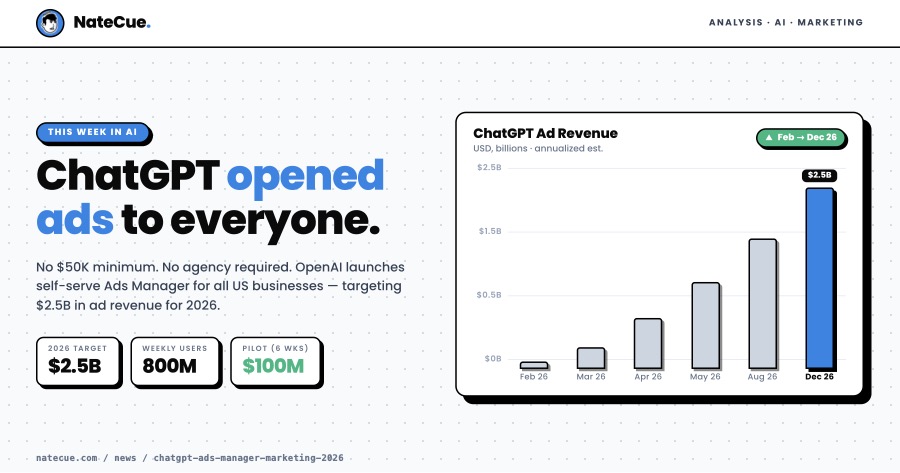
800 million weekly users. Six weeks into a limited US pilot, ChatGPT’s ad platform had already generated over $100 million in annualized revenue (The Decoder, 2026). On May 5, OpenAI made its next move: a self-serve Ads Manager open to all US businesses, no agency required, no minimum spend.
The Key Change: The $50,000 Wall Came Down
The pilot phase required a $50,000 minimum spend commitment - pricing out most small businesses and giving major holding companies early access to learn the platform.
That barrier is gone. Any US business can now sign up directly, set their own budget, and launch campaigns without going through a partner agency.
The platform offers CPC (cost-per-click) and CPM (cost-per-thousand impressions) bidding. CPA bidding is in development with no confirmed timeline. Measurement tools include a conversion tracking pixel; a conversions API is coming. Eligible ad categories currently: household goods, local services, travel, entertainment, digital products, and education - what OpenAI describes as “low risk” verticals.
Scale vs. Trajectory: Don’t Compare to Google’s Absolute Numbers
OpenAI is targeting $2.5 billion in ad revenue for 2026, with a longer horizon target of $100 billion by 2030 (Reuters / Storyboard18). For context: Google generated ~$295 billion in ads in 2025, Meta ~$196 billion.
The $2.5B looks like a rounding error. That’s the wrong lens.
The trajectory matters more: AI-driven search ads across the industry are projected to reach $2.08 billion in 2026 and climb to $26 billion by 2029 - equivalent to 13.6% of total US search ad spend (AdventurePPC, 2026). That’s a move from 1.3% to 13.6% market share in three years.
The underlying shift: users are increasingly resolving purchase decisions inside AI conversations rather than exiting to a results page and comparing options. Buying intent isn’t disappearing - it’s relocating.
What ChatGPT Ads Actually Look Like
The current ad format is minimal: a small favicon with accompanying text, appearing at moments when the user is asking about a purchase decision. OpenAI controls all placement decisions - advertisers cannot target specific conversation contexts.
OpenAI shares only aggregated performance data. No one sees the content of individual user conversations. This is a fundamental difference from Google Search Ads, which expose exact query-level data.
One important limitation: no third-party measurement partners have been announced. That means ROI attribution currently relies entirely on OpenAI’s first-party data - no independent verification. For performance marketers, this is a real concern.
That said, Dentsu, Omnicom, Publicis, and WPP are all in the beta. When the four largest agency holding companies commit early, that’s genuine industry signal.
What This Means for Marketers Outside the US
ChatGPT Ads Manager is US-only for now. Marketers in Vietnam, Southeast Asia, and most international markets cannot buy in yet.
Typical timeline for ad platform international expansion: 12-24 months after US launch.
Vietnam is worth noting specifically. The country leads Southeast Asia in AI adoption - 81% of users engage with AI tools daily (Vietnam News). ChatGPT is already embedded in how younger professionals and marketers there work. The user behavior is primed. The ad infrastructure just hasn’t arrived yet.
The strategic move isn’t to wait. It’s to start building Answer Engine Optimization (AEO) now - optimizing brand and product content to surface naturally in ChatGPT’s responses when users ask about relevant categories.
New ad platforms are cheapest and least competitive in their earliest phase. Google Ads in 2002. Facebook Ads in 2007. ChatGPT Ads in 2026 is sitting at exactly that inflection point. The brands that understand the conversational AI surface today will hold a structural advantage when the buy becomes available in their market.
NateCue's Take
The $2.5B revenue target looks small against Google's $295B empire. That framing misses the point entirely. What matters is the behavioral shift: users are increasingly resolving purchase intent inside a ChatGPT conversation rather than clicking through a search results page. The format today is basic - just a favicon and text. But every major ad platform started primitive. Google Ads in 2002. Facebook Ads in 2007. Same pattern. For marketers outside the US (including Vietnam and Southeast Asia, where this platform isn't available yet), the move isn't to wait for the ad buy - it's to build Answer Engine Optimization now. When ChatGPT Ads expands to your market, the brands already appearing organically in AI conversations will have a structural advantage over late movers.