
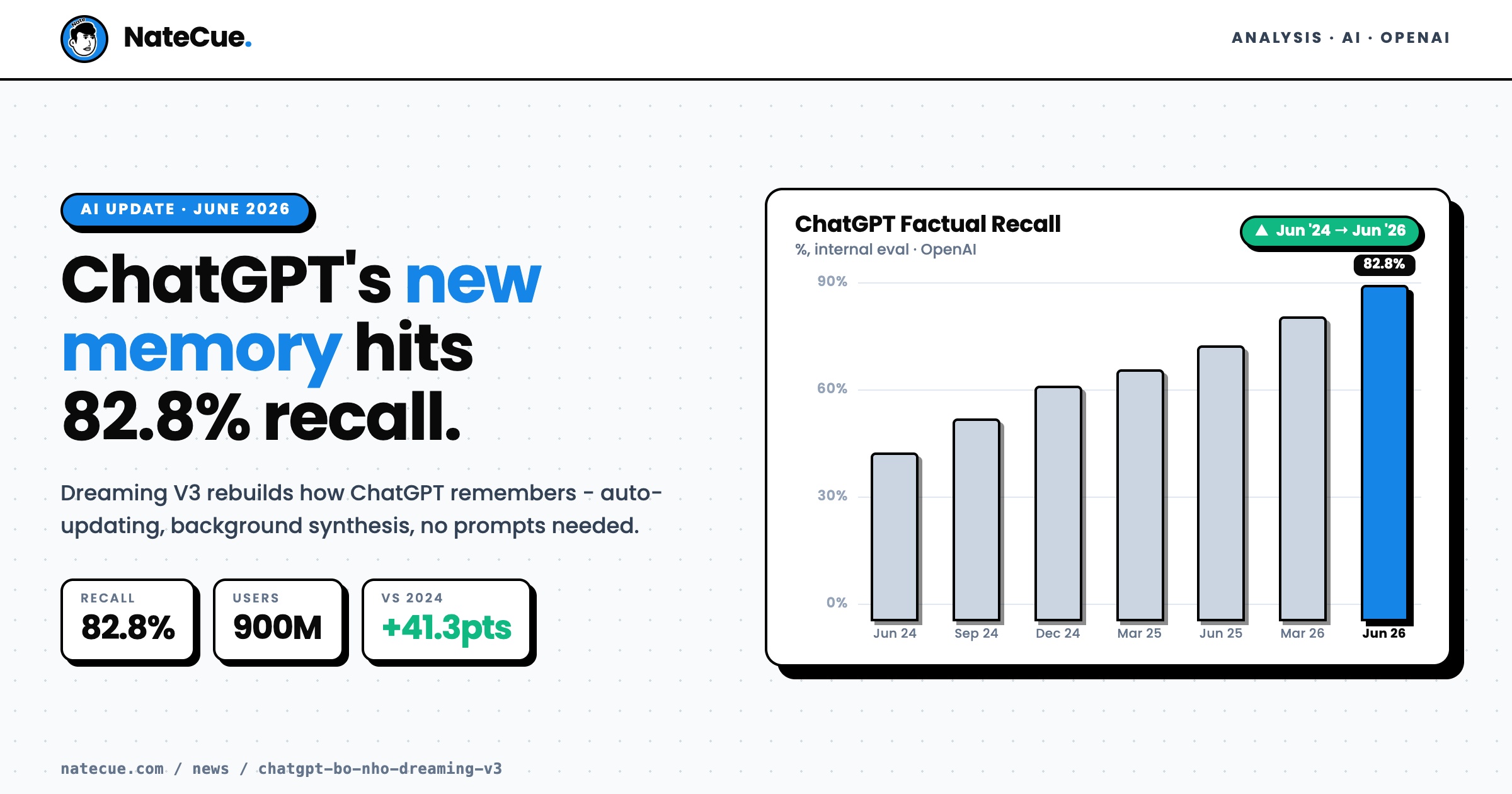
ChatGPT’s factual recall jumped from 41.5% to 82.8% in two years. Not from a bigger model - from a complete rethink of how AI remembers you. On June 4, 2026, OpenAI shipped Dreaming V3, the most significant memory architecture upgrade since ChatGPT’s launch.

What Dreaming V3 Actually Changes
The old memory system required explicit commands: “Remember that I prefer short-form writing.” Dreaming V3 drops that requirement entirely.
The system runs as a continuous background process, synthesizing memories from thousands of conversations simultaneously - no trigger needed, no command required. OpenAI’s own example: if you mention “I’m going to Singapore in July,” ChatGPT automatically updates that memory to “went to Singapore in July 2026” after the trip ends. No notification from you needed.
The architecture has evolved through three stages: manual saved memories (2024), Dreaming V0 with contextual references (2025), and now Dreaming V3 with fully autonomous synthesis (Digital Applied, 2026).
The Numbers Behind the Upgrade
OpenAI measures memory performance across three dimensions (TechTimes, 2026):
- Factual recall: 41.5% (2024) → 67.9% (Dreaming V0) → 82.8% (Dreaming V3)
- Preference adherence: 71.3%
- Time-sensitive accuracy: 75.1%
Compute cost dropped roughly 5x, making Free-tier rollout viable. Plus and Pro users get 2x memory capacity. The rollout began June 4, 2026 in the US for Plus/Pro subscribers - Free tier and international users are expected to follow within weeks.
That means roughly 900 million weekly active ChatGPT users are in the queue for persistent, auto-updating memory (Digital Applied, 2026).
The “Context Bleed” Problem OpenAI Hasn’t Answered
The upgrade comes with real concerns. 82% of 300 surveyed US ChatGPT users consider their conversations sensitive or highly sensitive (TechTimes, 2026).
The more technical problem is “context bleed”: sensitive information from one conversation can influence responses in a completely unrelated session. Memories are stored separately from conversation logs - which means deleting a chat does not delete synthesized memories derived from it.
EU AI Act transparency requirements take effect August 2, 2026 - less than two months after Dreaming V3’s deployment. GDPR classifies persistent behavioral profiling as requiring explicit consent and erasure rights. OpenAI has not disclosed how Dreaming V3 addresses either compliance framework.
Vietnam and SEA: The Fastest-Growing Market Meets a Pivotal Feature
ChatGPT Go costs ₫132,000/month (under $6) in Vietnam - low enough to accelerate mass adoption. Weekly active users in Vietnam tripled over the past year, placing it among the top 5 APAC countries for ChatGPT usage (Marketing-Interactive, 2026).
The regional picture is striking: Indonesia has reached 29.6 million weekly active users with 85% growth, the Philippines 24 million WAU with 67% growth (Siana Marketing, 2026). SEA as a whole has seen 4x growth in weekly active users.
When Dreaming V3 rolls out to Free tier - arriving soon - millions of users across Vietnam and SEA will have an AI assistant that knows them progressively better, at no additional cost.
For SMEs in Vietnam that lack dedicated data infrastructure, this is the first time they gain access to AI-driven personalization at enterprise depth, without a CDP, data warehouse, or data science team.
The New Personalization Paradox
A 2025 study identified a “personalization-convenience paradox”: the feature users value most is also the hardest to audit (TechTimes, 2026). Dreaming V3 amplifies exactly that tension.
ChatGPT now remembers users more reliably - but users don’t fully know what it’s remembering, and can’t precisely control which memories are flowing across unrelated conversations.
For marketers building AI workflows for their teams, the practical question is pointed: how well do you want your AI assistant to “know” your team - and who owns the boundary?
NateCue's Take
Dreaming V3 raises an uncomfortable question for marketers: if a user's ChatGPT already knows their preferences, workflow, and last trip to Singapore - what exactly is brand personalization solving? The "first-party data advantage" is being challenged not by a competitor, but by an AI assistant sitting on the user's side of the table. In Vietnam and Southeast Asia, where ChatGPT Go costs under $6/month and WAU have tripled in a year, SMEs are gaining access to enterprise-grade personalization without touching a CDP or data pipeline. Whether that's a threat or an opportunity depends entirely on which side of the table your business is on.