
On June 1, 2026, Anthropic quietly filed a confidential draft S-1 registration statement with the U.S. Securities and Exchange Commission. Valuation: $965 billion, following the close of a $65 billion Series H round. Annual revenue run rate: $47 billion - up from $87 million in January 2024 (VentureBeat, 2026). That’s 540x growth in 28 months - a trajectory with almost no historical parallel in enterprise software.
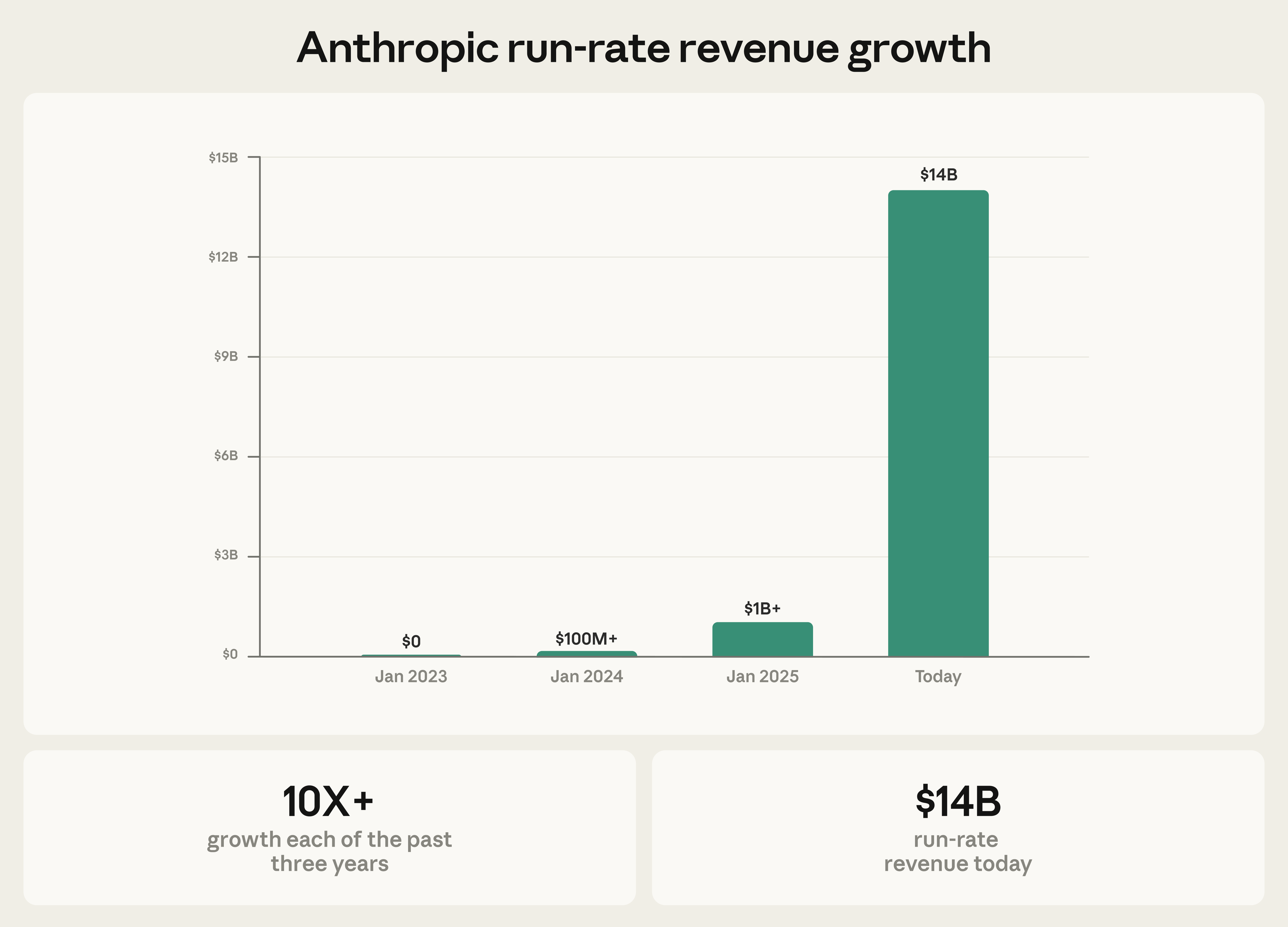
The 80x growth story behind the headline
Anthropic’s revenue timeline is unlike anything in recent software history:
- January 2024: $87 million annualized run rate
- December 2024: $1 billion
- End of 2025: $9 billion
- February 2026: $14 billion (post-Series G at $380B valuation)
- May 2026: $47 billion (VentureBeat, 2026)
Q2 2026 revenue is expected to reach $10.9 billion - nearly double the prior quarter (CNBC, May 2026). The company says its first profitable quarter is “coming soon.” Goldman Sachs, JPMorgan, and Morgan Stanley are competing to lead the underwriting. A public debut is expected around October 2026 per Bloomberg. Anthropic’s $965 billion valuation now exceeds OpenAI’s $852 billion - a reversal few analysts predicted 12 months ago.
Why enterprise - not consumers - is doing the heavy lifting
The growth is not coming from individual subscribers. More than 1,000 companies are spending $1 million+ per year on Claude - a number that doubled in under two months following the Series G close (Fortune, 2026). The Claude Partner Network spans Accenture, Deloitte (470,000+ employees globally), Cognizant, and Infosys - a B2B distribution engine that OpenAI is actively building its own version of.
The most telling signal comes from hiring data. Anthropic’s job postings show 72 open Sales roles versus 67 AI Research and Engineering positions (TechTimes, June 2026). For the first time in the company’s history, commercial hiring outpaces research headcount growth. This is not a coincidence. It is what a company looks like when it is preparing a revenue machine for public market scrutiny.
Risks investors will price in hard
The Pentagon’s “supply-chain risk” designation could freeze significant U.S. government contract revenue - a growing segment as AI moves into defense and federal infrastructure. This is the X-factor institutional investors will stress-test before committing to IPO allocations.
The Register described the filing as “Anthropic, now atop the AI bubble” - a pointed observation about near-$1 trillion valuations ahead of any formally reported profitable quarter. Competition adds pressure: OpenAI is heading toward its own public offering, and SpaceX is targeting a $2 trillion valuation in the same market window. Retail investors will face multiple “once-in-a-decade” AI deals simultaneously in fall 2026.
What this means for businesses in Vietnam and Southeast Asia
Anthropic does not operate direct offices in Vietnam or most of Southeast Asia. Enterprises in the region access Claude primarily through Amazon Bedrock (AWS) and Google Vertex AI - both of which are rapidly expanding their infrastructure across the region.
Going public typically triggers three predictable changes to API economics:
Pricing tier adjustments. OpenAI raised API prices multiple times after major funding rounds. Post-IPO, Anthropic will face quarterly pressure from shareholders expecting margin improvement. Claude API pricing that feels stable today could look materially different by mid-2027.
SMB gets de-prioritized. Public companies optimize for enterprise ARR. Free and low-cost tiers tend to get feature-gated or rate-limited to push upgrades. Anthropic’s current focus on Fortune 500 legal, coding, and security use cases signals where commercial priority already sits.
Product roadmap shifts toward B2B. When quarterly earnings calls drive decisions, enterprise features ship first. Developer tools for startups tend to arrive after enterprise contract requirements are satisfied first.
For businesses in Vietnam and Southeast Asia currently building products on Claude API via AWS Bedrock: now is the right time to review your pricing agreements and seriously evaluate fallback options - GPT-4o, Gemini 2.5 Pro, or capable open-source alternatives - before the post-IPO pricing environment settles in autumn 2026.
NateCue's Take
Anthropic has marketed itself as the "safety-first AI lab" - the responsible alternative to OpenAI. That brand positioning worked brilliantly for fundraising. But IPO math is different: when Sequoia and Altimeter Capital need to show LPs an exit, "responsible AI" must translate into gross margin expansion. The clearest signal is not the $965B valuation - it's that Anthropic now lists 72 open Sales roles versus 67 AI Research positions. First time in the company's history that Sales hiring outpaces Research. For businesses in Vietnam and Southeast Asia building on Claude API via AWS Bedrock: this is the moment to diversify your AI vendor stack before a new post-IPO pricing regime locks in.