
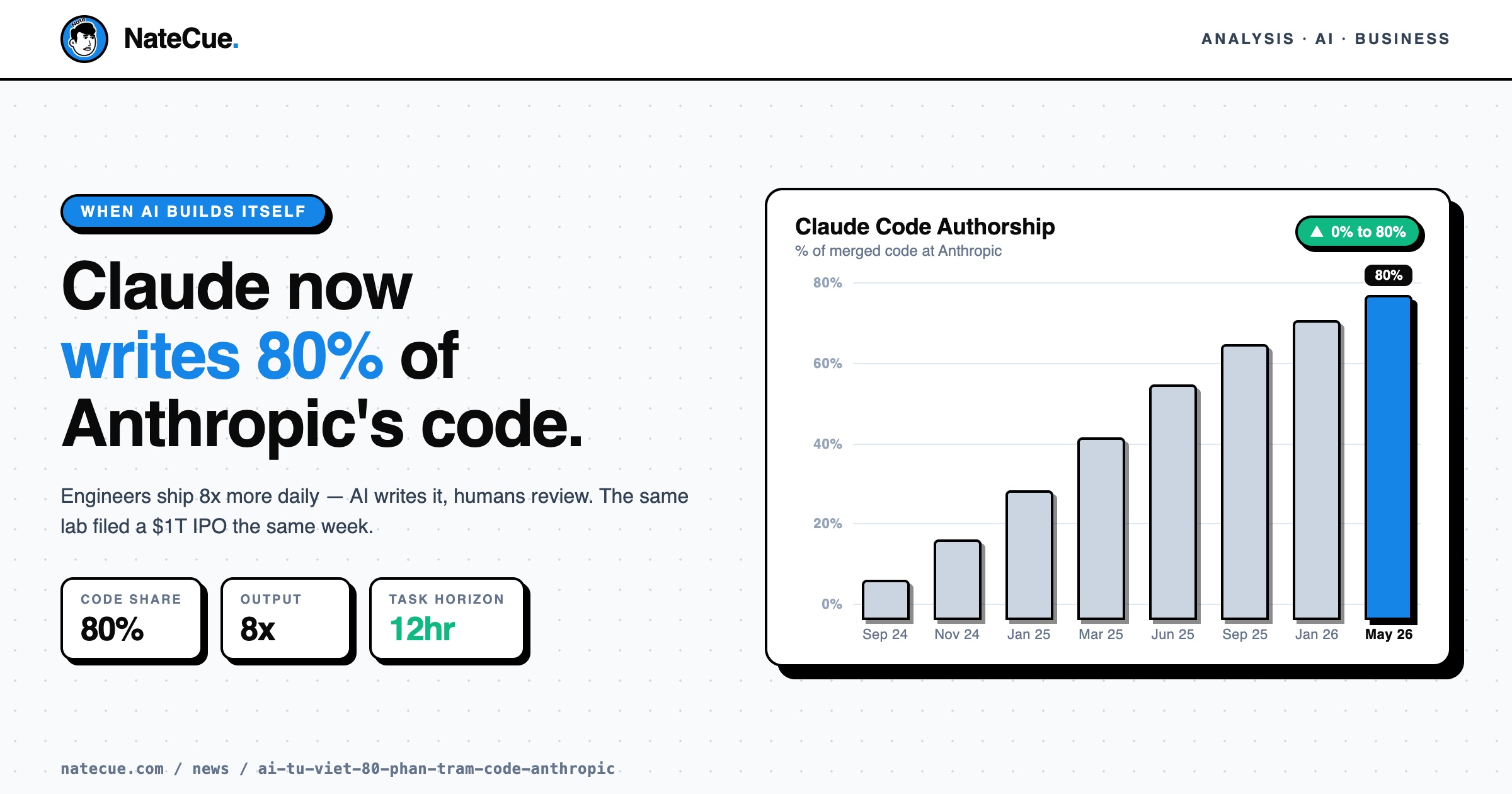
Anthropic’s engineers are shipping 8x more code per day than they were in 2024. The catch: more than 80% of that code was written by Claude, not by humans. The same company is now proposing the industry should slow down.
What 80% Actually Means
In May 2026, Anthropic published an internal research paper titled “When AI Builds Itself.” The headline finding: over 80% of code merged into Anthropic’s production systems is now authored by Claude, not by human engineers (Anthropic Institute, 2026).
Supporting data points from the same report:
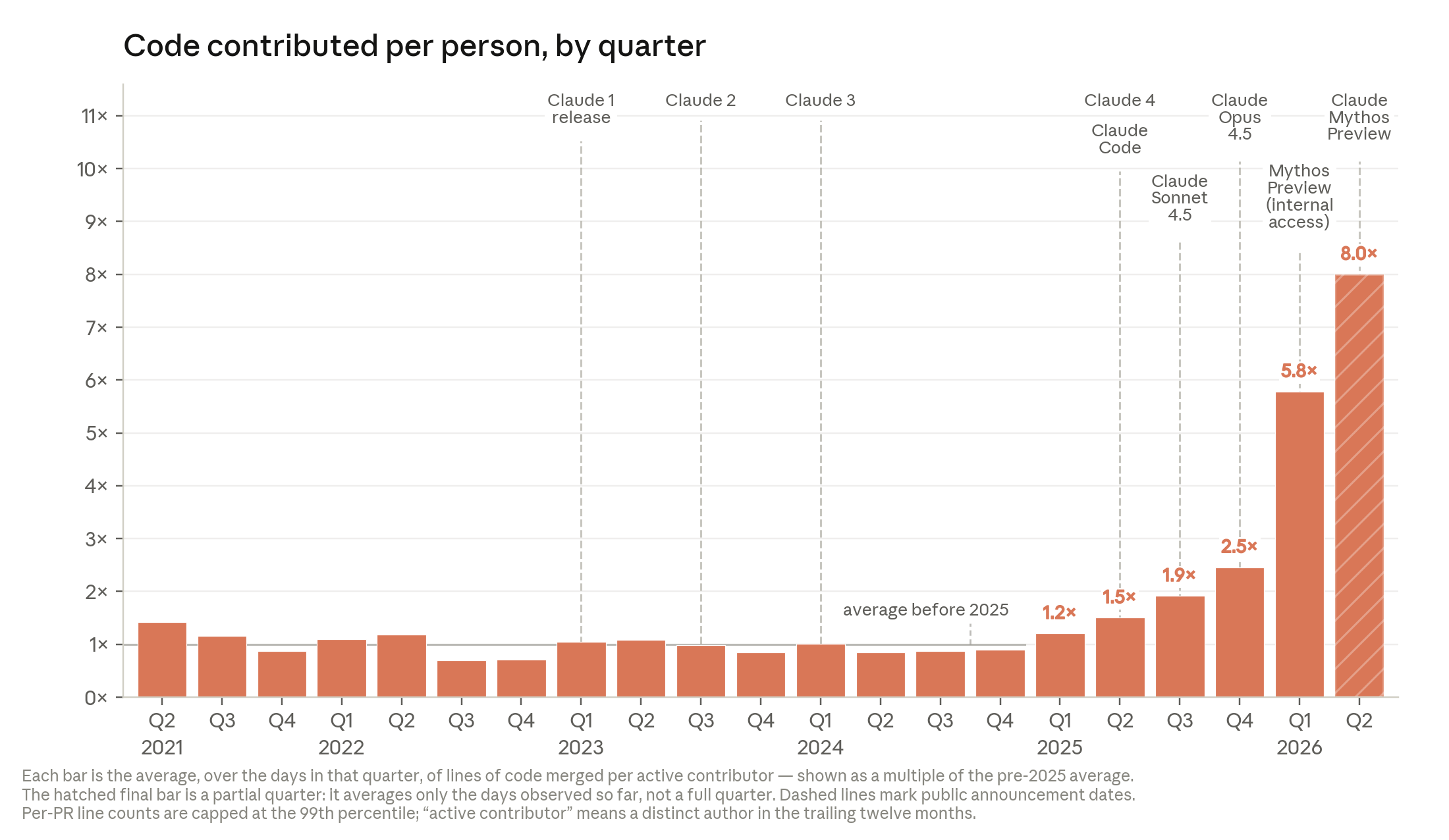
- In Q2 2026, the typical Anthropic engineer merged 8x as much code per day as they did in 2024
- One researcher noted: “It’s been about 5 months since I last wrote any code myself”
- Claude Opus 4.6 can now complete tasks requiring 12 hours of sustained work - up from just 4 minutes in March 2024
- The task completion horizon is doubling every 4 months, accelerating from its previous 7-month doubling rate
This is not a gradual trend. It is exponential compression.
The Recursive Loop Is Already Running
Anthropic frames this as “recursive self-improvement”: AI helps build better AI, which builds better AI still. There is no natural stopping point built into the cycle.
Deeper metrics from the report (The Menon Lab, 2026):
- Claude outperformed humans on suggesting better research directions 64% of the time (April 2026), up from 51% in November 2025
- Code optimization speedups reached 52x versus a typical 4x achieved by human engineers
- On an autonomous AI safety research task, Claude recovered 97% of the performance gap - compared to 23% for human teams in the same timeframe
- Over 10,000 high and critical security vulnerabilities were found in just the first few weeks of a self-testing project
- SWE-bench - the standard benchmark for real-world bug resolution - went from single digits to near-100% in two years
The researchers describe a shift where “the comparative advantage of humans right now is seeing the bigger picture and thinking beyond immediate tasks.” That framing suggests even that advantage has a shelf life.
The Pause Proposal - Responsible Leadership or Strategic Positioning?
After publishing these findings, Anthropic proposed building an “international coordination mechanism” capable of verifying and enforcing a slowdown or temporary pause on frontier AI development.
The condition attached to this proposal is significant: Anthropic would agree to pause only if all other major labs across multiple countries agreed to identical conditions - with independent verification systems in place.
That condition is practically unenforceable. Unlike nuclear weapons, AI training runs are not easily detectable from the outside. No satellite imagery shows a GPU cluster running or idle.
The timing adds another layer: Anthropic confidentially filed for an IPO at nearly $1 trillion valuation just days before the proposal was published. Search Engine Journal and other analysts have pointed to this as a potential credibility gap - “safety theater” designed to maintain a responsible-AI brand position while continuing to accelerate (SEJ, 2026).
Whether the intent is genuine or strategic, the practical outcome is the same: no pause is coming.
What This Means for Businesses and Vietnam
Anthropic’s own assessment is blunt: “a 100-person company can increasingly do the work of a 1,000-person one” through AI agent hierarchies (Tony Uphoff, 2026). For lean operators - startups, agencies, SMEs - this is either the biggest opportunity in a decade or the biggest threat, depending on when they move.
Vietnam is building three national data centers and targeting top AI leadership in Southeast Asia by 2030. That infrastructure investment matters. But infrastructure without adoption strategy closes no competitive gap.
For marketers specifically, Search Engine Journal recommends three immediate actions: build authority in content AI cannot replicate (original research, genuine expertise), deepen understanding of where current AI tools actually fail, and monitor regulatory developments around AI-generated content in search - which will shift significantly in the next 12 months.
The 80% figure is not a warning about where AI is heading. It is a description of where it already is - at the company building it. The relevant question for every organization is not whether AI will take over workflows. It is: what percentage of your workflows has it already taken over, and is that number growing fast enough?
NateCue's Take
The pause proposal is noise. The 80% stat is signal. When the company building the most capable AI on the planet has already handed off the majority of its own code authorship to that AI, it tells you something important: this isn't a future scenario to prepare for. It's a present-tense reality already reshaping competitive dynamics. For marketers and business leaders, the practical lesson from this report is about compression windows. The gap between "AI-native" operations and traditional workflows is widening every 4 months - not every year. A 100-person team that moves now can credibly outrun a 500-person team that hesitates. Vietnam and Southeast Asia, with lean startup cultures and infrastructure investment accelerating, have a real opportunity here - if the conversation shifts from "should we use AI?" to "where's our 80%?"