
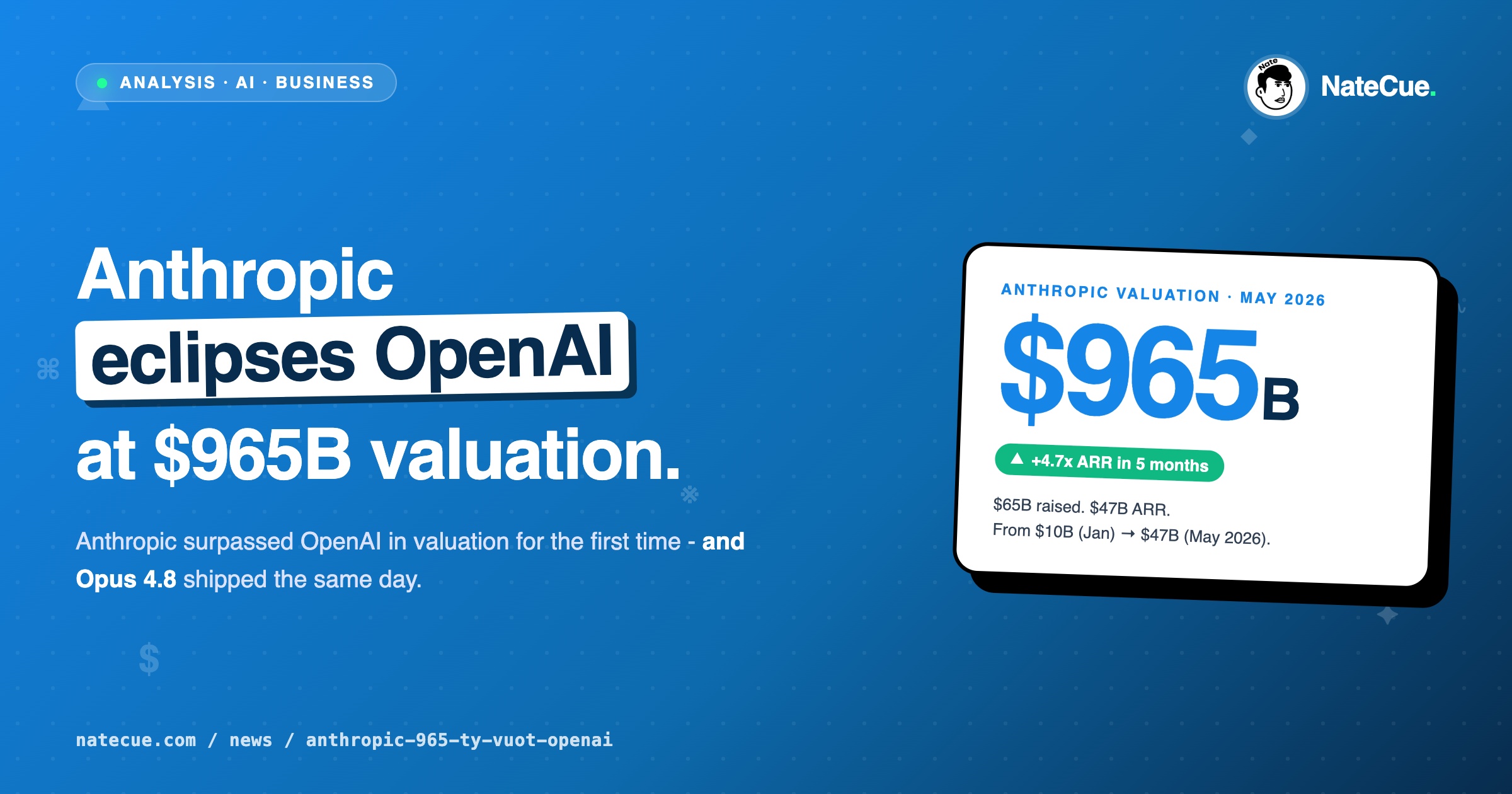
In May 2026, the world’s most valuable AI startup is not OpenAI. Anthropic closed its Series H on May 28 at $965 billion - surpassing OpenAI’s $852 billion for the first time. The round raised $65 billion. Revenue run rate: $47 billion, up from $10 billion just five months earlier.

The Number That Actually Matters Isn’t the Valuation
$965 billion is a headline. Here’s the number worth studying.
$47 billion ARR from $10 billion at the end of 2025. A 4.7x increase in five months. That kind of velocity at that scale has almost no historical precedent.
The $65 billion will go into three areas (Anthropic Official, 2026): expanding compute capacity to meet demand, advancing safety and interpretability research, and scaling products - specifically Claude Code and Cowork.
Lead investors include Altimeter, Sequoia, GIC, Coatue, Blackstone, and Fidelity. Samsung, SK Hynix, and Micron joined as infrastructure partners. PwC is deploying Claude enterprise-wide across hundreds of thousands of professionals globally (PwC x Anthropic, 2026). That’s not a pilot. That’s the kind of commitment that moves ARR.
TechCrunch projects 130% revenue growth for 2026, and this Series H could be Anthropic’s final private fundraise before an IPO (TechCrunch, 2026).
Claude Opus 4.8: Why “2.5x Faster, 3x Cheaper” Beats Any Benchmark
On the same day as the Series H announcement, Anthropic shipped Claude Opus 4.8.
The benchmarks improved: agentic coding climbed from 64.3% to 69.2%, knowledge work score from 1753 to 1890, computer use from 82.8% to 83.4% (9to5Mac, 2026). Good. But that’s not the lead.
The real change: Opus 4.8’s fast mode runs 2.5x quicker and costs 3x less than its predecessor, at the same price tier. For workflows running Opus through Claude Code or the API, that means more iterations at the same cost.
New features that matter in practice:
- Dynamic workflows (research preview): Handles larger-scale tasks within Claude Code
- Effort controls: Select “extra” or “max” effort for more intensive processing
- Messages API: Add system entries mid-conversation without breaking prompt caching
The development cadence is also signaling something: Opus 4.8 arrived just six weeks after Opus 4.7 (April 16, 2026). Anthropic is shipping faster than before.
Mythos and the Safety Paradox
At the same time, Anthropic referenced Mythos - its most powerful cybersecurity model, currently in limited release due to safety concerns. The plan is broader access “in coming weeks” for comparable models.
This is a visible tension in Anthropic’s strategy. Project Glasswing, which uses the Mythos Preview model, found over 10,000 critical-severity vulnerabilities across 50 partner organizations in its first month of operation (TechCrunch, 2026).
A model that capable isn’t something you deploy broadly without safeguards. And that’s precisely Anthropic’s position.
But it raises a question the company hasn’t answered publicly: when Mythos-tier capabilities reach general availability, where exactly is the line between security tool and attack surface? The safety-first brand will face its most difficult test at the frontier, not in the enterprise middle market.
What This Means for Vietnam and Southeast Asia
Vietnam has full access to both Claude.ai and the API - one of the few Southeast Asian markets where this is true. Usage data shows Vietnamese users engage with Claude primarily for software development and education (Anthropic Economic Index, 2025) - which aligns directly with Opus 4.8’s strongest improvements.
The practical friction remains: Claude Pro costs 4-5x more than ChatGPT Go in Vietnam (Digital in Asia, 2026). That keeps Claude in the premium developer tool category rather than mass adoption territory in the region.
The Anthropic - OpenAI competition is playing out primarily in enterprise, not consumer. ChatGPT leads decisively on user volume at 900 million weekly active users (OpenAI, 2026). Anthropic competes on contract size and revenue per customer. Those are different games with different metrics.
For developers and marketers working with Claude Code or the API: Opus 4.8 is a meaningful upgrade worth switching to now, particularly for dynamic workflows handling complex multi-step tasks and fast mode for lower-cost prototyping iterations.
The company that built its brand on “responsible AI” just became the world’s most valuable AI startup. Safety narrative, it turns out, is also a very effective enterprise sales strategy.
NateCue's Take
Anthropic is proving something skeptics underestimated: "safety-first" isn't a passive marketing position - it's an enterprise sales strategy that works exceptionally well. PwC, Fortune 500 companies, and financial institutions chose Claude because they face real legal and compliance risk with AI output. OpenAI has 900 million weekly active users, but Anthropic earns more per enterprise account. That's a fundamental business model difference, not just a product distinction. From Vietnam's vantage point: the top Claude use cases in Vietnam are coding and education - exactly what Opus 4.8 improves most. But at 4-5x the price of ChatGPT locally, Claude remains a premium developer tool rather than a mass-market product. The question worth asking: if you're building serious AI workflows, is that premium justified by the output quality difference?