
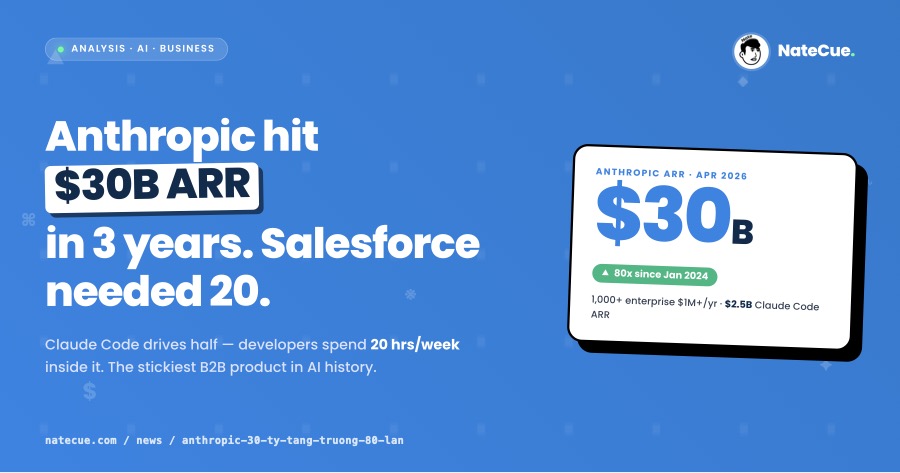
Salesforce took 20 years to reach $30 billion in annual revenue. Uber got there in 13. Netflix in 24. Anthropic did it in three - and the product driving most of that growth isn’t the one most people have heard of: it’s Claude Code.

The Timeline: $87M to $30B in 28 Months
January 2024: Anthropic’s annualized run rate was $87 million. A normal number for an AI startup.
December 2024: $1 billion. December 2025: $9 billion. February 2026: $14 billion. March 2026: $19 billion. April 2026: $30 billion.
CEO Dario Amodei called it “80x growth” compared to early 2024. CFO Krishna Rao described “exponential growth in our customer base.” For context, the global enterprise AI market is projected to reach $1.7 trillion annually by 2032 (24/7 Wall St., 2026). Anthropic is capturing a disproportionate slice of it - particularly in enterprise, where Claude holds an estimated 29% market share (Second Talent, 2026).
Claude Code: The Stickiest B2B Product in AI History
Claude Code crossed $1 billion ARR within its first six months - the fastest any B2B SaaS product has reached that milestone. By February 2026, it was generating over $2.5 billion in annualized revenue, with enterprise accounting for more than half.
The number that matters most isn’t the revenue. It’s usage: the average developer spends 20 hours per week working in Claude Code (Anthropic, 2026). That’s half a workweek locked into a single tool. No B2B software - not Slack, not GitHub Copilot, not Figma at its peak - has achieved this level of daily workflow integration.
Enterprise concentration is accelerating fast. Over 1,000 customers now spend more than $1 million annually. That figure doubled in under two months. Two years ago, there were “a dozen” accounts at that level. Today, 70% of Fortune 100 companies and 8 of the Fortune 10 are active Claude customers.
The Infrastructure Bet Behind the Numbers
Revenue at this scale demands matching infrastructure.
Amazon has committed up to $25 billion. Google and Broadcom finalized a multi-gigawatt TPU capacity agreement expected online from 2027, expanding Google’s total commitment beyond $40 billion (Anthropic, 2026). Combined committed infrastructure investment: over $65 billion.
The risk is real. GPU chips run $25,000-$70,000 per unit. Anthropic’s revenue trajectory is extraordinary, but the company has disclosed no profitability data. An IPO is under consideration for October 2026, with Goldman Sachs, JPMorgan, and Morgan Stanley already in preliminary discussions.
The question Wall Street will press: at this cost structure, what does the margin profile look like?
The Southeast Asia Angle Nobody’s Talking About
Vietnam has emerged as an above-average market for Claude usage in software development and education - Anthropic’s own Economic Index flags Vietnam as a market with disproportionately high coding use cases relative to its size (Anthropic Economic Index, 2025).
But the pricing structure creates a hard friction layer for emerging markets. Anthropic’s flat $20/month global rate carries no PPP adjustment. For users in Vietnam, Indonesia, or the Philippines, that translates to a 4-5x relative price premium over ChatGPT alternatives (Digital in Asia, 2026).
The practical result: large enterprises that can afford $1M+ annual contracts get full access. Independent developers and SMEs across Southeast Asia are effectively priced out of the consumer tier.
This matters because Vietnam’s developer community is already punching above its weight in Claude adoption despite the premium. The growth potential locked behind that pricing wall is substantial. If Anthropic eventually adjusts its emerging market strategy - through regional pricing, tiered plans, or local partnerships - the growth curve could look different from a regional perspective.
One open question: if Vietnam devs are among the heaviest per-capita Claude users globally despite paying 5x the proportional price, what happens when that pricing friction is removed?
NateCue's Take
The $30B headline is impressive. But the number that matters is 20 hours per week - how long the average developer spends in Claude Code. No B2B software has ever achieved this level of workflow integration, not Slack, not Figma, not GitHub Copilot at their peaks. This isn't a productivity tool anymore. It's a cognitive dependency. For marketers, the real question is: what's the Claude Code equivalent for marketing workflows? No product today comes close to that stickiness. The company that builds it - whether in Vietnam, the US, or anywhere - will capture the next wave of enterprise AI budget. Vietnam has the technical talent. The pricing model is the blocker.