
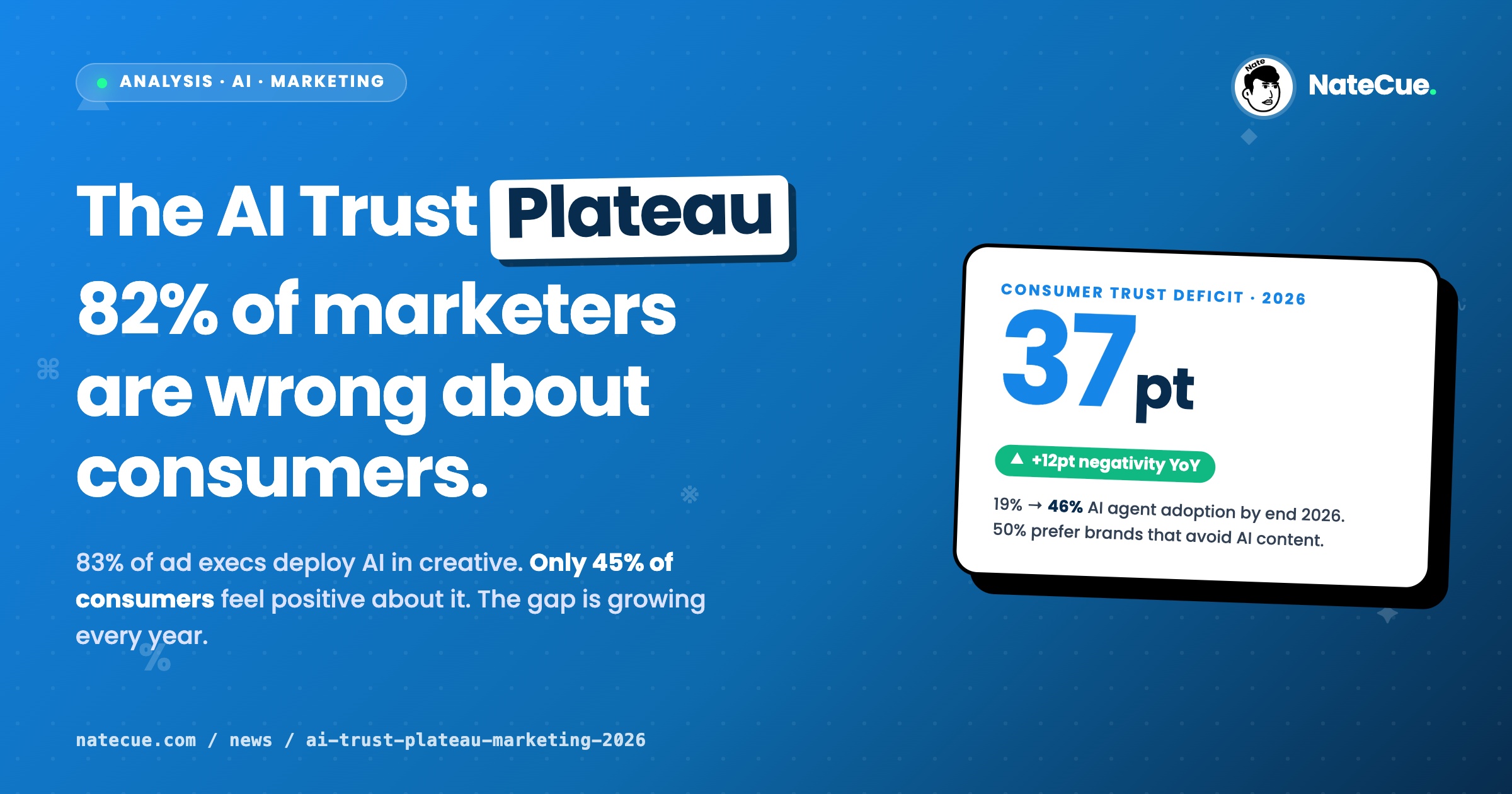
82% of marketing executives believe Gen Z and Millennial consumers have a positive view of AI-generated ads. The actual number: 45%. That 37-point gap isn’t a rounding error - it was 32 points in 2024 and has grown every year since (IAB, 2026).

Adoption Accelerates, Trust Stagnates
83% of ad executives have now deployed AI in creative production, up from 60% in 2024. At the same time, 38% of consumers report negative feelings about AI ads - a 12-point jump in a single year.
This is the central contradiction of 2026: brands are accelerating, trust is plateauing - or declining.
Braze named this phenomenon the “trust plateau” in their 2026 Customer Engagement Review, surveying 2,200 marketing executives and 4,000 consumers across the US and UK. The data is stark: 93% of marketers believe their AI systems accurately understand consumer needs. Only 53% of consumers agree - a 40-point gap at its highest recorded level.
Marketers Are Measuring the Wrong Things
The problem isn’t that AI doesn’t work. The problem is what gets measured.
Most marketing teams track AI adoption rates and short-term ROAS. Almost no one is measuring trust decay - the slow erosion of brand equity that accumulates each time a consumer identifies content as AI-generated.
Klaviyo’s 2026 research shows 32% of consumers trust a brand less when they encounter AI-generated marketing content. Nearly 1 in 5 consumers now see low-quality AI content from brands weekly. 50% would actually prefer to give their business to brands that avoid generative AI in customer-facing interactions.
Short-term ROAS may hold steady. Brand equity erodes quietly, with no metric sending an alert.
Gen Z Is the Earliest Warning Signal
Gen Z is the cohort that warrants the most attention. 39% have negative feelings about AI ads, versus 20% of Millennials. 30% consider AI-using brands “inauthentic.” 24% call them outright “unethical” (IAB, 2026).
This isn’t passive ad-skipping. Gen Z is forming negative brand associations with companies that deploy AI poorly. That demographic enters peak purchasing power in the next five years.
There’s one clear opportunity: 73% of Gen Z and Millennials say they would respond more positively to AI-generated content if brands disclosed it upfront. Transparency isn’t a weakness in this environment - it’s a differentiator.
Vietnam: A Fast-Follower Trust Debt Story
Vietnam offers a useful lens for understanding how fast-follower markets navigate this dynamic. 89% of Vietnamese businesses have integrated AI into marketing - higher than most Southeast Asian peers.
But EuroCham’s 2026 survey across 44 countries flags a sharp divergence: concern about AI spreading false information in Vietnam jumped from 36% to 65% in a single year - the largest increase of any measured metric, and nearly double the baseline.
Usage is up. Confidence in AI-generated information is down. These two trends can’t run in parallel indefinitely.
Globally, AI agent adoption for brand interactions stands at 19% today and is projected to reach 46% by end of 2026 (Braze). But 27% of consumers already refuse to share data with AI agents, and 43% say they would stop engaging with a brand entirely if their data were misused.
The adoption curve is real. The trust infrastructure isn’t keeping pace with it - in any market.
NateCue's Take
The issue isn't that consumers hate AI. They hate AI without transparency. IAB data shows 73% of Gen Z and Millennials respond more positively when brands disclose AI usage. Marketers are selling the wrong product story: they think they're delivering "AI-enhanced experiences," but consumers read it as a signal that the brand is cutting corners on the one thing that matters - individual attention. Vietnam is an interesting case study here: 89% of businesses have adopted AI in marketing, but concern about AI-driven misinformation jumped 80% in a single year. Fast-follower markets accelerate both adoption and skepticism simultaneously. The window to build trust infrastructure before it becomes a systemic conversion problem is shorter than most marketers think.