
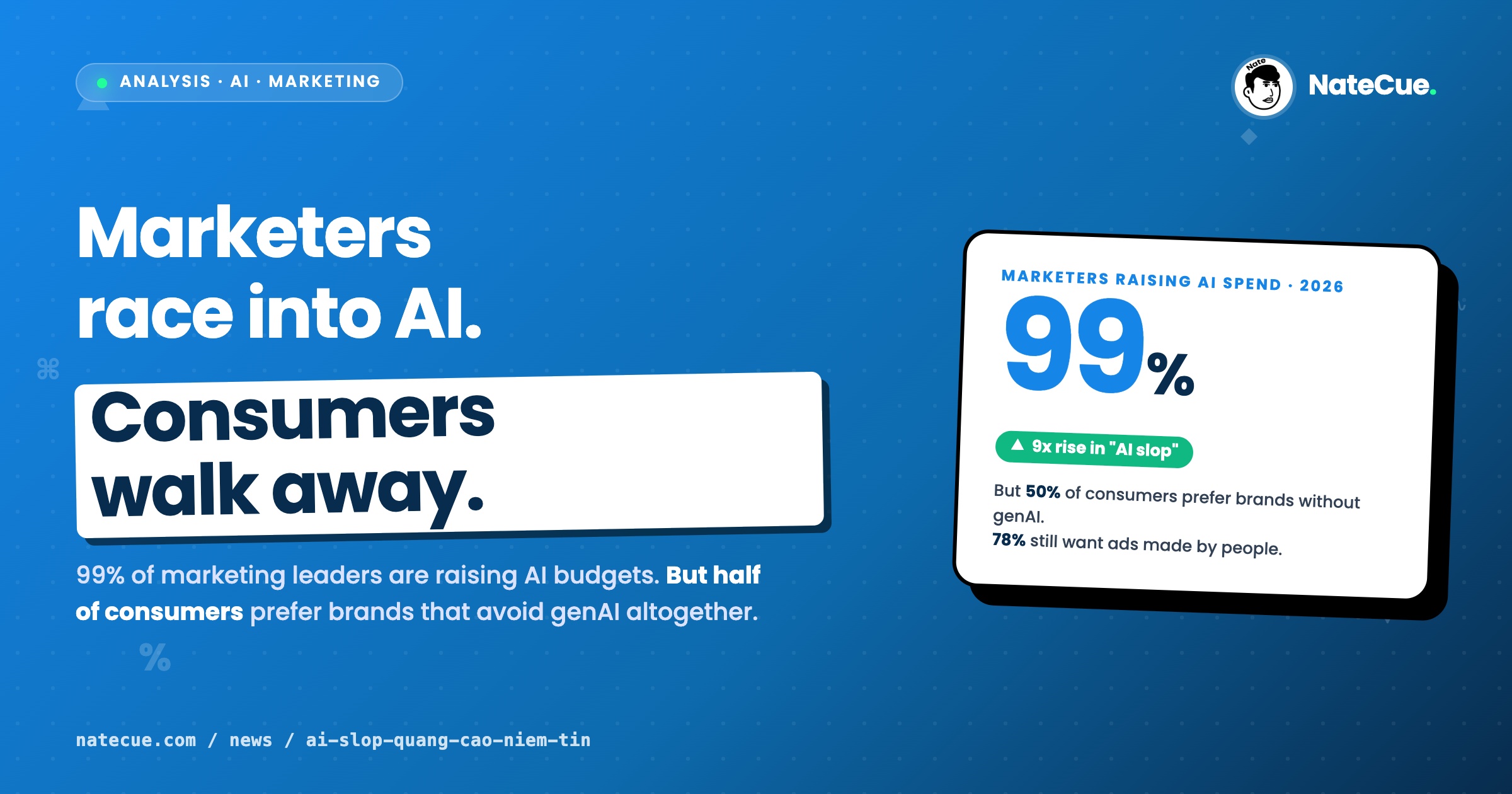
99% of marketing leaders say they will increase AI investment in 2026 (Canva, 2026). At the same time, 50% of US consumers say they prefer brands that do NOT use genAI in customer-facing content (Gartner, 2026). Those two numbers run in opposite directions. That gap is the real marketing story of the year.

The marketer’s one-way race
On the marketer side, AI is no longer an experiment. 97% of marketing leaders use AI in daily creative work (Canva, 2026). 99% plan to grow their AI budgets. The era of “just testing” is over.
The money is moving fast. 77% of senior marketing decision-makers plan to shift budget from traditional creator marketing toward AI-generated content (Billion Dollar Boy, via eMarketer). The logic is obvious: faster, cheaper, infinitely scalable.
The problem is nobody asked the person on the other side of the screen.
Consumers are walking away
They feel the opposite. Only 7% of consumers say visible AI-generated content makes them trust a brand more. 31% say it makes them trust the brand LESS (Klaviyo, survey of 8,000 people across 8 countries, December 2025).
Anti-AI sentiment is becoming a trend. Mentions of “AI slop” - cheap, soulless AI output - jumped ninefold in media monitoring data (Canva, 2026). 41% of marketing leaders admit it is a real problem. Nearly 1 in 5 consumers say they see low-quality AI content from brands every week.
And they still want humans. 78% say they would rather see ads made by people, even if AI could do it better (Canva, 2026). 87% believe the best advertising still needs a human touch.
The disclosure trap
Here is the part most marketers miss. Consumers demand transparency: 91% expect brands to disclose when they use AI in marketing (Emplifi). Sounds easy - just label it.
But labeling AI lowers trust on its own. The same content, once revealed as AI, scores lower. That is the trap: you are required to disclose, and disclosing costs you.
It gets worse once AI starts recommending purchases. 75% of Americans say they would trust AI less if its recommendations were swayed by ad dollars (Quad x The Harris Poll, survey of 2,180 people, February 2026). Only 39% trust AI agents for everyday purchases. When AI is both the ad channel and the shopping advisor, the conflict of interest is instant.
Vietnam: the law just made this mandatory
Vietnam is not sitting this out. Under Decree 142/2026/ND-CP, organizations and individuals using AI systems must disclose when content is created or altered by AI in ways that affect perceptions of authenticity.
In other words, the disclosure trap above is now a legal obligation in Vietnam, not a choice. That makes the country an early stress test for what the rest of the world will face.
Vietnamese consumers are more authenticity-sensitive than expected. A cross-national study (839 responses across Vietnam and Australia) found Vietnamese consumers evaluate AI ad videos on cognitive signals: informational clarity, authenticity, credibility. Message authenticity significantly boosts their positive experience.
On the ground, the pattern holds: Vietnamese audiences spot fully AI-generated content instantly. The winning formula uses AI for post-production and efficiency, while keeping humans for storytelling and the on-camera presence. Behind-the-scenes content builds trust faster than polished ads.
The AI race in marketing is not wrong about speed. It is wrong to run without watching which way the people paying the bills are walking.
NateCue's Take
Most marketers are measuring the wrong thing. They track "hours saved by AI" and "creatives shipped per week." Nobody tracks the trust tax - the silent cost paid every time a customer realizes it was AI. The winning move isn't "more AI" or "no AI." It's AI invisible in the back office, humans visible up front. Use AI to draft 50 versions, build briefs, crunch data - no one sees it. But the face, the voice, the story that hits the customer has to be a real person. Vietnam just made this a law. Decree 142 forces AI disclosure, and the label itself lowers trust. So in 2026 the edge belongs to brands brave enough to keep humans at the storefront - not the ones automating fastest. This is a global pattern wearing a Vietnamese nameplate.