
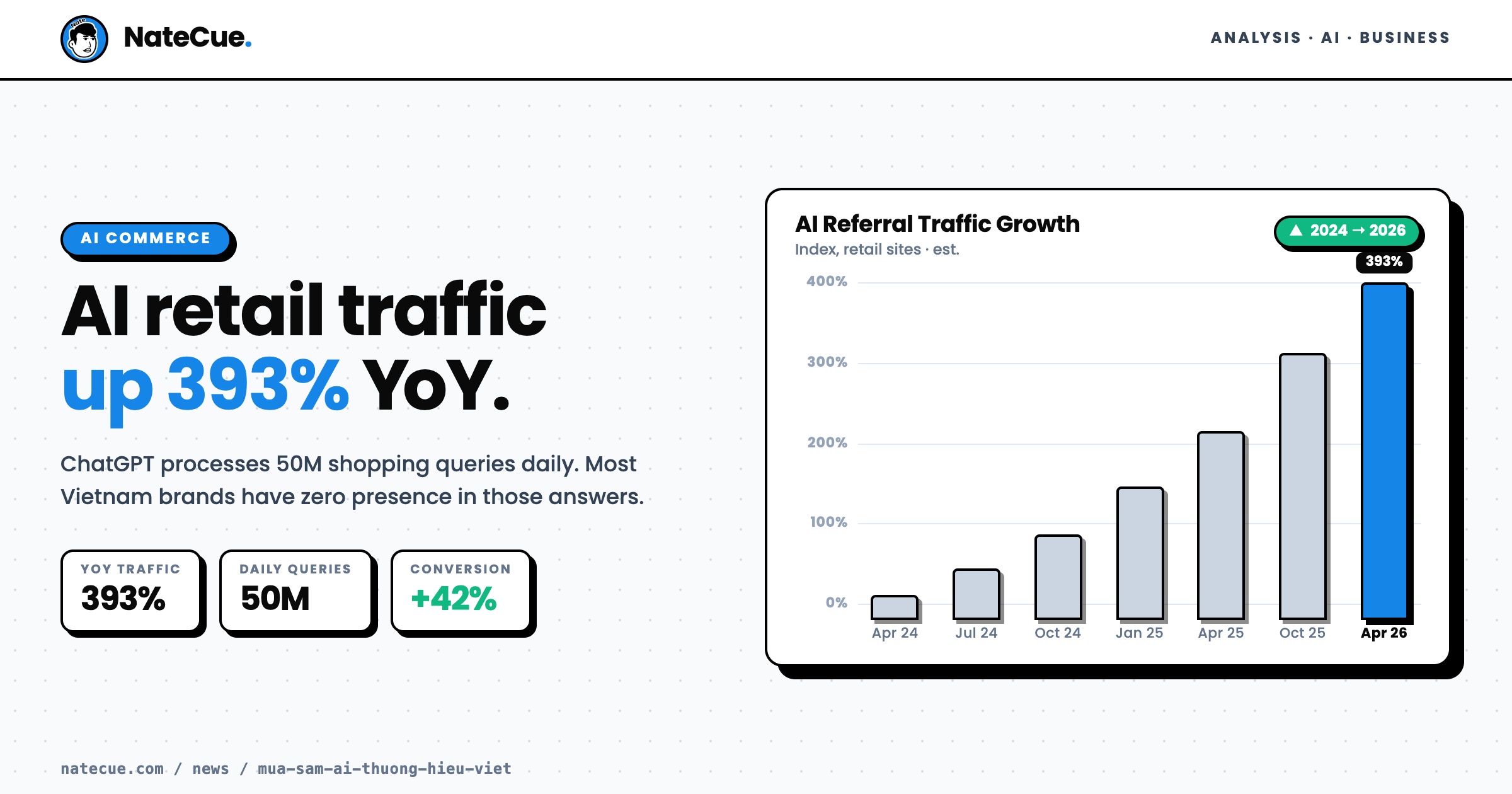
AI referral traffic to U.S. retail sites grew 393% year-over-year in Q1 2026. Walmart attributes roughly 20% of its referral traffic to ChatGPT. Amazon’s AI shopping assistant Rufus converts customers 60% better than traditional browsing. Salesforce tracked $262 billion in sales influenced by AI agents during the 2025 holiday season alone. This isn’t a forecast - it’s the current quarter’s data.
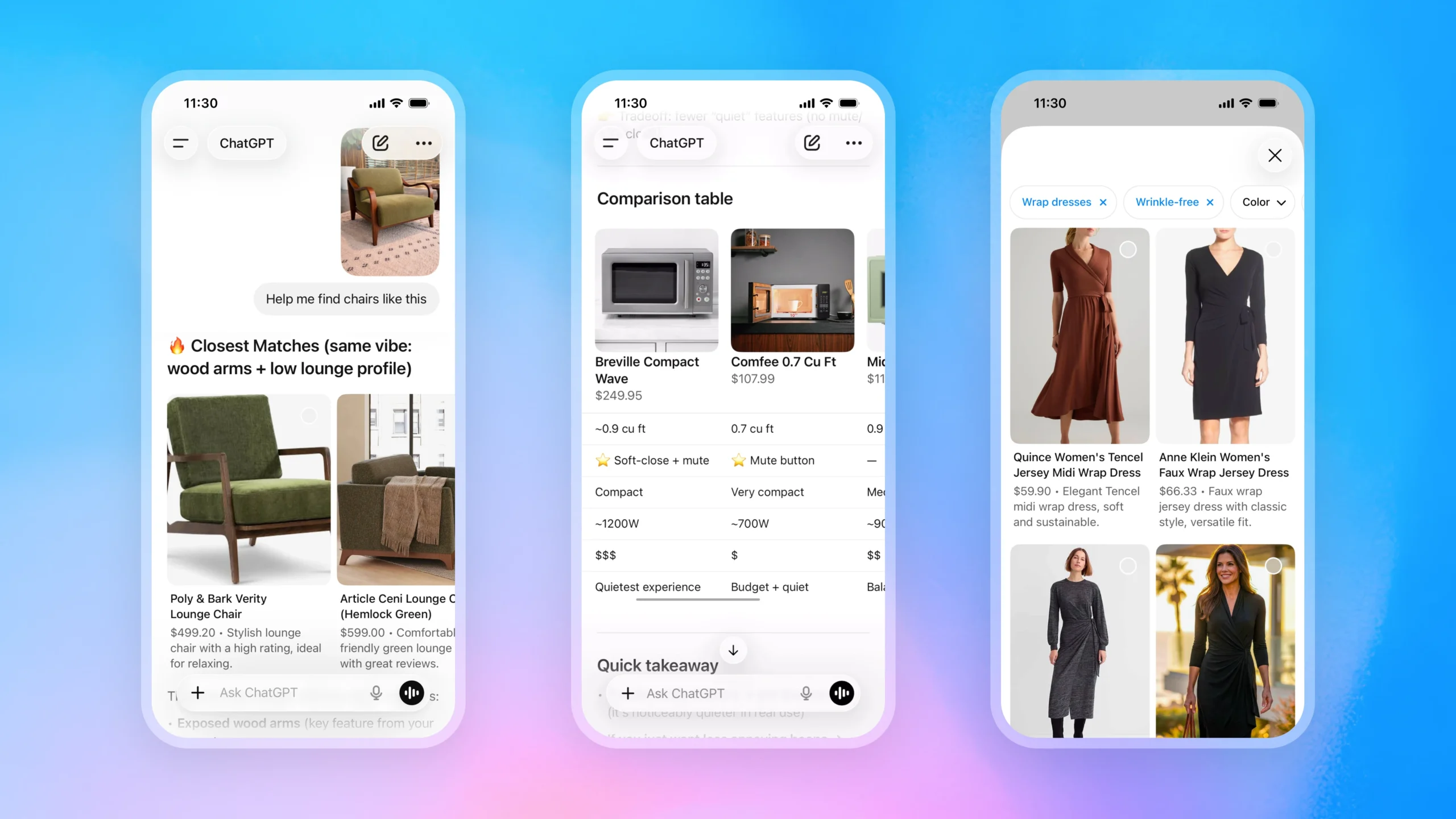
ChatGPT Is Not a Chatbot Anymore - It’s a Distribution Channel
When a shopper asks ChatGPT “best moisturizing lipstick under $20 for dry lips,” they don’t get a list of links to browse. They get specific product names, reasons to choose one over another, price comparisons, and sometimes a direct purchase path.
If your product isn’t in that answer, you don’t exist in that shopping journey.
ChatGPT processes roughly 50 million shopping queries per day - about 2% of all queries across its 900 million weekly active users (Elogic Commerce, 2026). And AI referral traffic doesn’t just bring more visitors - it brings better ones: 42% higher conversion than non-AI traffic in March 2026, with 37% higher revenue per visit and 87% longer time on site.
Three Eras of Commerce AI - We’re Entering the Third
Commercetools maps the progression clearly:
- 2016-2022: Chatbots linking to product pages
- 2023-2025: AI recommendations populating shopping carts
- 2026 onward: Autonomous checkout inside chat interfaces
We’re entering the third era. Major retailers including Target, Sephora, Nordstrom, Lowe’s, Best Buy, and Wayfair have already integrated their product catalogs via OpenAI’s Agentic Commerce Protocol (ACP). Klarna has a dedicated shopping app inside ChatGPT. Walmart is launching account-linked loyalty integration directly inside the chat interface.
70% of global consumers say they’re comfortable letting an AI agent make purchases on their behalf (Commercetools, 2026). 73% are already using AI somewhere in their shopping journey - 45% for product ideas, 37% for review summaries, 32% for price comparisons.
The Retailer-Consumer Gap Is Where the Opportunity Lives
Here’s the most notable tension in the data: two-thirds of retail leaders don’t expect consumers to fully embrace agentic AI before 2028. But consumers are already doing it now.
This gap is a real opportunity. Deloitte found 29% of Asia Pacific consumer businesses are implementing agentic AI today - projected to reach 76% within two years. Alhena.ai estimates 10-30% of product discovery will migrate to LLM-based platforms within 18 months.
The long-term projections are even larger: McKinsey puts global AI agent-mediated commerce at $3-5 trillion. Bain projects 15-25% of U.S. e-commerce flowing through AI agents. Morgan Stanley: nearly half of online shoppers using AI agents by 2030, accounting for ~25% of spend.
Vietnam Angle: Live Commerce Leads, But AI Will Reshape Discovery
Vietnam’s market has a distinct character worth understanding. TikTok Shop commands 41% of e-commerce market share - driven by live commerce, KOL trust, and social buying behavior rather than keyword-driven search. Vietnamese consumers buy because they trust the seller, not because they followed a search result.
This makes fully autonomous AI checkout feel more distant for Vietnam than for the U.S. or European markets. But that framing misses the key dynamic.
AI shopping doesn’t need to replace live commerce. It will likely dominate the phase before the TikTok purchase: when someone asks “should I even buy this type of product?” or “what’s the difference between these three options?” - before they open TikTok to make the final call.
Southeast Asia’s e-commerce market hit $159 billion in 2024 and is tracking toward $215 billion by 2026 (Momentum Works). Vietnam’s new E-Commerce Law, effective July 2026, adds a regulatory layer to monitor. But the underlying dynamic is consistent across the region: AI is becoming the gateway to the purchase funnel, and whoever controls the top of that funnel influences what converts downstream.
29% of APAC consumer businesses are already running agentic AI implementations (Deloitte, 2026) - that number rising to 76% within two years means this shift will be regional infrastructure, not a niche experiment.
Three Actions That Don’t Require an Engineering Sprint
1. Audit your AI visibility today
Ask ChatGPT and Gemini about your product category. “Best Vietnamese skincare brand for oily skin,” “air purifier for a 30sqm apartment.” Does your brand appear? Which sources are being cited? This baseline tells you exactly what gap you’re working with.
2. Rewrite product descriptions for natural language queries
AI surfaces products based on contextual fit, not keyword density. “Good for sensitive skin because it’s alcohol-free and dermatologist-tested” outperforms “alcohol-free hypoallergenic formula clinically tested.” Real shoppers ask AI in natural language - your product descriptions need to mirror how they phrase the question, not how SEO tools phrase the answer.
3. Build presence on the sources AI cites
ChatGPT regularly pulls from Reddit, Wirecutter, trusted review publications, and industry media. Product mentions in those places become AI recommendations. This is the SEO equivalent for AI discovery - not optimizing for an algorithm directly, but building presence on the sources the algorithm trusts.
NateCue's Take
This pattern mirrors Google Shopping circa 2015: a new distribution channel emerges, most brands ignore it, and early movers lock in organic visibility before competition drives up the cost. Vietnam's live commerce culture is real - TikTok Shop's 41% market share isn't going anywhere. But AI will own the discovery phase that precedes the TikTok purchase. Brands with clean product data, reviews on sources AI cites, and descriptions written for natural language queries will win top-of-funnel before competitors realize the game changed. The action isn't a big engineering investment - it's a one-hour audit: ask ChatGPT about your product category right now and see where your brand lands.