
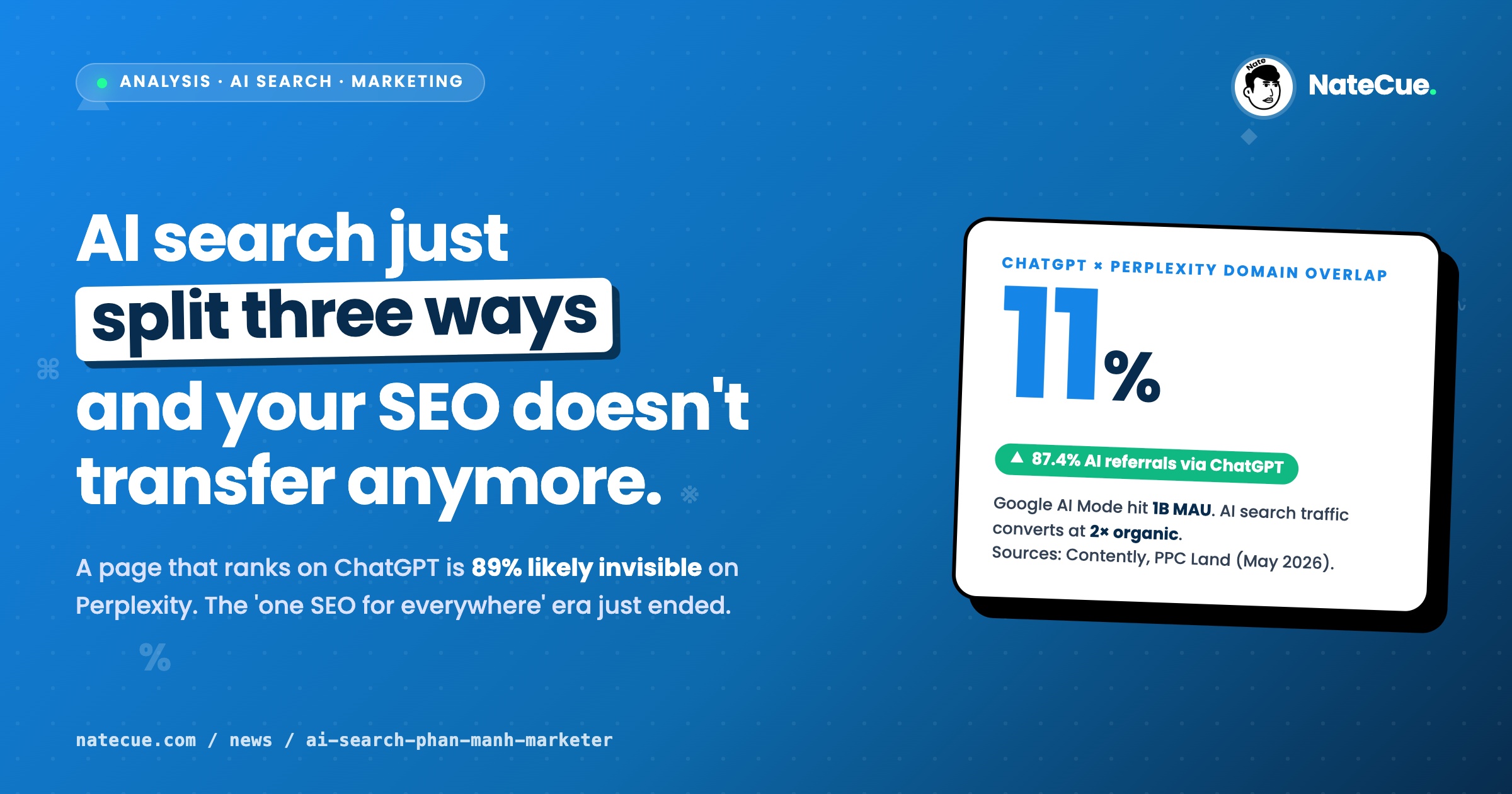
Only 11% of domains get cited by both ChatGPT and Perplexity (Contently, Apr 2026). A page that ranks on one is 89% likely to be invisible on the other. The most basic assumption of SEO - that optimizing well means showing up everywhere - just broke.
The “one SEO for everywhere” assumption is dead
For a decade, SEO ran on a quiet premise: rank on Google and you’d rank on Bing and Yahoo too. Different engines, similar signals. AI search just deleted that.
Contently’s data is blunt: ChatGPT and Perplexity draw from entirely different citation pools. Only 11% of domains appear in both. Run the same query twice and the two AIs return two almost non-overlapping source sets. The reason? ChatGPT favors brand authority and content depth; Perplexity rewards citation density and recency. Two different logics, no shared formula.
The consequence for marketers: content strategy now has to fork three ways - one for ChatGPT, one for Perplexity, one for Gemini. No shortcut available.
ChatGPT is winning the traffic - but who is measuring?
The numbers get harsher in real traffic. 87.4% of all AI-generated referrals come from ChatGPT (Contently). ChatGPT has 700 million weekly active users. Google AI Mode just crossed 1 billion monthly active users in May 2026, with query volume doubling every quarter (PPC Land, May 28, 2026).
More importantly: AI traffic isn’t junk traffic. Conductor’s benchmark shows visitors arriving from AI search convert at 2x the rate of traditional organic (Demand Local, May 22, 2026). Meanwhile, Google Ads CPL has climbed to an average of $70.11 (WordStream via Demand Local), while OpenAI Ads Manager CPC sits at just $3-5 (PPC Land).
The gap: most marketing teams have no AI visibility tracking in place. They don’t know if ChatGPT cites them, which content Perplexity picks up, or whether Gemini surfaces them at all. The inflow converts 2x. The outflow is blind.
65% of US adults use AI weekly - the tipping point already passed
In February 2026, 52% of US adults used AI weekly. By May 2026, the figure is 65% - roughly 175.5 million people (PPC Land). That’s 36 million new users in three months. This isn’t an early-adopter curve anymore. It’s mass adoption.
At the same time, OpenAI dropped the Ads Manager minimum spend from $250,000 to $0 (PPC Land, May 28, 2026), and added daily budgets, geo-targeting, and dynamic CTAs. ChatGPT is targeting $2.5 billion in ad revenue for 2026 (JumpFly, May 28, 2026). The infrastructure for SMB participation is fully built - it’s just waiting for the market to walk in.
Vietnam: a narrow window, open briefly
Vietnamese marketers sit in a strange position. ChatGPT has been a default office tool since 2024. Yet AI visibility tracking barely exists in the local market. Most domestic SEO agencies still bundle “AI Overviews optimization” as a feature, rather than treating ChatGPT, Perplexity, and Gemini as three distinct optimization problems.
This is rare arbitrage. Once tracking becomes standard (likely 12-18 months out), AI ad CPCs will rise with demand, citation slots will get contested, and the first-mover advantage will collapse. Vietnamese brands have one genuine asset: Vietnamese-language content is still thin in AI training and retrieval indexes. Competition is materially lower than for English-language content in the same niches.
The question isn’t whether to invest in AI search visibility - it’s whether to move before competitors or wait until they’re done and chase.
NateCue's Take
The real risk isn't having to optimize three times. The real risk is that most companies still can't measure whether they're visible in ChatGPT - while AI traffic, though small in volume, already converts at 2x organic. Once tracking goes mainstream, the first-mover discount disappears. Practical split: 70% effort on ChatGPT (87.4% of volume), 20% on Perplexity (citation-dense content), 10% on Gemini (rides Google SEO). Don't spread evenly - even distribution is the surest way to win nowhere. Emerging markets like Vietnam still have a language arbitrage window; English-first markets are already pricing it in.