
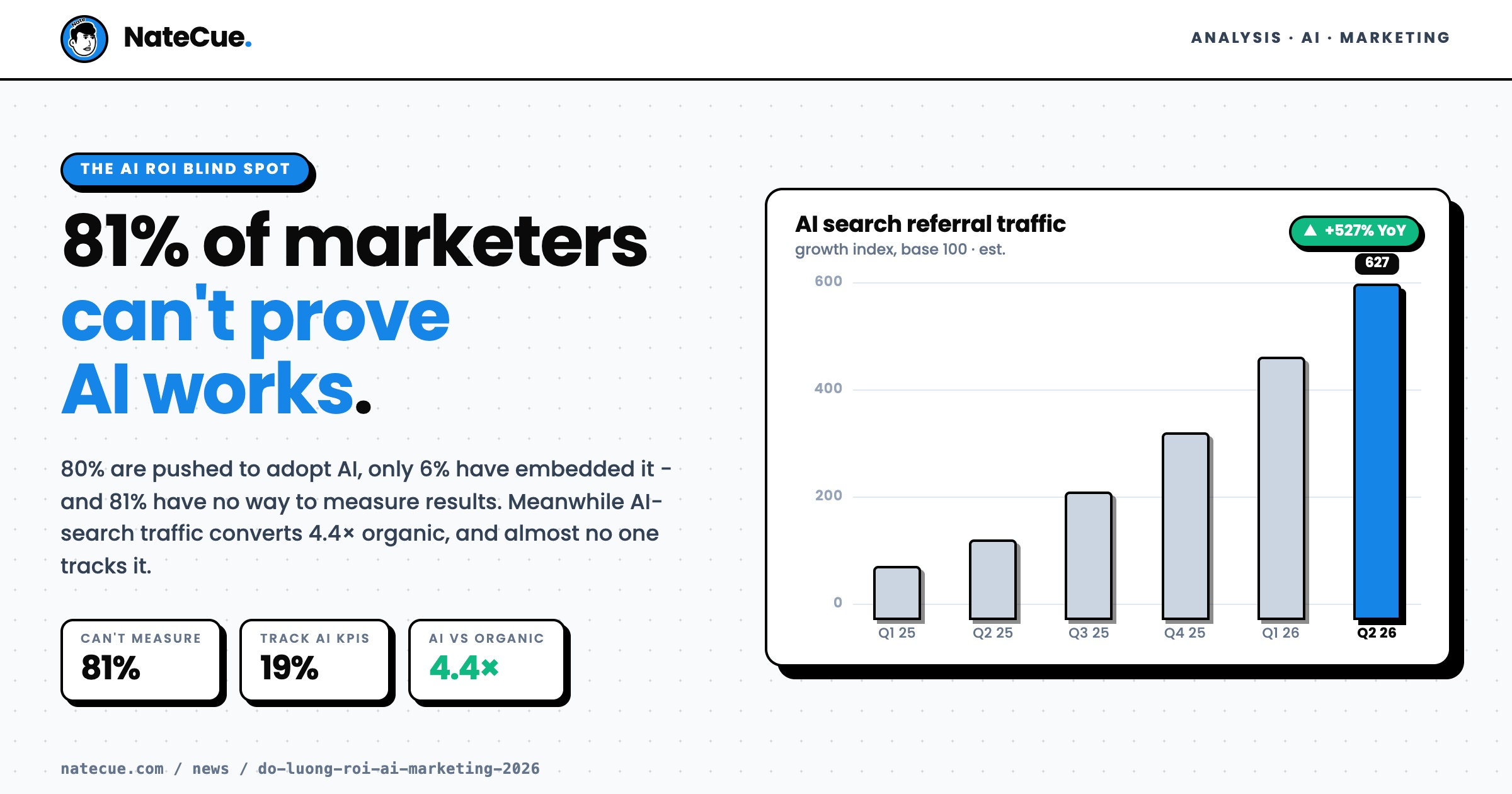
80% of marketers are pushed by leadership to use AI (Supermetrics, 2026). Only 6% have actually embedded it into their workflows. And 81% have no way to tell whether AI is producing results or just producing content (DigitalApplied, 2026).
An entire industry is spending on something almost nobody can prove is worth the money.
Everyone uses AI, almost nobody measures it
The adoption numbers look great. 74% of content marketers have AI in their workflow. But only 19% have a measurement framework built specifically for AI (DigitalApplied, survey of 1,200+ practitioners, 2026). The other 81% still measure with pre-AI KPIs.
The pressure comes from the top. Supermetrics surveyed 435 marketers globally: 80% feel pushed to adopt AI, and 89% say that pressure comes from the C-suite and the board. At the same time, 45% name ROI measurement as their single biggest challenge.
AI search is worse. Goodfirms (2026) found only 14% of marketers track whether their brand gets cited in AI search - even though 89% of brands already appear in AI-generated results. Jennifer Warren, Senior Researcher at Goodfirms, put it bluntly: “Visibility and traffic are no longer the same metric, and most analytics frameworks haven’t caught up to that reality.”
The double blind spot: missing the cost, ignoring the revenue
Here’s the connection few people make. Marketers are blind on both ends.
The cost end: 81% don’t know whether AI is saving or burning money, because they measure outputs (traffic, leads) instead of AI’s own efficiency.
The revenue end is worse. Traffic from AI search converts at 4.4x the rate of organic search for informational queries (Semrush, June 2025). Split by platform, ChatGPT converts at 15.9% while Google Organic sits at 1.76% (Marshal data). Ahrefs found that 0.5% of its AI-sourced visitors drove 12.1% of total signups - a 23x multiplier. These visitors also engage harder: ChatGPT users view 2.3 pages per session, nearly double the organic average (Marshal data).
Yet only 16% of brands systematically measure AI search performance. This traffic is still about 1% of total visits, but it’s growing 527% year over year. The highest-converting source is precisely the one least measured.
Why nobody measures: old ruler, new object
The problem isn’t a lack of tools. It’s that teams still measure with the KPI set from before AI existed.
Old KPIs - traffic, leads, conversions - can’t detect the two things AI actually changes: cost and production speed. DigitalApplied proposes AI-specific metrics: content velocity (target 2-4x baseline within six months), cost per content unit (40-70% reduction for standard formats), and AI edit rate (kept at 25-40% human revision).
The encouraging part: teams that tracked velocity and cost before and after AI could demonstrate concrete productivity gains within 90 days. No need to wait a year. Just measure the right thing.
The Vietnam lens: higher pressure, thinner measurement
In an emerging market like Vietnam, the leadership-driven AI fever runs even hotter. But the measurement foundation is thinner. Many companies haven’t set up GA4 properly, have no first-party data stack, and have nobody who owns tracking.
The result: a Vietnamese brand may already be showing up in Vietnamese-language ChatGPT answers without knowing it. And that 4.4x upside is completely invisible to them.
But that’s also the reassuring part, and it generalizes. Measuring AI traffic is nearly free - it’s a segment in GA4. No team, anywhere, needs to wait for budget to start. What’s missing isn’t money. It’s the discipline to measure the right number.
The open question for 2026: when the CFO starts asking “what did AI return,” which teams will already have the number, and which will still be counting posts per week?
NateCue's Take
Here's the uncomfortable part: a lot of teams don't measure AI ROI because they're afraid of the answer. Tracking "content velocity" and "posts per week" feels safer than tracking "revenue AI brought in." If the honest number is negative, vanity metrics are a great place to hide. But avoidance isn't a strategy. The real unlock costs nothing. Two free moves: segment AI-search traffic in GA4 - you'll be surprised how well it converts - and log cost-per-content before and after AI. The team that measures first keeps its budget when the hype cools. The team hiding behind output metrics loses it first - because when the CFO asks "what did AI return," "we shipped more content" is not an answer. This is a global pattern, and it reads even sharper from an emerging market like Vietnam.