
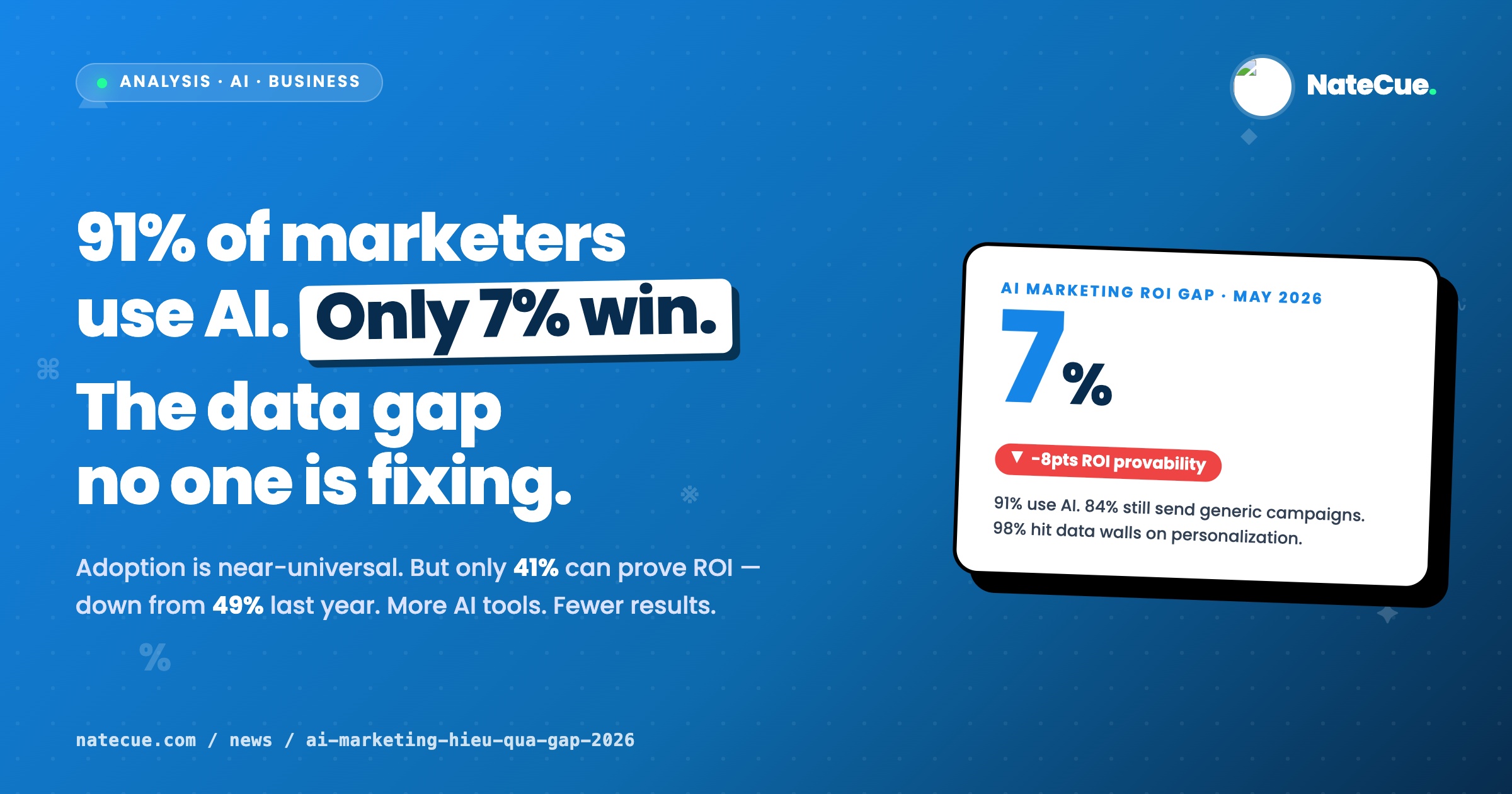
91% of marketers are now using AI. Yet only 41% can prove it’s driving ROI - and that figure is falling from 49% last year. Adoption is up. Provable business results are down. That’s not a tool problem. That’s a structural problem.
Adoption Peaks While ROI Declines
Jasper surveyed 1,400 marketers in early 2026: 91% actively use AI in their daily work, up from 63% a year ago (Jasper, 2026). That adoption figure is near-universal.
But at the same time, only 41% can demonstrate that AI is generating ROI - down from 49% in 2025 (Jasper, 2026). And Supermetrics goes further: just 7% of marketing teams have embedded AI in ways that deliver measurable business outcomes (Supermetrics, 2026).
The two trend lines are moving in opposite directions. Adoption up. Provable results down. Something isn’t adding up.
87% Are Using AI to Do the Wrong Thing Right
Supermetrics breaks down how marketers actually use AI: 87% use it for content creation and copywriting - by far the most common application (Supermetrics, 2026). Only 39% use it for reporting and analytics. Only 33% use it for marketing automation in any meaningful sense.
The pattern is clear: AI is accelerating output, not impact. More content, faster. But not better-performing content.
Salesforce’s 10th State of Marketing report (4,450 marketers surveyed) puts it bluntly: 84% of marketers admit they’re still running generic campaigns despite using AI (Salesforce, 2026). Salesforce’s CMO captured the irony precisely: “We are using the most powerful technology in history to send more one-way spam, faster.”
That’s not a technology failure. That’s a strategy failure.
Data Is Where the Gap Lives
Salesforce identified a striking number: 98% of marketing teams using AI face at least one data-related barrier to personalization (Salesforce/Diginomica, 2026). Not some teams - virtually all of them.
Supermetrics traces the root cause: 52% of marketers don’t control their own data strategy - decisions are made by external teams or IT, not marketing (Supermetrics, 2026). Only 33% can effectively activate their data. Only 24% achieve personalization at scale.
The core problem: AI cannot personalize what it doesn’t have clean data to personalize against. Without first-party data, without working attribution, without integrated systems - AI is just a faster content factory pointing at the wrong targets.
The flip side: teams that have invested in data infrastructure are getting 2-3x returns (Jasper, 2026). The gap between “AI is working” and “AI is burning budget” is large and growing - and data strategy is the dividing line.
What This Looks Like in Vietnam and Southeast Asia
No Vietnam-specific data appears in these reports. But the implication is clear.
Adoption pressure is intense everywhere: 80% of marketers globally say they feel C-suite pressure to adopt AI (Supermetrics, 2026). In Vietnam, AI has become a mandatory talking point in every strategy deck. Teams are buying tools, adding AI slides to presentations.
But what about the data foundation? Most Vietnamese SMBs don’t have a CDP. Cross-channel attribution is still unsolved for many teams. First-party data is fragmented across website analytics, CRM, and social - not connected into anything AI can act on.
If globally only 6% have truly embedded AI effectively, Vietnam’s number is almost certainly lower. Not because of tool access - tools are available - but because the data infrastructure AI needs to perform doesn’t exist for most organizations yet.
The regional opportunity is real: Southeast Asia’s digital ad market is growing fast, and first-mover advantage on data-ready AI marketing will be significant. But the race is for infrastructure, not tools.
Who Is Actually Winning
Jasper profiles the characteristics of best-in-class AI marketing organizations. The top traits: content treated as a systematic process, governance embedded at scale, and clear ownership over data (Jasper, 2026).
None of those characteristics are “use the newest AI tool.” The differentiator between winning and losing teams isn’t the model they’re using. It’s the invisible infrastructure behind it: the process design, the data architecture, and the accountability structure.
In 2026, the question isn’t “are you using AI?” Everyone is. The question is: “Is your data clean enough for AI to actually work?”
That’s the gap most marketing teams haven’t closed. And until they do, more AI tools just means more generic campaigns delivered faster.
NateCue's Take
Here's the uncomfortable truth buried in all this data: AI doesn't produce better results, it just produces more of them, faster. 87% of marketers use AI for content creation, but 84% still run generic campaigns. The bottleneck isn't the tools - it's data infrastructure. For markets like Vietnam where most SMBs have no CDP, no clean first-party data, and no working attribution model, this problem is even more acute. AI strategy without data strategy is just a faster way to spend money on things you can't measure. The 6% who are actually winning built the plumbing first. That's the lesson that keeps getting skipped in every AI hype cycle.