
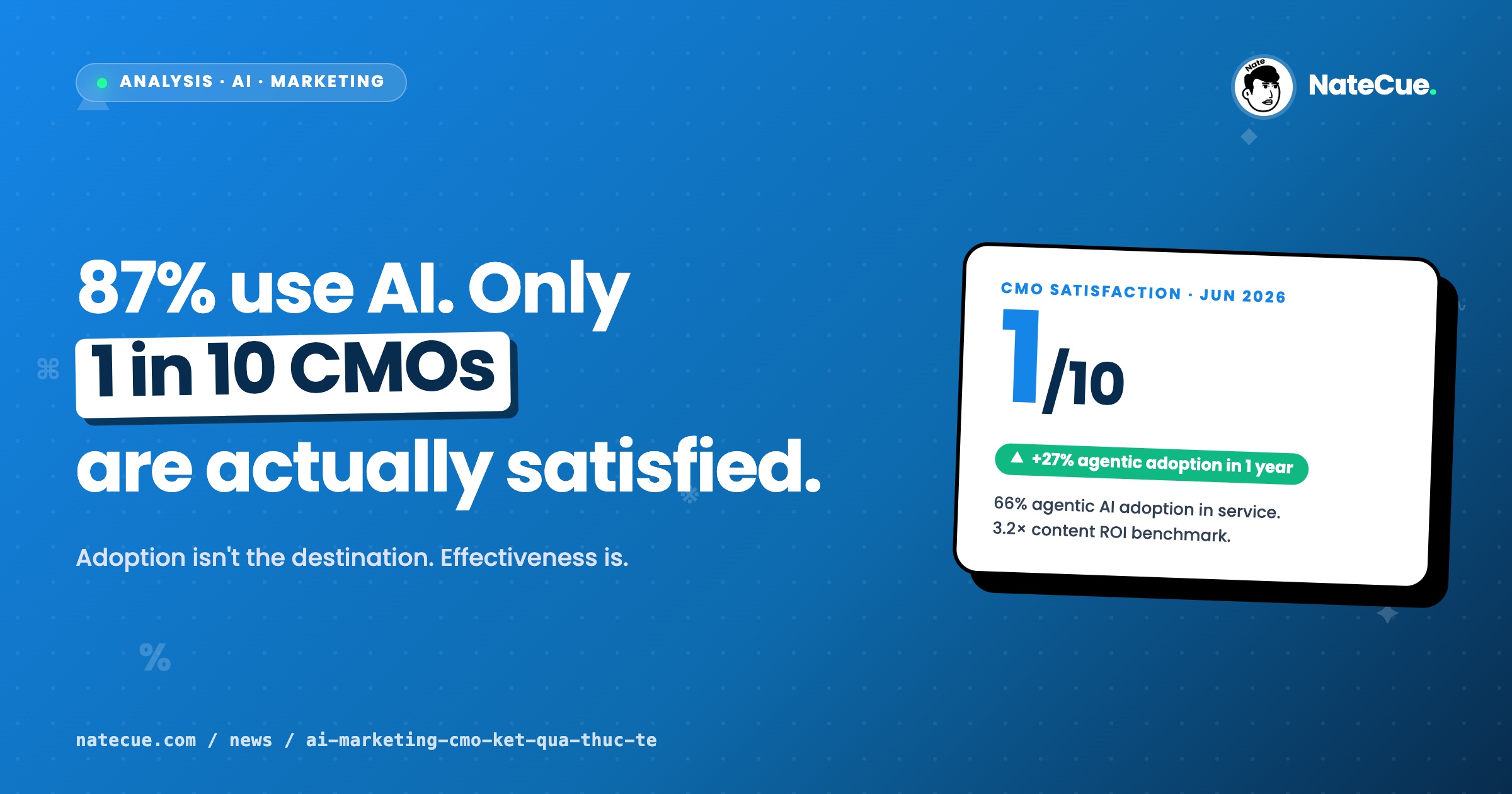
87% of marketers have deployed AI into at least one workflow. Ask 500+ CMOs whether their AI stack is actually performing at an excellent level - only 1 in 10 says yes. This is not a technology problem. It’s the defining tension in marketing for 2026.
Adoption is accelerating. Effectiveness isn’t keeping up.
Agentic AI adoption in customer service jumped from 39% to 66% in a single year - based on a Salesforce survey of more than 3,000 service professionals. Talkwalker tracked over 17 million agentic AI mentions from late 2023 to late 2025, with 91% net positive sentiment.
The interest is obvious. The results are not.
A June 2026 survey of 500+ global CMOs found that roughly 1 in 10 rates their organization’s AI technology enablement as “excellent.” The majority report the same familiar blockers: fragmented data infrastructure, organizational rigidity, and limited C-suite support for real transformation.
Research from French mid-market firms adds more evidence: over 75% have adopted generative AI tools, but only a small minority report meaningful productivity gains. Companies are buying fast. Building slow.
Who is actually winning with AI right now?
70% of organizations report measurable ROI within 60 days of agentic AI deployment (Salesforce). That number sounds encouraging - but there’s a selection condition built in.
Those are organizations that already had the data accessible, the workflows standardized, and people who could interpret AI output and course-correct when needed.
Real-world benchmarks from First Page Sage show content drafting agents delivering average 3.2x ROI, personalization agents at 2.7x, and audience research tools at 2.4x. Typeface breaks down the timeline more precisely: operational time savings on campaign creation appear within days, measurable lift on personalization and A/B testing within weeks, and genuine improvement in conversion rates and operational costs requires 3-4 quarters.
The difference between companies seeing results in 60 days and companies waiting 4 quarters is not the AI. It’s organizational readiness.
Talkwalker identifies the most significant blocker: 45% of executives cite lack of visibility into AI decision-making. When an agent makes a campaign decision, who is responsible? How do you verify the output? That’s a governance question - not a product one.
Where does Southeast Asia stand?
Vietnam ranks second in Southeast Asia for AI adoption, with 26.5% of the population actively using AI tools (VnExpress) - ahead of Malaysia (21.8%), the Philippines (20.1%), and Thailand (12.4%), trailing only Singapore (63.4%). Strong signal for consumer-level readiness.
But enterprise marketing readiness is a different picture.
Deloitte reports that only 29% of Asia Pacific consumer businesses have deployed agentic AI in production - and projects that number will reach 76% within two years. That’s the pace the entire region is being forced to match.
The stakes are significant. Deloitte forecasts that Asia Pacific - including Vietnam - will contribute approximately two-thirds of new global retail sales growth over the next five years, driven by 4.3+ billion shoppers and a rapidly expanding middle class. Gartner projects that 60% of brands will use agentic AI for one-to-one customer interactions by 2028.
The window to build the operational foundation is narrowing.
The real problem isn’t the tool
Salesforce’s State of Marketing 2026 (4,450 marketers surveyed) frames it directly: 83% of marketers say customers now expect two-way conversations, but 69% can’t respond in time because they lack the context. Only 58% have full access to service data, 56% to sales data, and 51% to commerce data.
Agentic AI cannot perform on a data stack like that.
That’s why 9 in 10 CMOs are dissatisfied. Not because the AI isn’t capable enough. Because most organizations are trying to run agents on top of data and process infrastructure that isn’t ready for it. The tool can be purchased in a day. The foundation takes months to build.
87% adoption looks impressive on a slide deck. The more useful question for end of 2026: of those, what percentage is generating a measurable delta in actual business outcomes?
NateCue's Take
The "70% see ROI in 60 days" stat is real - but it selects for companies that already had clean data, clear process, and people who could operate in the gap between AI output and business judgment. That's a small subset of the market. For most mid-sized businesses in Southeast Asia - Vietnam especially - you're looking at 3-6 months just to get data infrastructure to a usable state before an AI agent can do anything meaningful. The adoption numbers are optimistic. The readiness numbers tell the real story. What matters now isn't buying more tools. It's building the foundation that makes them work.