
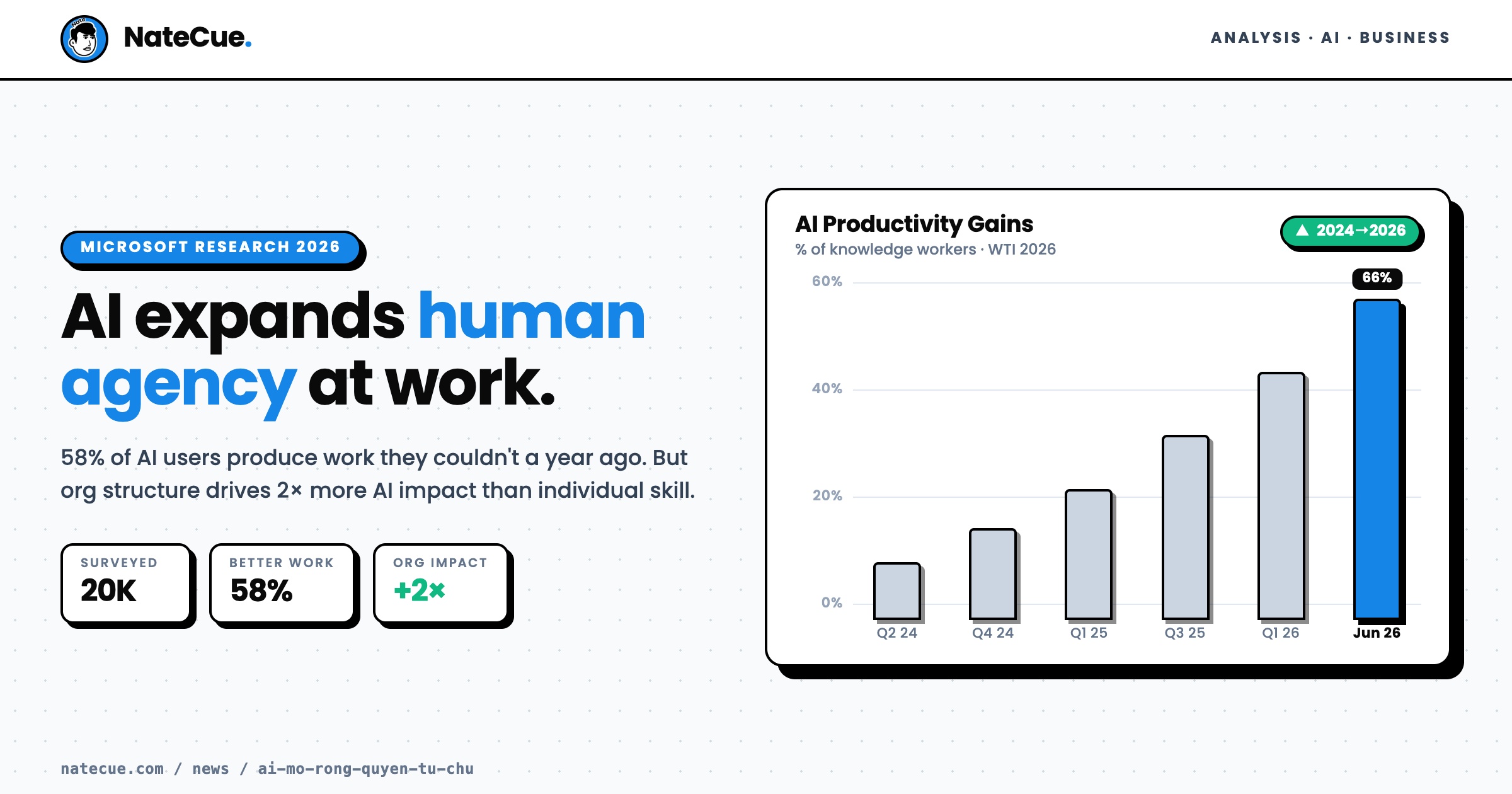
58% of AI users say they’re producing work they couldn’t have done a year ago. But only 19% of them work inside organizations genuinely structured to support that capability (Microsoft Work Trend Index, 2026). That gap - between high-performing AI users and AI-ready organizations - is the central tension of this year’s most important workforce report.
The Agency Equation: AI Does More, Humans Decide More
Microsoft’s 2026 Work Trend Index surveyed 20,000 knowledge workers across 10 countries and analyzed trillions of anonymized Microsoft 365 signals. The headline finding runs counter to the dominant fear narrative: as AI agents take on more execution, workers report gaining more agency over their work, not less.
Microsoft calls this the “agency equation”: the more agents handle the doing, the more humans own the directing.
49% of Copilot conversations now involve cognitive work - analysis and problem-solving - not just drafting emails. 66% of AI users report spending more time on high-value tasks. The question is no longer “will AI take my job?” It’s “is my organization being redesigned to take advantage of what I can now do?”
The Real Bottleneck is the Organization
The most counterintuitive finding: organizational factors account for more than 2x the reported AI impact compared to individual factors - 67% vs. 32% (Microsoft, 2026).
You can be the best AI user on your team. But if leadership isn’t aligned, the impact ceiling stays low.
Evidence: only 26% of AI users say leadership is “clearly and consistently aligned” on AI direction. Microsoft segments workers into four groups:
- Frontier Professionals (19%): use AI for multi-step workflows and routinely redesign how work gets done
- Emergent (50%): actively building their AI capabilities
- Blocked (10%): capable but unsupported by their organizations
- The remaining segment has barely started
The “Blocked” 10% is the most revealing category. These are workers who know how to use AI well - but the systems around them aren’t built to leverage it.
Managers Drive 30 Points of AI Value
A separate 1,800-person study within the report found that when managers actively model AI use and create psychological safety for experimentation, their teams report:
- +17 points in perceived AI value
- +22 points in critical thinking about AI output
- +30 points in trust of agentic AI (Microsoft, 2026)
Teams with that psychological safety are 1.4x more likely to become high-frequency agentic AI users.
On the individual side: 86% of AI users treat AI output as a starting point, not a final answer. The most prioritized skill to develop is judgment over AI output - not prompting speed.
The Vietnam Angle: The Gap is Wider Here
If the global data already shows a fragile organizational layer, Vietnam’s picture is more precarious.
Only 36.5% of Vietnamese businesses had a documented AI strategy as of 2025 (InvestVietnam). 46.4% lack sufficient internal AI skills. And 55% cite workforce skills as the primary barrier to expanding AI adoption.
Marketing (27.5%) and business/sales (18.3%) roles in Vietnam rank among the highest-risk positions for AI-driven disruption (Michael Page, 2025). But most Vietnamese enterprises haven’t built systems to redirect those workers toward AI-supervisory roles before the disruption hits.
The broader data point comes from Deloitte’s 2026 enterprise AI report: 74% of organizations want to grow revenue through AI, but only 20% are actually achieving it. 37% remain at “surface-level use” - applying AI without redesigning the underlying processes.
Microsoft’s conclusion lands differently when applied to Vietnam: “The question is no longer whether organizations are adopting AI. The larger question is whether they are structurally capable of capturing its value.” In a market where less than 40% of companies have a documented AI strategy, that structural question is even more urgent - and largely unasked at the leadership level.
NateCue's Take
Microsoft framed this exactly right: the agency equation means more AI execution equals more human direction. But the real question - especially in emerging markets like Vietnam - is who actually has the mandate to redesign organizational systems around AI? Not IT. Not HR. Not even most CMOs. It falls to whoever is willing to restructure workflows while still running daily operations. That is a leadership courage problem, not a technology problem. Deloitte found only 20% of organizations are achieving revenue growth through AI while 74% want to. That 54-point gap is the system design gap Microsoft is pointing to - and it is wider in markets where documented AI strategies exist at under 40% of companies. The "Blocked" 10% - capable workers trapped in unsupportive systems - may be the most underreported cost of slow organizational AI adoption.