
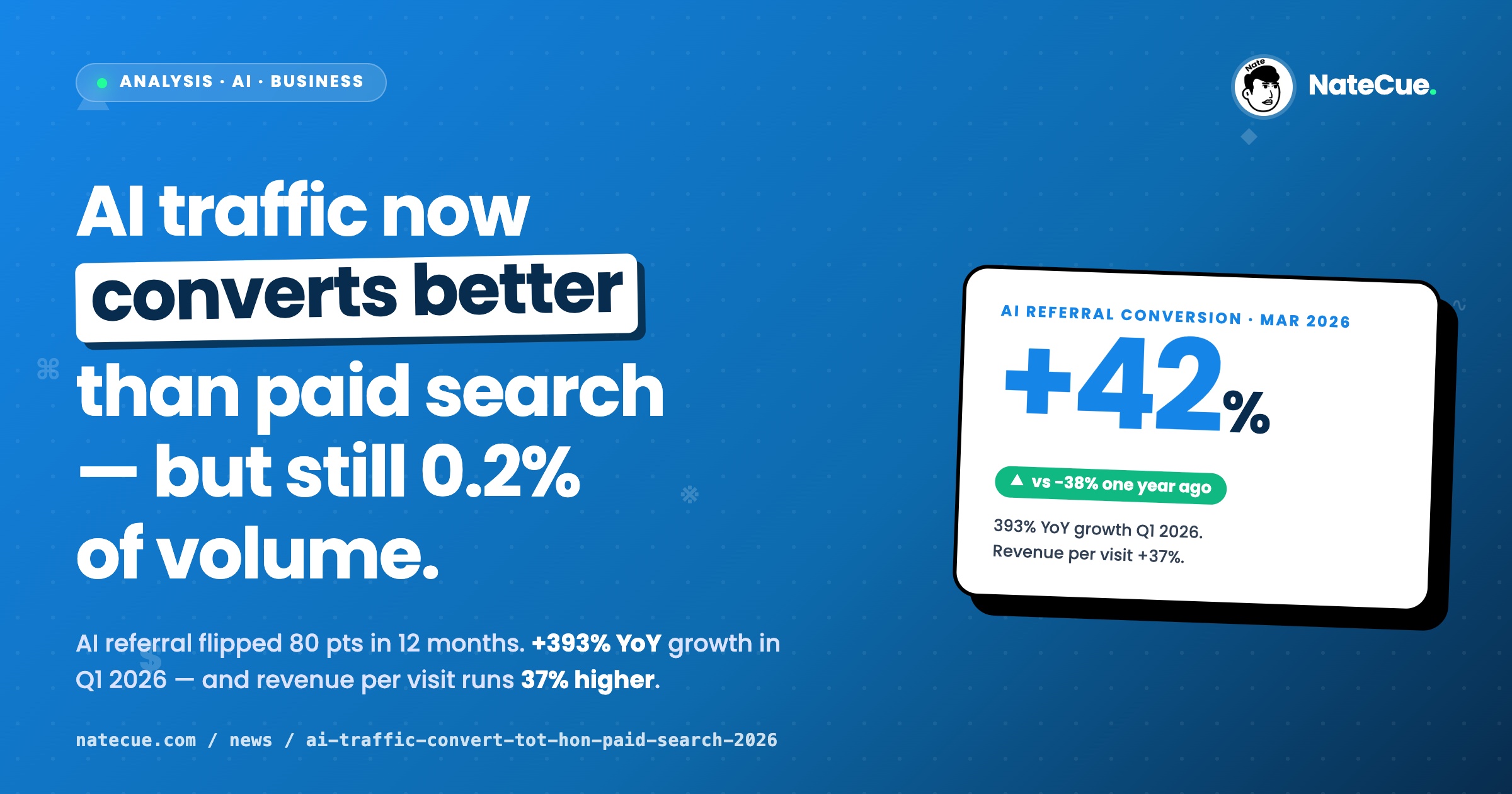
Twelve months ago, AI referral traffic converted 38% worse than traditional channels. In March 2026, that same traffic type converts 42% better than paid search - with revenue per visit running 37% higher (Adobe Analytics). During this same period, AI sessions still account for less than 0.2% of total global ecommerce traffic.
That gap is the most important signal in digital commerce right now.

The 80-Point Reversal No One Talked About
March 2025: AI traffic underperformed traditional channels by 38%. March 2026: AI traffic outperforms paid search by 42%.
Adobe Analytics described this as a “quality reversal” - an 80-percentage-point swing in 12 months. That’s not a gradual improvement. It’s a structural shift in how AI platforms are delivering buyers.
The mechanism is straightforward: when someone asks ChatGPT “best laptop under $800 for video editing,” they’ve already pre-qualified themselves at a depth that generic ad clicks don’t reach. The AI is doing the funnel work that used to require a sequence of landing pages. By the time that user lands on your product page, the consideration stage is largely complete.
ChatGPT now processes approximately 50 million shopping queries daily - about 2% of its total query volume across 900 million weekly active users (OpenAI, February 2026).
Triple-Digit Growth Off a Small Base
The “only 0.2%” framing misses what the trajectory looks like:
- Q1 2026: AI-driven visits to US retail sites up 393% year-over-year (Adobe Analytics)
- Black Friday 2025: AI traffic up 805% YoY
- Shopify: 7x AI traffic growth; 11x purchase growth through 2025
A channel growing 400% annually with better conversion quality than paid search doesn’t stay at 0.2% for long. The question isn’t whether AI commerce becomes significant - it’s whether your brand is in position when it does.
The Trust Gap: Referral Engine, Not Checkout Agent
77.6% of global consumers have used AI for shopping in the past six months. But only 14% trust AI to place orders autonomously on their behalf (Kearney). Even among Gen Z - the highest-trust cohort - autonomous checkout trust sits at 29%.
This defines how AI commerce actually works in 2026: it’s a last-mile referral engine, not a payment layer. Users rely on AI to compare, filter, and recommend - then complete the purchase through standard channels. That’s precisely why AI traffic converts well: these are buyers who’ve already decided.
Walmart found the opposite when trying to close purchases inside chat interfaces: conversion dropped 3x compared to redirecting users to the standard website. The signal is consistent - users want AI to advise, not to transact.
For marketers, winning this phase means getting recommended by AI. Not automating the checkout. Those require entirely different strategies.
Vietnam: Southeast Asia’s Emerging AI Commerce Market
The Vietnam angle is worth watching closely. A Lazada report from April 2026 found Vietnam and Indonesia leading Southeast Asia in AI application in ecommerce - 42% of businesses report using AI in operations. 77% of Vietnamese sellers are familiar with AI tools, above the regional average.
Microsoft ranks Vietnam #2 in Southeast Asia for AI adoption at 26.5% of the population, behind only Singapore at 63.4%. Vietnam posted the largest 12-month increase in the region at 3 percentage points.
The payment and logistics infrastructure constraints make autonomous checkout a harder sell in Vietnam than in Singapore or South Korea. But the recommendation model fits the market well - and demand is forming at exactly the point the market can absorb it. With 78% of Vietnam’s online population having used an AI platform in the past three months (per digital market reports), the audience base is there.
Structured Data Is Now a Distribution Channel
Pages with structured data are cited 3.1x more frequently in Google AI Overviews (Commercetools / Google). That’s not an SEO optimization anymore - it’s a distribution multiplier for AI-driven channels.
Only 8.6% of companies have AI agents deployed in production (Recon Analytics). The early-mover window is still open. Brands investing in structured data, clear brand positioning, and content that answers the kind of queries AI agents field will compound that advantage as volume scales.
Conversion quality has reversed. Growth is triple-digit. Trust is building. These three conditions rarely align - and the companies already positioned when volume arrives will capture disproportionate share.
NateCue's Take
Most marketers are watching the wrong number. The 0.2% traffic share makes AI commerce look negligible. But conversion quality reversing 80 percentage points in 12 months is the leading indicator that matters. The brands building structured data, clear brand signals, and agent-compatible content NOW will compound that advantage when volume scales. Vietnam is an interesting case: ranked #2 in Southeast Asia for AI adoption with 42% of sellers already using AI in operations - yet the trust gap (only 14% of buyers trust autonomous checkout) means the winning position here is getting recommended by AI, not automating the checkout. Those are two completely different strategies.