
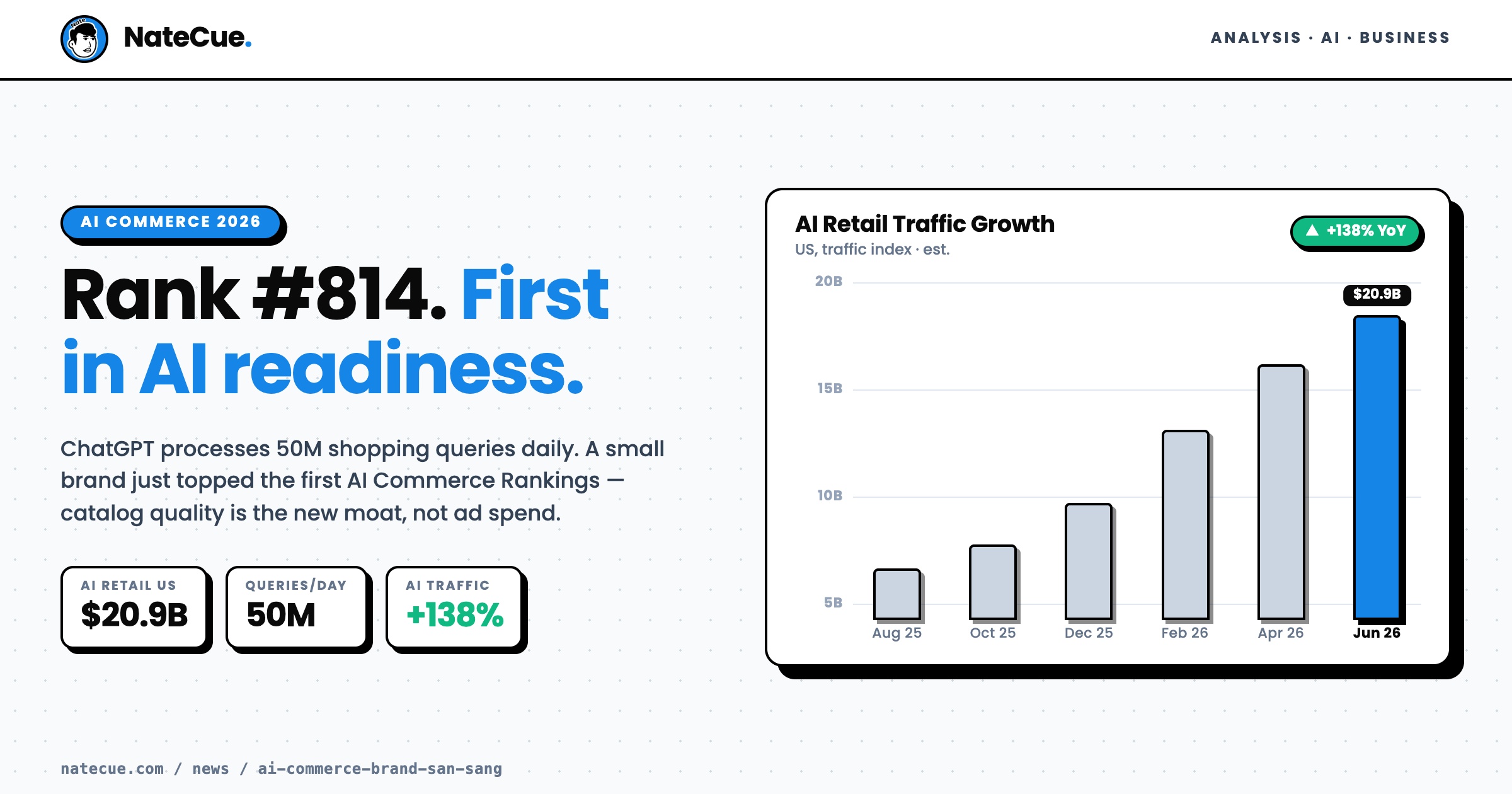
Online Labels ranks #814 by revenue among America’s Top 1000 retailers. But in the AI Commerce Rankings - the first benchmark measuring how well retailers show up in AI-driven product discovery, launched July 15, 2026 - they hold the top spot with a score of 71.8 out of 100.
Several household brand names in the Top 100 by revenue are sitting in the 20-30 point range. Scale and marketing budget don’t translate automatically to AI visibility.

ChatGPT as the New Discovery Layer
ChatGPT processes 50 million shopping queries daily (eMarketer, 2026). A user asks “best noise-canceling headphones under $50” - the AI returns a short list, the user clicks through to buy. No Google. No platform search bar.
45% of consumers already use AI for at least one stage of their buying journey (IBM Institute for Business Value, January 2026). AI-referred traffic to retail sites grew 138% year-over-year through May 2026 (Digital Commerce 360). Conversion rates from AI-sourced traffic outperform traditional search traffic by a meaningful margin - and the gap is widening as AI agents become more capable at intent qualification.
This is not a future channel. It is an active one.
What the AI Commerce Rankings Actually Measure
Digital Commerce 360 and ReFiBuy built the AI Commerce Rankings as a new readiness layer on top of the Top 1000 PRO Database, updating quarterly. Four signals drive the score:
Bot friendliness: Can AI agents parse your product catalog? Data buried in complex JavaScript or missing structured attributes simply gets skipped.
AI source traffic: What share of your traffic originates from ChatGPT, Perplexity, Gemini, and AI Overviews? This is the baseline signal - are AI systems sending users to you at all?
Diversity of AI sources: Is your AI traffic coming from one engine or many? Single-source dependency is concentration risk.
90-day momentum: Is AI-driven traffic trending up or slowing down over the trailing quarter?
The first-edition results contain a signal worth noting. Office supplies leads all 15 categories with an average readiness score of 47.4. Not fashion. Not consumer electronics. The reason is straightforward: office supplies catalog data tends to be precise, standardized, and machine-readable by nature. SKUs are well-defined, attributes are consistent, AI can ingest and cite it cleanly. Brand size had nothing to do with it.
ACP vs. UCP: The Protocol War Under the Surface
Behind AI shopping is a technical standards competition that will shape which brands get recommended where:
ACP (Agentic Commerce Protocol) - Built by OpenAI and Stripe, live in ChatGPT since September 2025. Enables users to discover, evaluate, and purchase products without leaving the chat. OpenAI takes a 4% transaction fee on every completed purchase. Strongest for conversational discovery where users don’t know exactly what they want.
UCP (Unified Commerce Protocol) - Google’s answer, launched at NRF in January 2026 with 20+ launch partners including Shopify, Etsy, Target, Walmart, Best Buy, Mastercard, Stripe, and Visa. Better suited for high-intent queries where users are in comparison mode.
AI platforms are expected to process $20.9 billion in US retail spending in 2026 - roughly 1.5% of total US ecommerce (eMarketer). The absolute number is modest, but it represents a 4x increase year-over-year. McKinsey QuantumBlack projects agentic commerce will unlock $3-5 trillion in global value by 2030.
Nudge, the agentic commerce startup that closed $1.1M in pre-seed funding from s16vc and Antler, frames the core challenge: brands now have to sell to two buyers simultaneously - the AI agent evaluating information and the human making the final call. That requires a fundamentally different content and catalog strategy than traditional SEO.
The Vietnam and Southeast Asia Angle
Vietnam’s ecommerce structure adds an interesting wrinkle. Shopee holds 56% market share. TikTok Shop grew 69% and is narrowing the gap fast. Both are building AI-powered internal search and recommendation layers - closed ecosystems designed to keep users inside the app.
But users don’t start shopping inside Shopee. They ask ChatGPT or Gemini first. That pre-shopping layer sits above every platform - and neither Shopee nor TikTok controls it. 66% of Vietnamese businesses already use AI for customer communication, and 63% use it to acquire new customers (VIR, 2026). The user behavior is there. The brand infrastructure for AI discovery is not.
Most brands in the region are optimizing for Shopee SEO and TikTok hashtags. Product catalog data is often written for human readers, not for AI systems to parse, cite, and recommend from. That is the gap opening up.
Retailers with AI agent integration showed roughly 7x better sales growth during Cyber Week 2025 compared to those without (eMarketer). The same pattern will emerge in Vietnam and Southeast Asia as AI shopping adoption rises. The question is whether your brand is on the list when a user asks.
NateCue's Take
What's easy to miss in the AI Commerce Rankings data is that catalog quality has always mattered - it just didn't show up in any metric before. Google rewarded brands with budget for backlinks and PPC. AI agents reward brands with clean, structured, context-rich product data. That's a fundamentally different moat. For brands in Vietnam and broader Southeast Asia, the challenge is dual: the superapp platforms (Shopee, TikTok Shop) are building closed ecosystems to keep users inside, while ChatGPT and Gemini are becoming the pre-shopping layer that sits above every platform. AI readiness isn't replacing platform optimization - it's adding a new channel that compounds differently. Unlike ad spend, a well-structured catalog pays dividends indefinitely. The early movers in 2026 will look very smart by 2028.