
In February 2026, $285 billion in market cap evaporated from SaaS stocks in a single trading session. ServiceNow dropped 7%. Intuit fell 11%. Thomson Reuters collapsed nearly 16%. The trigger wasn’t bad earnings — it was the growing evidence that companies are canceling SaaS subscriptions and replacing them with AI agents.

Enterprises Are Running 312 Apps and Using Half of Them
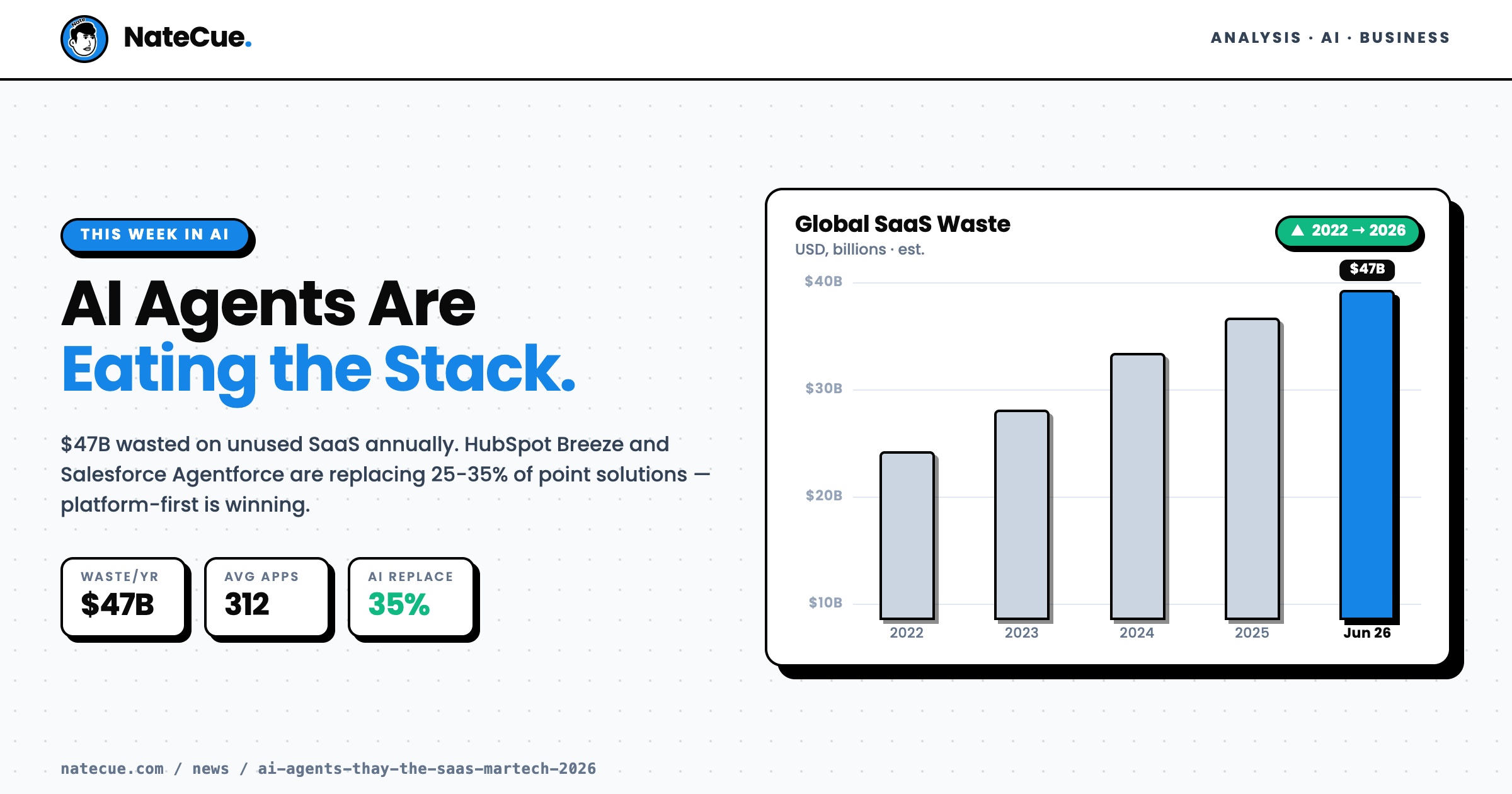
According to BetterCloud (2026), the average enterprise now runs 312 SaaS applications — up from 200 just four years ago. Only 47% are actively used. The math: $47 billion wasted globally every year on software no one touches. Per company: approximately $21 million annually.
For the Martech stack specifically: the average marketing team pays separately for an SEO tool, email platform, social scheduler, landing page builder, analytics dashboard, CRM, live chat, and pop-up tool. All monthly subscriptions. All requiring separate logins. All needing integrations that break when vendors update their APIs.
This is the “best-of-breed” model — use the best tool for each job. It dominated marketing from 2010 to 2022. It’s starting to lose.
HubSpot Breeze and Salesforce Agentforce Are Swallowing the Stack
No need to wait for “the future of AI.” Replacement is happening now.
HubSpot Breeze is available across all paid tiers starting at $15/seat/month. It currently replaces: standalone writing tools, research platforms, data enrichment services, prospecting agents, and customer support automation. This isn’t a beta. It’s a production feature running across millions of accounts.
Salesforce Agentforce prices at $2 per conversation — significantly cheaper than paying separately for a chatbot, lead scoring tool, and conversation intelligence platform. It handles autonomous agents for sales, service, marketing, and commerce within a single system.
Vantagepoint (2026) documents that Publicis Sapient — one of the world’s largest agencies — has already cut 50% of its Adobe licenses, replacing them with generative AI tools. Not a future roadmap. A signed contract being deployed today.
Gartner forecasts that 35% of point-product SaaS will be replaced by AI agents before 2030.
Why CFOs Are Tightening Martech Budgets Right Now
82% of CFOs now require formal ROI justification before renewing any SaaS contract exceeding $50K annually (Vantagepoint, 2026). That number has increased sharply from prior years.
The reason is straightforward: AI agents are providing direct comparison cases. When Salesforce Agentforce handles prospecting at $2/conversation, the question “why are we paying $800/month for a separate prospecting tool?” becomes very hard to answer.
This isn’t SaaS dying. It’s SaaS point solutions getting squeezed from two sides simultaneously: AI-native platforms from above, and open-source AI tools from below.
The Tension in the Data: SaaS Is Still Growing, But Share Is Shifting
Here’s the contradiction worth facing directly. The global SaaS market is still projected to reach $375-465 billion in 2026 (BetterCloud). Enterprise software spending is forecast at $1.4 trillion with 14.7% growth.
But token costs dropped 80% year-over-year while total AI spending grew 320% (BetterCloud, 2026). Companies are spending more on AI and less on standalone SaaS. The overall pie is growing — but point solutions are getting a smaller slice.
The ROI numbers are compelling: organizations using platform-first AI consolidation report 3.2x ROI in the first 12 months. With full AI-led consolidation: 4.1x. Gartner’s data on Salesforce consolidators shows 287% ROI over three years.
Three Concrete Steps for Your Marketing Stack
Step 1: Audit by actual usage - Not “could use” or “already paid for.” Export actual login data from the past 90 days. Which tools have user adoption below 50%? Those are your first cut candidates.
Step 2: Inventory what your current platform already includes - If you’re on HubSpot or Salesforce, check what AI features are already included before renewing a separate point solution. Many teams are paying twice because they don’t know the platform already covers the use case.
Step 3: Calculate true total cost of stack - Subscription fees are only the visible part. Add integration costs, maintenance time, context switching between tools, and onboarding cost for new hires. The real number is usually 1.5-2x the subscription total.
For marketing teams in Southeast Asia: the pressure is arriving at an accelerated pace because SaaS vendors are raising prices while AI platforms are cutting them simultaneously. The renewal decision you make in the next 6 months will shape your budget efficiency for the next 3 years.
NateCue's Take
I've been recommending best-of-breed stacks to clients since 2019. It was the right call when budget was secondary to feature depth. 2026 changed that equation. Platform-first AI agents aren't just "good enough" anymore — for most common use cases, they're beating specialized tools in total cost. HubSpot Breeze may not write email sequences better than Jasper. But it does it well enough for 80% of use cases, at lower total cost, with no integration tax. For marketing teams in Vietnam and Southeast Asia: this is the best moment to pause before signing another point-solution contract. Not because AI will replace everything overnight. But because ROI justification for standalone tools is now much harder when the CFO is comparing it against what the platform already includes. The renewal conversation has permanently changed.