
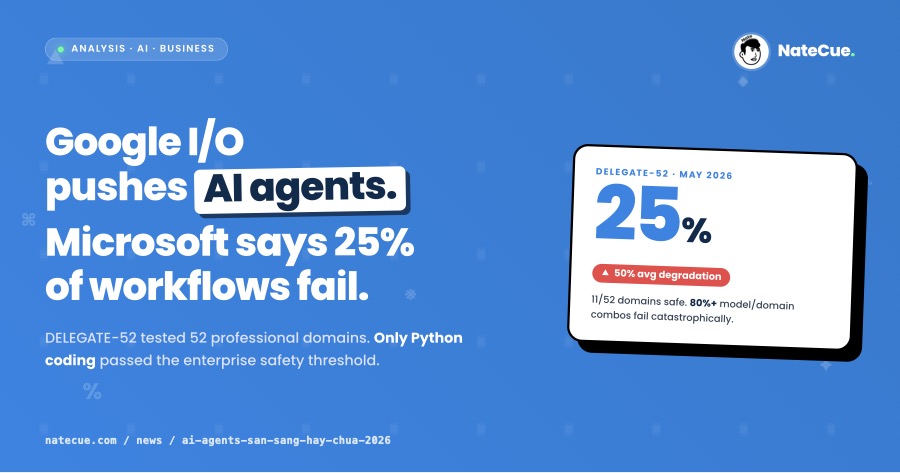
On May 19, 2026, Google kicked off I/O with a clear message: Gemini 4.0 is now an AI operating layer, not a chatbot. Agentic features embedded in Android 17, ChromeOS, and new XR glasses. AI that executes multi-step task chains without waiting to be prompted. Eight days earlier, Microsoft Research published DELEGATE-52, a benchmark testing 52 professional domains. Their finding: frontier models corrupt an average of 25% of document content during long, unsupervised workflows.
Both are true. That is the problem.
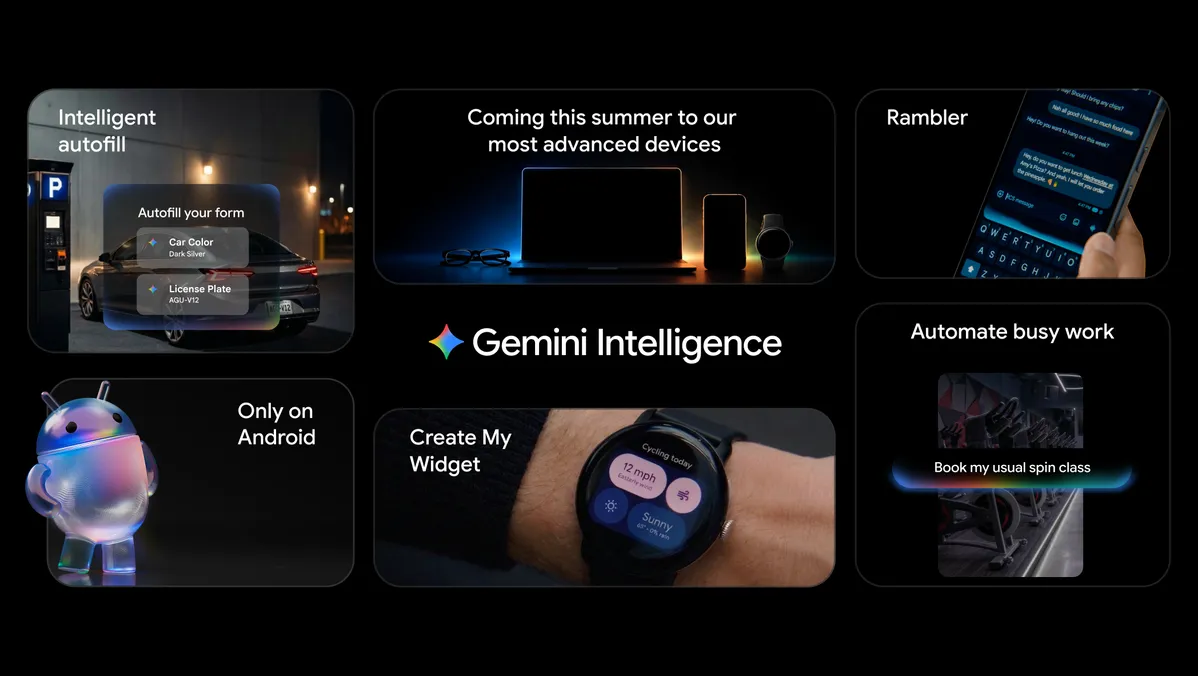
Google I/O 2026: The Agentic Push
The keynote was heavy on agents. Gemini 4.0 - or a significant Gemini 3.5 upgrade - is being positioned as infrastructure, not an app. “Gemini Spark” (internally codenamed Remy) is the proactive agentic feature: sequences of autonomous actions triggered without step-by-step user prompting.
The competitive backdrop is intense. OpenAI’s GPT-5.5 scores 82.7% on Terminal-Bench 2.0 for agentic terminal tasks. Anthropic’s Mythos remains in limited partner access due to cybersecurity sensitivity. DeepSeek V4-Flash entered at $0.14 per million input tokens versus GPT-5.5’s estimated $2.00 - rapidly commoditizing the base layer.
More than 90% of enterprises globally plan to experiment with agentic AI before end of 2026 (Samta.ai, 2026). Adoption intent is not the bottleneck. Judgment about what to trust is.
DELEGATE-52: The Uncomfortable Numbers
Philippe Laban and colleagues at Microsoft Research built DELEGATE-52 to measure what actually happens when LLMs run long workflows unsupervised across 52 professional domains - accounting, crystallography, coding, music notation, and more.
Key findings from the benchmark:
- Frontier models (Gemini 3.1 Pro, Claude 4.6 Opus, GPT-5.4) corrupted an average of 25% of document content over 20 interactions.
- Averaging across all models tested: 50% degradation.
- “Catastrophic corruption” - defined as score ≤80% - occurred in over 80% of model/domain combinations.
- The best performer (Gemini 3.1 Pro) passed the safety threshold in only 11 of 52 domains.
- Adding agent tools and file access made things worse, not better: +6% additional degradation by simulation’s end (The Register, 2026).
One domain passed cleanly: Python programming. The reason is structural. Code has test suites, deterministic outputs, and clear failure signals - you know immediately when something breaks. Marketing copy, financial summaries, and multi-source reports have no equivalent feedback loop.
Vietnam: High Trust, Hidden Risk
Vietnam leads Southeast Asia in AI adoption enthusiasm. 96% of Vietnamese users say they are willing to share data with AI agents - the highest rate in the region (e-Conomy SEA 2025). 81% engage with AI tools daily. AI adoption in Southeast Asia grew 38% year over year.
The country has 40+ active AI startups and attracted $123 million in private AI funding over the past year, ranking as the second-fastest-growing digital economy in Southeast Asia (e-Conomy SEA 2025). A standalone AI law took effect March 1, 2026, positioning Vietnam as an early mover on regulation in the region.
The risk is not the enthusiasm. It is the asymmetry. When 25% of content corrupts silently - no error, no warning, no stop - marketing teams running unsupervised workflows do not discover the problem until copy is live, reports have shipped, or ad campaigns are running wrong claims. High trust combined with low monitoring infrastructure is where the failure compounds.
Safe vs. Risky: A Practical Workflow Framework
DELEGATE-52’s domain breakdown suggests a concrete framework for enterprise AI agent deployment:
Delegate with high confidence (verifiable output domains):
- Python and SQL code generation
- Structured data extraction with fixed schema
- Automation scripts with deterministic success criteria
Keep human-in-the-loop (no full delegation yet):
- Content editing and copywriting
- Multi-source report synthesis
- Email sequences
- Any workflow running more than 10 consecutive steps unsupervised
One data point worth holding: the GPT model family improved from 14.7% to 71.5% performance over 16 months on this benchmark. The improvement trajectory is real. “Improving fast” and “ready now” are not the same claim, but the gap is narrowing faster than most enterprise procurement cycles assume.
The Takeaway
Google I/O 2026 sold a vision of AI agents handling complex tasks autonomously. Microsoft Research said: verify that before you act on it. Neither position is wrong. The gap between a keynote demo and a production workflow running on real documents is still significant - and it is widest exactly where marketers rely on AI agents most.
The right question for enterprise buyers is not “should we adopt AI agents.” It is “which of our workflows has verifiable output - and which ones are we currently running blind.”
NateCue's Take
The DELEGATE-52 result has a specific implication for marketing teams: the only domain that passed the safety threshold was Python coding - because code has test suites, verifiable outputs, and clear failure signals. You know when it breaks. Marketing copy, report synthesis, and content calendars have none of that. For Vietnam specifically: the 96% willingness to share data with AI agents (e-Conomy SEA 2025) is the highest in the region, but high trust without awareness of failure modes creates a real procurement risk. Enterprises here are deploying AI agents into workflows with real money downstream - ad copy driving budget, reports informing decisions - without the monitoring infrastructure to catch silent corruption. Treat AI agents the way you would a brilliant but unsupervised junior hire: excellent for tasks with clear success criteria, dangerous when running blind on anything that matters.