
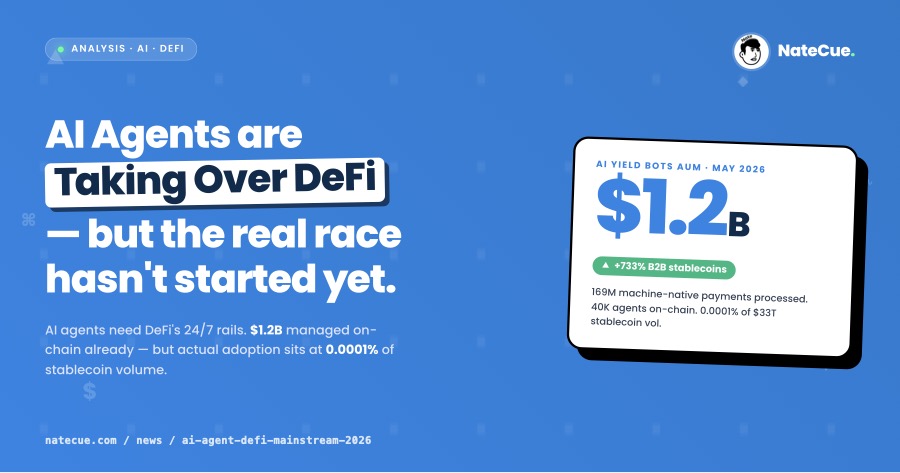
Yield farming bots currently manage $1.2 billion in on-chain assets. AI frontier models successfully simulated $4.6 million in DeFi exploits on real smart contracts (Anthropic Fellows Program, 2026). Yet the actual payment volume of all AI agents across blockchain today? 0.0001% of total stablecoin volume.
That gap between narrative and real infrastructure is the defining tension in AI + DeFi 2026.
Why AI Agents and DeFi Are Structurally Inseparable
DeFi needs AI agents for a purely technical reason: markets run 24/7 and humans don’t. Uniswap v4 and PancakeSwap have already integrated open-source hooks designed for AI agents monitoring thousands of liquidity pools across 8+ blockchains simultaneously (KuCoin Research, 2026). No human team replicates that continuously.
AI agents need DeFi for the symmetric reason: when an agent executes 35 million transactions on Solana, it needs financial rails without KYC requirements, banking hours, or signature requirements. That’s why a16z Crypto describes DeFi as “essential infrastructure” for the autonomous machine economy (CoinDesk, 2026).
Coinbase’s x402 protocol is the clearest current proof - it has processed 169 million machine-native payments across 590,000 buyers and 100,000 sellers, at under $0.0001 per transaction with 2-second settlement.
The Real Numbers vs. The Numbers Being Told
40,000 on-chain AI agents collectively process $50 million in payments (Nevermined, 2026). Total stablecoin volume in 2025: $33 trillion. Penetration rate: 0.0001%.
Two contradictory signals need to be read together.
B2B stablecoin payments grew 733% YoY to $226 billion - enterprises are genuinely using stablecoin rails. At the same time, AI-agent-specific infrastructure protocols (ERC-8004, x402, Anthropic’s ACP) are still competing, with no standard winning yet.
The 0.0001% gap isn’t a signal of missing demand. It’s the signature of a pre-standardization phase - analogous to the early 1990s internet when TCP/IP hadn’t yet become the default.
The Security Risk the Hype Glosses Over
In 2026, AI trading agent vulnerabilities resulted in $45 million in security incidents (KuCoin Security Report, 2026). Crucially, attackers didn’t hack smart contracts directly - they targeted agents’ long-term memory and the LLM routers connecting agents to trading tools.
26 routers were confirmed to have injected malicious tool calls, stealing $500,000 from client wallets (CoinDesk, 2026).
The Anthropic Fellows Program added another dimension: GPT-5 and Claude Sonnet 4.5 could synthesize complete exploit scripts and drain simulated liquidity in ways described as “clinically identical to real attacks” on previously compromised contracts. Simulated damage: $4.6 million.
DeFi doesn’t eliminate financial risk. It shifts risk to new vectors that most users don’t yet understand.
Southeast Asia: Enabling Conditions Exist, Adoption Still Takes Time
Vietnam’s DTI Law took effect in May 2026 - the first time digital assets are formally recognized as property under the Civil Code. A five-year pilot program (2025-2030) permits licensed trading and issuance with strict AML/CFT requirements and Level 4 cybersecurity standards for custodians.
APAC is the fastest-growing region for on-chain activity - +69% YoY value received (Chainalysis, 2026). The stablecoin corridor connecting Vietnam, Philippines, and Indonesia has already pushed remittance costs below 1%.
But don’t confuse enabling conditions with adoption curves. Vietnam is still at the licensing infrastructure stage. AI-native DeFi products that are consumer-ready for the Vietnamese market are at minimum 1-2 years away.
The nearest realistic use case: AI agents intelligently routing stablecoin payments across SEA borders. Not complex yield farming. Simple enough to build in the current ecosystem, large enough to create real impact.
“Machine customers” are projected to account for up to 20% of enterprise revenue by 2030 (Nevermined Research, 2026). Who’s building for them now?
NateCue's Take
The question isn't whether AI agents will use DeFi - they will. The question is who owns the infrastructure layer. Right now three protocols are competing: Coinbase's x402, ERC-8004, and Anthropic's ACP. None has won. For Southeast Asia, the near-term opportunity isn't complex AI yield strategies - it's the simple part: stablecoin payment corridors for machine-to-machine cross-border transactions. Vietnam, Philippines, and Indonesia already have remittance corridors below 1% cost. AI agents intelligently routing those payments would be a $10B+ problem solved quietly. The builders working on machine customer infrastructure today will have compounding advantages when adoption actually arrives. Don't get distracted by the yield farming narrative.