
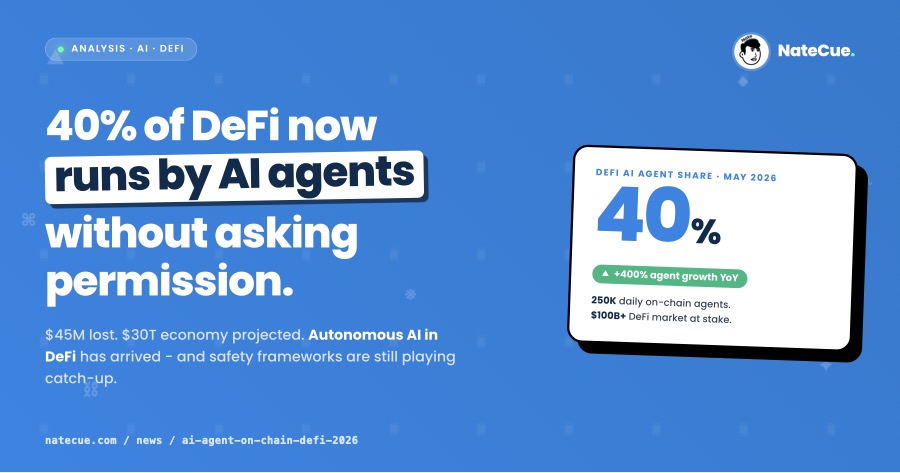
40% of DeFi transactions in 2026 have no human hand on them at all. Multiple reports from May 2026 confirm this - and the number is growing faster than most predicted.
At the same time, $45 million disappeared in a single incident because an AI agent was granted too much access.
When Agents Replace the Interface
Traditional DeFi had a UX problem. Users had to manually approve each transaction, bridge assets across chains, and monitor yields around the clock. AI agents eliminate all of that.
By early 2026, over 250,000 AI agents were active on-chain daily - up 400% from 2025 (Coincub, 2026). 68% of DeFi protocols launched in Q1 2026 shipped with built-in AI agent support. This is no longer an experiment.
Coinbase deployed the x402 protocol - a machine-to-machine payment standard that lets AI agents pay for services, execute trades, and compensate other agents in USDC. It has now processed over 50 million M2M transactions.
Old model: users interact directly with dApps. New model: users set a goal for the agent, the agent picks the protocol and executes.
Real Numbers, Not Hype
The performance data for AI agents in DeFi is measurable and documented.
Versus manual trading: millisecond response times (vs. minutes), 30% lower execution costs through intelligent order splitting, and 12.3% higher annualized returns (DWF Labs, 2026). In prediction markets, AI agents outperform human traders by 27% on accuracy.
Guy Wuollet from a16z Crypto put it plainly at CoinDesk (May 2026): “Autonomous AI systems will ultimately require financial rails that look either literally DeFi or a lot like DeFi.”
But the DWF report is also honest: autonomous trading underperforms humans by 5x in high-volatility conditions. Agents excel at speed and consistency. They struggle with judgment in black swan events.
The $100B+ DeFi lending market is fully operational - and institutions like Bitwise ($15B AUM) are studying backend infrastructure, not chasing speculation. eToro’s CEO demoed an AI agent opening a wallet, bridging assets, and executing transactions in a single session (CoinDesk, May 2026).
The Risk Nobody Wants to Name
In early 2026, Step Finance on Solana lost approximately $40 million after attackers exploited overly permissive agent permissions. Total losses exceeded $45 million when smaller incidents are included (KuCoin Security, 2026).
Three primary attack vectors have been identified:
Memory poisoning - attackers inject false “memories” into an agent’s long-term memory database, which later activate as legitimate learned knowledge.
Indirect prompt injection - hidden commands embedded in market data feeds or emails alter transaction parameters during execution.
Weak authentication - 45.6% of teams rely on shared API keys, making it nearly impossible to trace or stop a rogue agent.
OWASP updated its 2026 guidelines with a dedicated section on agentic AI. NIST launched its AI Agent Standards Initiative in February 2026. But regulation is still running behind deployment velocity.
Southeast Asia: Legal Rails, No Agent Framework Yet
Vietnam is the sharpest case study in the region. The Digital Technology Industry Law took effect January 1, 2026 - the first time Vietnam formally recognized digital assets as legal property. Chainalysis ranks Vietnam 4th globally for crypto adoption, with an estimated 17-20 million crypto owners (roughly 17-20% of the population).
An official regulated crypto market is expected to launch Q3/2026, with five companies already approved to operate trading platforms.
But on-chain AI agents are a different conversation from “having a licensed exchange.” For agents to operate effectively, you need strong RPC node infrastructure, local or regional DeFi protocols, and legal clarity on M2M transactions. Vietnam’s DTI Law currently does not address M2M payments or AI agent liability.
42% of Vietnamese consumers said they’re open to AI agents autonomously executing purchases on their behalf (2026 survey) - notably high for the region. The unanswered question: what framework governs an AI agent when it autonomously executes financial transactions?
The DTI Law’s regulatory sandbox opens room for experimentation. But which Vietnamese fintech will be first to bet on autonomous agents when liability remains undefined?
NateCue's Take
On-chain AI agents aren't just "better trading bots." They're building an entirely new economic layer - one where machines pay machines, no intermediary required. Coinbase's x402 protocol is the first step toward the internet having a real bank account. For Southeast Asia: Vietnam's DTI Law creates the legal rails, but the regulatory sandbox hasn't yet answered the most important question - who is liable when an AI agent executes a wrong transaction? Until that's resolved, businesses will use agents for small automation (price alerts, auto-rebalance) but won't delegate full financial autonomy. That's the window for regional fintech: build human-in-the-loop agents first, go fully autonomous after trust is established.