
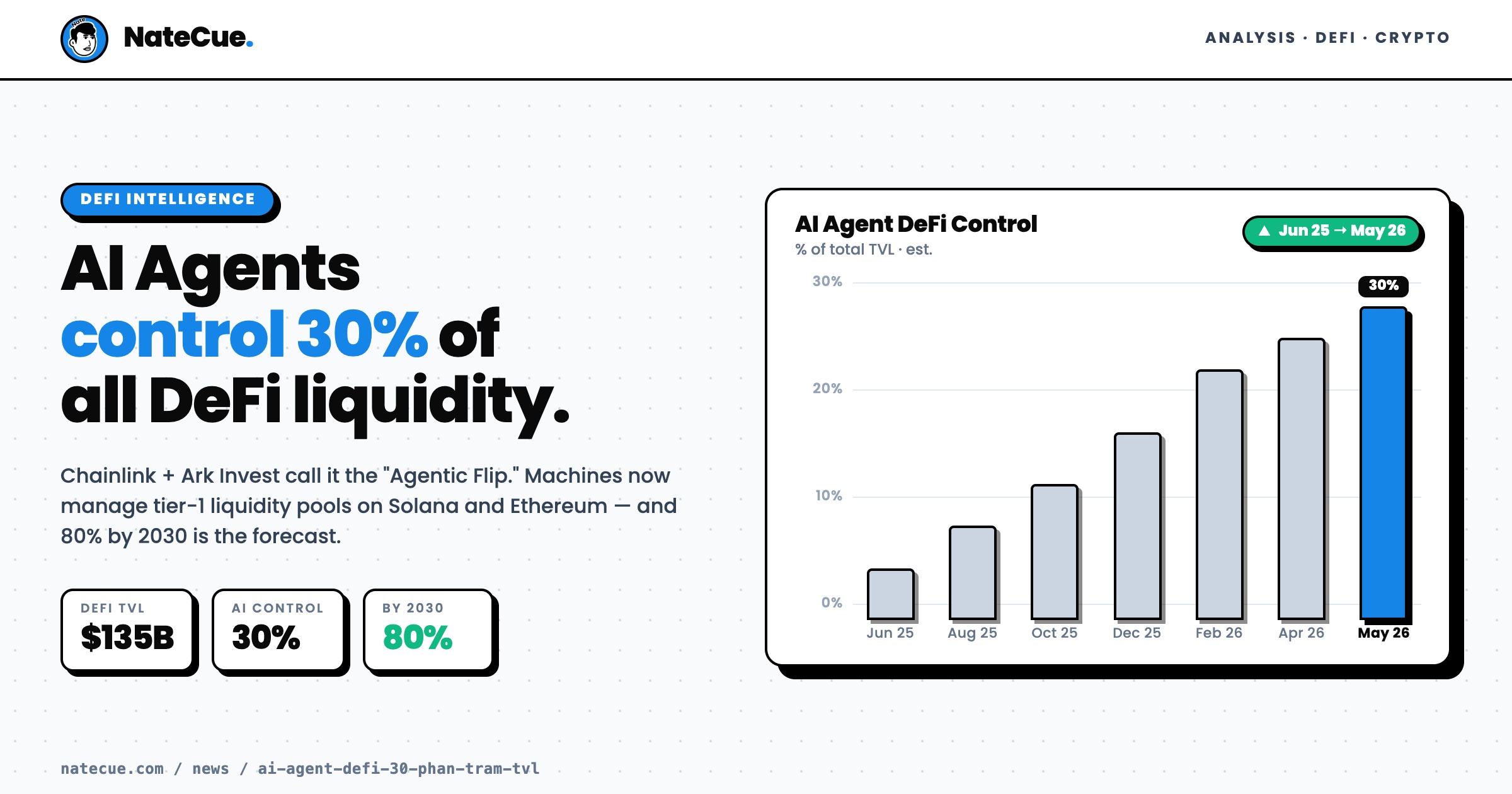
A May 2026 report co-authored by Chainlink and Ark Invest confirmed what on-chain data had been signaling for months: AI agents now control approximately 30% of total value locked (TVL) in tier-1 liquidity pools across Solana and Ethereum. The authors named this moment the “Agentic Flip” - the threshold where machines, not humans, became the primary market-makers in decentralized finance.
What the Agentic Flip Actually Means
These aren’t simple trading bots running preset rules.
The agents in this report integrate Large Language Models directly with smart contract execution layers. They run arbitrage and yield optimization at millisecond speeds, scanning global news feeds and rebalancing positions across multiple chains faster than any human team could authorize a single trade.
The measurable effects are already visible: slippage on major trading pairs has dropped to near-zero. “Vampire attacks” - the predatory liquidity raids that defined early DeFi competition - have largely ceased. Agents optimize for long-term stability over short-term extraction.
DeFi TVL currently sits at $130-140 billion (early 2026), nearly 3x the $48.9 billion recorded in 2021. The sector is projected to grow at a 43.3% CAGR between 2026 and 2030.
The Road from 30% to 80%
Today’s 30% is a floor, not a ceiling.
KuCoin Research (April 2026) predicts that by 2030, AI agents will execute over 80% of all DeFi transactions and manage 80%+ of total TVL. As a benchmark today: a single Solana-based AI agent is already handling more daily volume than the bottom 20% of all human retail traders on the network combined.
Protocol integration is accelerating across the stack. Uniswap v4 and PancakeSwap have shipped open-source hooks for AI agent integration. Bittensor (TAO) is drawing institutional interest as AI infrastructure. Virtuals Protocol lets users buy shares in high-performing agents. NEAR Protocol and Internet Computer (ICP) are emerging as preferred substrates for compute-heavy AI tasks.
The Risk Hidden in That 30%
The Chainlink report doesn’t soft-pedal the downside: if thousands of agents trained on identical datasets trigger the same strategy simultaneously, the result could be a flash crash “orchestrated entirely by silicon.”
DeFi has already lost $3.1 billion to hacks in 2024-2025, with 83% from flash loan attacks (KuCoin Research). AI agents introduce a newer attack surface: data feed manipulation targeting governance AI systems - harder to detect than flash loans, and harder to recover from.
Goldman Sachs projects data center power consumption will jump 175% by 2030. The “gigawatt ceiling” may become a real constraint on how large AI DeFi infrastructure can actually scale, particularly for energy-intensive chains.
What This Means for Vietnam - and Emerging Markets
Vietnam is an interesting case study in readiness.
The country leads Southeast Asia in AI adoption: 81% of Vietnamese users engage with AI tools daily, and 96% are willing to share data with AI agents - both the highest rates in the region (Vietnam News, 2026). Vietnam also consistently ranks near the top of the Chainalysis global crypto adoption index.
On May 24-27, Da Nang will host Vietnam’s first Blockchain & AI Demo Day at the Web3 Builders’ Summit - a concrete signal that builder infrastructure is being assembled locally.
But the deployment gap is real. Only 13.8% of Vietnamese businesses have deployed AI at meaningful scale. Most retail crypto activity stays at the CEX layer - buying and selling on Binance or OKX, never touching a DeFi protocol directly.
When AI agents optimize every pool to near-maximum efficiency, the cost of arriving late compounds quickly. Emerging markets don’t lose because they’re slow to adopt. They lose when they skip the infrastructure layer entirely and stay at the consumer end of a stack built elsewhere.
NateCue's Take
Vietnam tops Southeast Asia in AI adoption (81% daily users) and ranks near the top of every global crypto adoption index. Yet most of that activity stays at the CEX layer - real DeFi engagement is still thin. When AI agents optimize every liquidity pool to near-perfect efficiency, manual retail traders lose their edge completely. That's not a warning about the future. 30% is already gone. The real question for emerging markets isn't whether AI DeFi is good or bad - it's whether local developers and founders are building AI agent infrastructure, or whether they'll remain passive users of tech built by Solana-native and US-based teams.