
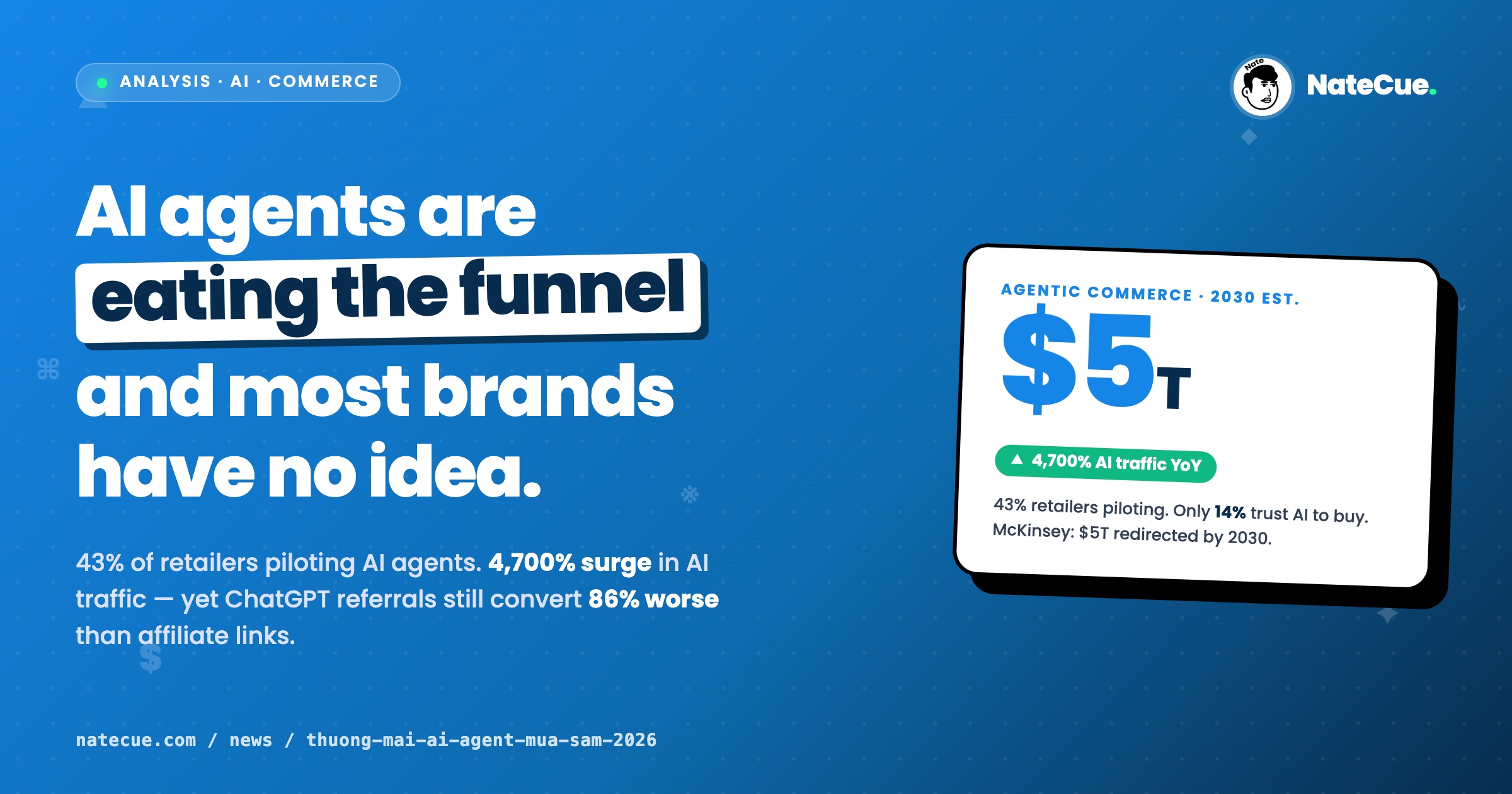
AI traffic to US retail sites grew 4,700% year-over-year in 2025 (MetaRouter / Adobe). At the same time, ChatGPT referrals convert 86% worse than affiliate links (Kaiser & Schulze). These two numbers belong to the same story - and together, they describe where agentic commerce actually stands in May 2026: enormous structural shift, underwhelming near-term performance.

The Funnel Is Collapsing From the Middle
Traditional retail funnels have five stages. Agentic AI is cutting out stages two through four.
A shopper no longer searches Google, opens twelve tabs, reads three review sites, and eventually adds to cart. They ask an agent: “Find me noise-canceling headphones for an open office, under $80, good for calls.” The agent responds. In growing cases, the agent completes the purchase.
43% of retailers are now piloting autonomous AI shopping systems (PYMNTS, 2026). Gen Z adoption is sharper: 54% say they’d be comfortable letting AI buy on their behalf (PYMNTS). Shopify President Harley Finkelstein called this “the biggest transformation in the company’s history” - Shopify is “all in” on agentic shopping (TechCrunch, 2026).
McKinsey projects AI agents could redirect $5 trillion in global retail spend by 2030, with nearly $1 trillion from the US alone. Bain estimates 15-25% of all e-commerce flows through agentic channels by the same date.
The Conversion Paradox Nobody Mentions
Here’s the tension buried beneath the headline numbers.
AI-driven sessions during Black Friday 2025 generated $14.2 billion globally (MetaRouter). That sounds large. But AI-driven sessions still represent less than 0.2% of total e-commerce traffic (Kaiser & Schulze). And ChatGPT referrals convert 86% worse than affiliate links.
Why the gap? Consumers are using AI to research, not to buy - not yet. 89% of shoppers still verify AI recommendations before purchasing (eMarketer / IAB). Only 14% actually trust AI to place orders autonomously. The 45% who say they’re “comfortable” with AI purchasing reflects stated preference, not observed behavior.
The $5 trillion projection is structurally sound. The timeline most brands are planning around is likely wrong by several years.
Product Data Is the New Infrastructure Layer
If AI agents decide which products to recommend, the critical question is: where does the agent source its data?
McKinsey finds 4.4x higher conversion rates for AI-generated recommendations - but only when product data is high quality. 42% of customers abandon purchases due to insufficient product information (Mirakl). Businesses lose an average of $15 million annually from poor data quality (Mirakl). 71% of ChatGPT-cited pages include structured data; 65% of Google AI Mode citations do too (Commercetools).
Gartner projects 20% of digital commerce transactions will run through AI platforms by 2030. Getting into that 20% requires clean, agent-readable product data. Not as a nice-to-have - as infrastructure. This is why agentic AI in programmatic media buying and product discovery are converging into the same data quality problem.
Southeast Asia: Platform-Native Agents Change the Calculus
Southeast Asia’s e-commerce market hit $157 billion in 2025. Shopee holds 52% of platform GMV ($66.8B). TikTok Shop captures 18% at $22.6B and growing 40-55% YoY (Digital in Asia). Vietnam alone reached approximately $25B.
ByteDance earmarked $23 billion for global AI infrastructure, with Southeast Asia among the priority investment regions. If TikTok Shop builds and deploys a native AI shopping agent inside its app - one that already has access to live GMV data, real-time inventory, and live-stream engagement signals - brands in Vietnam and across SEA won’t need to optimize for ChatGPT.
They’ll need to optimize for TikTok Shop’s agent.
This isn’t hypothetical. Content commerce already accounts for 32% of platform GMV in SEA. The infrastructure for agent-driven commerce - recommendation engines, live inventory, social proof signals - is partially built into these platforms already.
For global brands entering SEA markets, the strategic question is concrete: are you building discoverability for open-web agents (ChatGPT, Google Shopping Graph) or for the closed-loop platform agents that already control your target consumer’s checkout flow?
Both matter. But they require different optimization strategies - and conflating them is the fastest way to invest in the wrong one.
NateCue's Take
Most agentic commerce coverage asks the wrong question. It's not "will AI agents reshape shopping?" - they will. The real question is: whose agent wins in your market? In Southeast Asia, TikTok Shop and Shopee control the product data that agents need to operate. ByteDance is investing $23B in AI infrastructure with SEA as a priority. If TikTok Shop deploys a native shopping agent first, brands in Vietnam won't optimize for ChatGPT - they'll optimize for TikTok's agent. This changes the AEO strategy entirely. Clean, structured product data isn't for Google; it's for whichever platform-native agent controls your market's checkout flow. Build data quality for portability - not for any single agent's format.